AMC 25.795(d) Security of chemical oxygen generators
ED
Decision 2015/019/R
1. Purpose
CS 25.795(d)
requires each Chemical Oxygen Generator (COG) or its installation to be
designed so that it meets one of several criteria. The means of compliance
described in this AMC provides guidance to supplement the engineering and
operational judgment that should form the basis of any compliance findings
related to a COG installed on an aeroplane.
2. Definition of terms
For this AMC, the following definitions apply:
(a) Access: The
ability to manipulate the COG with the intent of making alterations for a
purpose for which the COG was not originally designed. This includes gaining
access to the area surrounding the COG.
(b) Activation: Release
of the firing mechanism of the COG for the purpose of initiating the chemical
reaction inside.
(c) Alteration: A
change in the configuration of the COG once ‘access’ has been gained for the
purpose of using the COG for a function other than the one it is intended for.
(d) Chemical Oxygen Generator
(COG): A device that releases oxygen that is created
from a chemical reaction.
(e) Immediately obvious: Where
an attempt to gain ‘access’ to the COG would be readily recognised as
suspicious (prior to gaining ‘access’). This would only be in locations with
‘unrestricted access’ that are ‘observable’.
(f) Intervention: The
actions crew members must take to prevent damage to the aeroplane once an
alert is activated indicating that the COG is being tampered with. The time it
takes to intervene when the lavatory is occupied has not been determined;
however, it can be assumed that it will take several minutes to resolve the
issue.
(g) Observable: A crew
member is able to see if a person attempts to gain ‘access’ to a COG
installation during the course of the crew member’s normal duties.
(h) Tamper-evident feature: A
unique feature that provides an active and obvious contemporaneous alert to
crew members that someone is trying to gain ‘access’ to the COG and immediate
crew ‘intervention’ is necessary.
(i) Tamper-resistance: The
level of deterrence for gaining ‘access’ to the COG.
(j) Unrestricted access: An area
of the cabin passengers can enter without overcoming locks or other mechanical
closure means.
3. Related
Certification Specifications (CSs)
CS 25.795 Security considerations
CS 25.1301 Equipment — Function and installation
CS 25.1309 Equipment, systems, and installations
CS 25.1322 Flight crew alerting
CS 25.1450 Chemical oxygen generators
4. Compliance with CS 25.795(d)
(a) Acceptable
means of determining if a COG or its installation is designed to be secure
Several criteria may be used for determining if a COG installation is
secure or has a security vulnerability. COG installations with a security
vulnerability must include design features to prevent potential misuse of the
COG. Figure 1, Criteria for Assessing an Installation, includes assessment
criteria that can be used for determining if a COG installation has a security
vulnerability. Table 1 includes guidance to assist in answering the questions
in Figure 1. For installations identified as having security vulnerabilities,
such as those for which the answers to the assessment statements in Figure 1
result in the answer to question number 4 being yes, the design should be
changed. Alternatively, the COG can be replaced with an acceptable oxygen
source that is not a security threat.
Figure 1: Criteria for assessing an
installation
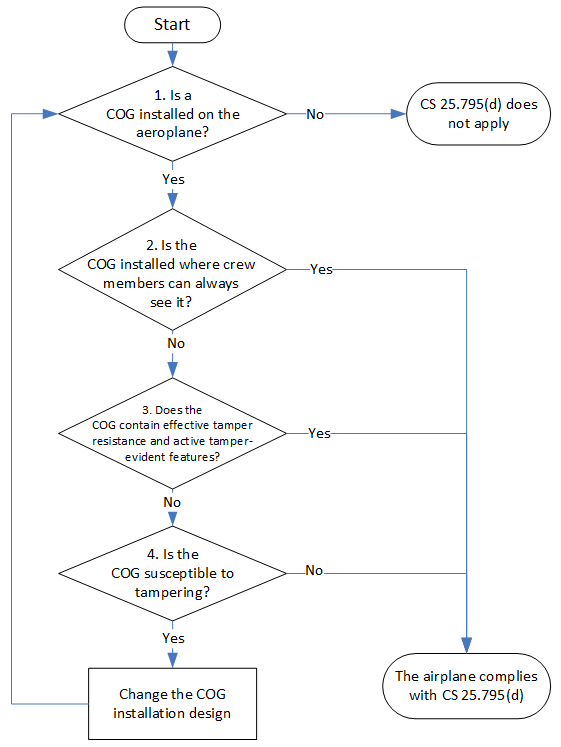
Table 1: Assessment statement
analysis
|
Question number |
Notes and questions to assist with the assessment
statement analysis |
|
1. |
Review the instructions for continued airworthiness. Review the drawing system. Inspect the aeroplane’s configuration. |
|
2. |
Can crew members observe the COG installation?
Check the area where the COG is installed. Isolated areas such as galleys,
lavatories, crew rests, enclosed occupied compartments, and lower lobe
lavatory complexes are potential areas of concern and require further
evaluation. Are crew members close to the COG installation
during their normal duties? Are there physical barriers between the crew
members and the area being evaluated? Is there significant distance between the crew
members and the area being observed? How accessible is the COG? Is the COG installation surrounded by curtains?
Curtained areas are also considered potential areas of concern and may
require further evaluation. |
|
3. |
Are there locks on doors/access panels to prevent
access? Are there tamper-resistant fasteners on panels? Are alarms or some other active alerting tamper
indication method part of the installation’s design? |
|
4. |
Check if the COG can be compromised in place. Assess the vulnerability of the adjacent materials
to contain the compromised device. Assess the ability of the compartment to contain
the event. Check if the COG can be removed. |
(b) Installation of
tamper-resistant features
Tamper-resistant design features can be used, in whole or in part, to
make a COG installation secure. There are different types of tamper-resistant
design features, and their functionality largely depends on the installation.
The principal benefit of tamper-resistance is to delay exploitation of the COG
as a weapon. However, it is not likely that an existing COG installation that
can be accessed from within the lavatory could be modified with
tamper-resistant design features sufficient to prevent a successful attack.
This is because typical measures of tamper-resistance, such as special tools
and fasteners, could likely be overcome given enough time. These measures are
normally used as one of several layers of security. Thus, the reliance on such
measures is only one element of the security system.
(1) A
tamper-resistant installation employs multiple elements, which may include:
(i) the
COG’s location;
(ii) the
method of mounting;
(iii) physical
protection (through shielding or mechanical isolation of key components); and
(iv) internal
design.
(2) Eliminating
access to the COG is the most straightforward way to make the COG
tamper-resistant. Typically, this can be done by placing the COG in a location
where significant disassembly of the cabin interior would be required to gain
access. For example, the COG for a lavatory could be located so that the
entire lavatory module would have to be removed to access the COG. However,
the installer should also consider the ramifications on maintenance when this
approach is used.
(c) Installation
of tamper-evident features
(1) For
COGs that can be accessed from isolated compartments, such as lavatories, some
form of active tamper-evidence (for example, an alert) would be needed in
addition to the installation of tamper-resistant features. This is necessary
so that the time to intervene and stop the attack is less than the time
required to carry out the attack. In this case, passive tamper-evident
features, such as a tamper-evident seal, are not effective because they
provide an after-the-fact notification of tampering. The effectiveness of a
tamper-evident system depends on intervention; it cannot be assumed that the
alarm by itself would inhibit the attack.
(2) Once
an alert is activated indicating that the COG is being tampered with, actions
by crew members and other available, authorised responders are necessary to
prevent catastrophic damage to the aeroplane. Therefore, there is a critical
relationship between the tamper-evidence system and the training and
capability of the crew to respond. To be most effective, crew training should
be accomplished prior to the alarm feature being deployed into the fleet. The
time needed to successfully respond to the alarm may be several minutes and
depends on several factors. The time available to respond to a threat and
intervention times are functions of not only the design features but also of
many complex and human factor-dependent variables that are difficult to define.
These variables include but are not limited to the individual capabilities and
numbers of flight attendants/authorised responders relative to the
terrorists/accomplices, as well as the extensiveness of the training received.
(3) In
order to be effective, the alerting system must itself be resistant to
tampering. Otherwise, the entire concept of using the early notification to
crew could be nullified and the COG accessed without impediment.
(d) System
safety considerations
The applicant should consult AMC
25.1309 for guidance on compliance with CS 25.1309.
(e) Hazard
classification. Failure of tamper-resistant or tamper-evident features should
be considered major.
(f) System
performance when installed
A tamper-evidence system installed for compliance with CS 25.795(d) is intended to
notify crew members that someone is trying to gain access to a COG. The system
should provide aural and visual warnings to immediately notify crew members so
that they can provide direct response in a timely manner. For example, visual
indication should be provided so that crew members can identify which COG
location is being tampered with while performing their normal duties. Aural
alerts should be distinct from other alerts and clearly audible to the crew
members expected to respond to the alert. If an alert is provided to the
flight crew, the alert should be presented in accordance with CS 25.1322.
5. Areas that are immediately obvious
For COG installations located where any attempt to access would be
immediately obvious, additional safety measures are not required. Immediately
obvious areas include the main passenger cabin and other areas where occupants
are always present. While some measure of tamper-resistance is encouraged for
these locations, none is required to meet CS 25.795(d). Private
compartments (such as a lavatory) or visually divided sections of larger cabin
areas are assessed independently. The ‘immediately obvious’ criterion applies
to the specific location of each COG installation, not simply the general area
in which it is located. In addition, the installation should be evaluated
under all conditions that may exist during a flight. So, for example, if
tampering would be immediately obvious except when a curtain is pulled to
provide privacy, the installation should be evaluated based on the curtain
being arranged in a way that most conceals the installation. As with
tamper-evident designs, crews should be made aware that tampering with any COG
is a safety risk, and any necessary information should be incorporated into the
training programmes.
[Amdt
25/17]