GM1
ATS.OR.200(3)(iii) Safety management system
ED Decision 2017/001/R
CONTINUOUS IMPROVEMENT OF THE SMS — COMPLEX ATS PROVIDERS
(a) Substandard performance of the SMS can manifest itself in two ways. Firstly, where the SMS processes themselves do not fit their purpose (e.g. not adequately enabling the air traffic services provider to identify, manage and mitigate hazards and their associated risks) resulting in the safety performance of the service being impacted in a negative way. Secondly, where the SMS processes fit their purpose, but are not applied correctly or adequately by the personnel whose safety accountabilities and responsibilities are discharged through the application of the SMS. Personnel who have safety accountabilities and responsibilities are considered an essential part of the effectiveness of the SMS and viewed as part of the SMS.
(b) Therefore, by detecting substandard performance of the SMS, the air traffic services provider can take action to improve the SMS processes themselves or to improve the application of the SMS processes by those with safety accountabilities and responsibilities resulting in an improvement to the safety performance.
(c) Continuous improvement of the effectiveness of the safety management processes can be achieved through:
(1) proactive and reactive evaluations of facilities, equipment, documentation, processes and procedures through safety audits and surveys; and
(2) reactive evaluations in order to verify the effectiveness of the system for control and mitigation of risks.
(d) In the same way that continuous improvement is sought through safety performance monitoring and measurement (see GM1 ATM/ANS.OR.B.005(a)(3) and GM1 ATS.OR.200(3)(i)) by the use of leading and lagging indicators, continuous improvement of the SMS provides the air traffic services provider with safety assurance for the service.
(e) As with safety performance monitoring, the continuous improvement of the SMS lends itself to a process that can be summarised as:
(1) Identify where there are potential weaknesses or opportunities for improvement;
(2) Identify what goes right and disseminate as best practice;
(3) Identify what can be done to tackle weaknesses or lead to improvement;
(4) Set performance standards for the actions identified;
(5) Monitor performance against the standards;
(6) Take corrective actions to improve performance; and
(7) Repeat the process by using the continuous improvement model below:
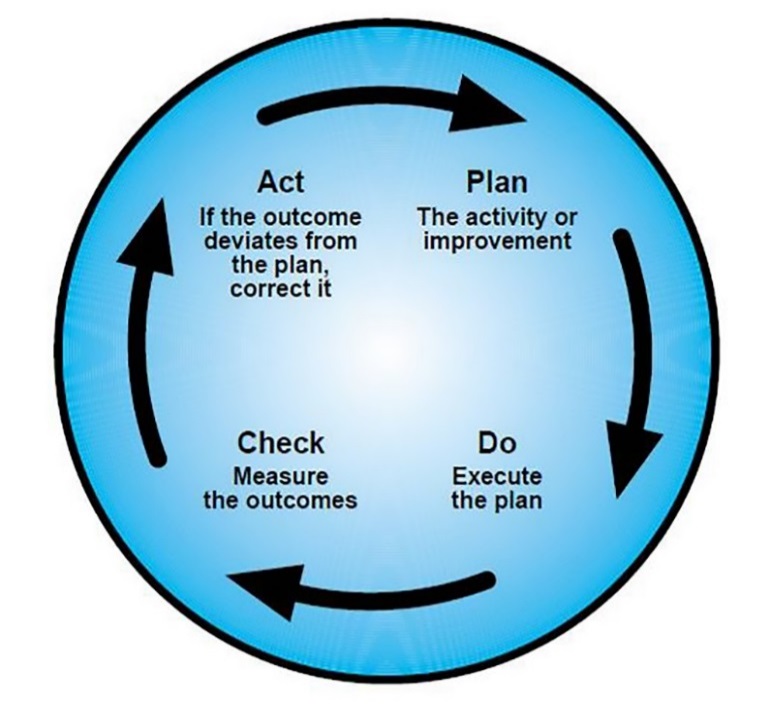
(f) Taking into account that the SMS is being required to manage safety, it can be assumed that by continuously improving the effectiveness of the SMS, ATS providers should be able to better manage and mitigate, and ultimately control the safety risks associated with the provisions of their services.