GM1
ATS.OR.200(3)(i) Safety management system
ED Decision 2017/001/R
SAFETY ASSURANCE — COMPLEX ATS PROVIDERS
(a) Leading indicators
(1) Metrics that measure inputs to the safety system (either within an organisation, a sector or across the total aviation system) to manage and improve safety performance.
(2) Leading indicators measure the specific features of the aviation safety system designed to support continuous improvement and to give an indication of likely future safety performance. They are designed to help identify whether the providers and regulators are taking actions and/or have processes in place that are effective in lowering the risk.
(b) Lagging indicators
Metrics that measure the outcome of the service delivery by measuring events that have already occurred and that impact safety performance. There are two subsets of lagging indicators:
(1) Outcome indicators: These include only the occurrences that one aims to prevent, for example fatal or catastrophic accidents. Depending on the system, the severity of the occurrences that are included as outcome indicators can be adjusted to include all accidents and serious incidents.
(2) Precursor indicators: These indicators do not manifest themselves in accidents or serious incidents. They indicate less severe system failures or ‘near misses’, and are used to assess how frequently the system comes close to severe failure. Because they are typically more numerous than outcome indicators, they can be used for trend monitoring.
(c) Safety management system
In the case of a complex air traffic services provider, the SMS should include all of these measures. Risk management efforts, however, should be targeted at leading indicators and precursor events. The reason for doing this is to reduce the number of accidents and serious incidents.
(d) Differing levels of safety performance monitoring
(1) Measurements of safety in terms of undesirable events, such as accidents and incidents, are examples of ‘lagging indicators’, which can capture safety performance a posteriori. Such indicators give valuable signals to all involved in air traffic services — providers, regulators, and recipients — of the levels of safety being experienced and of the ability of the organisations concerned to take appropriate mitigation action.
However, other types of measurement — ‘leading indicators’ — can give a wider perspective of the safety ‘health’ of the functional system, and focus on systemic issues, such as safety maturity and SMS performance.
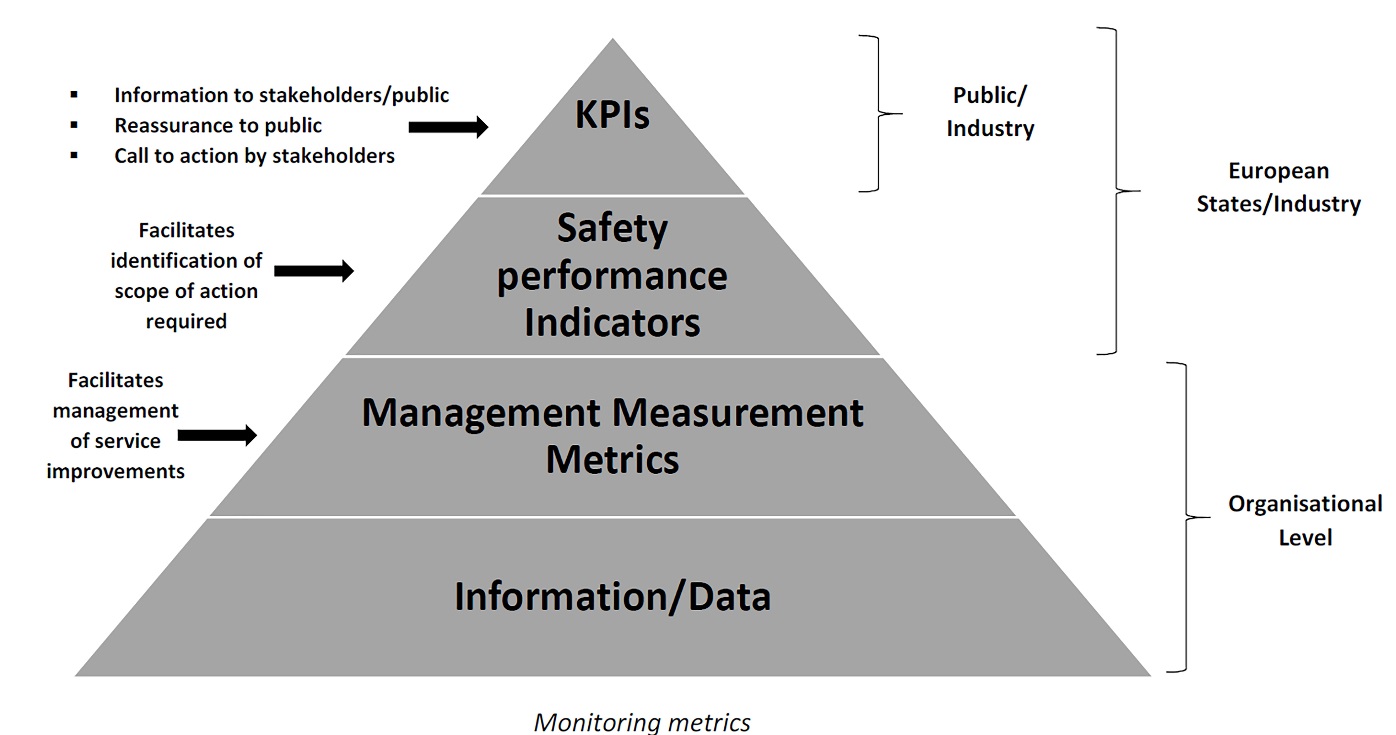
(2) A holistic approach to performance monitoring is an essential input to decision-making with regard to safety. It is important to ensure that good safety performance is attributable to good performance of the SMS, not simply to lack of incidents or accidents. It is also essential that the metrics chosen match the requirements of the stakeholders and decision-makers involved in safety improvement.
(3) As shown in the diagram, stakeholders in the wider aviation industry and the general public require relatively small numbers of safety indicators (safety performance indicators or key performance indicators) which can give an instant ‘feel’ for the overall position regarding safety performance. Conversely, those involved in the management of services concerned need a more detailed set of metrics on which to base decisions regarding the management of the services and facilities being reviewed.