ED Decision 2011/004/R
Definitions are written to support the content of this AMC and its associated certification specification. Elsewhere, terms such as “warning” may be used in a manner that is not consistent with the definitions below. However, the intent of this section is to facilitate standardisation of these terms.
|
Term |
Definition |
|
Advisory |
The level or category of alert for conditions that require flight crew awareness and may require subsequent flight crew response. |
|
Alert |
A generic term used to describe a flight deck indication meant to attract the attention of and identify to the flight crew a non-normal operational or aeroplane system condition. Alerts are classified at levels or categories corresponding to Warning, Caution, and Advisory. Alert indications also include non-normal range markings (for example, exceedances on instruments and gauges.) |
|
Alert inhibit |
Application of specific logic to prevent the presentation of an alert. Alerts can be inhibited automatically by the alerting system or manually by the flight crew. |
|
Alert message |
A visual alert comprised of text, usually presented on a flight deck display. Note: Aural Alert messages are referred to as “Voice Information.” |
|
Alerting function |
The aeroplane function that provides alerts to the flight crew for non-normal operational or aeroplane system conditions. This includes Warning, Caution, and Advisory information. |
|
Alerting philosophy |
The principles, guidance, and rules for implementing alerting functions within a flight deck. These typically consider: 1. The reason for implementing an alert. 2. The level of alert required for a given condition. 3. The characteristics of each specific alert. 4. Integration of multiple alerts. |
|
Attention-getting cues |
Perceptual signals (visual, auditory, or tactile/haptic) designed to attract the flight crew’s attention in order to obtain the immediate awareness that an alert condition exists. |
|
Caution |
The level or category of alert for conditions that require immediate flight crew awareness and a less urgent subsequent flight crew response than a warning alert. |
|
Collector message |
An Alert message that replaces two or more related Alert messages that do not share a common cause or effect. Example: A “DOORS” alert Collector message is displayed when more than one entry, cargo, or service access door is open at the same time. |
|
Communication message |
A type of message whose initiating conditions are caused by incoming communications, primarily data link conditions. Traditionally, this type of message is not a flight crew alert and does not indicate a non-normal system or operational condition. |
|
(1) Comm High |
A communication message which requires immediate flight crew awareness and immediate flight crew response. Note: At this time there are no communication messages defined that require immediate flight crew response. |
|
(2) Comm Medium |
An incoming communication message that requires immediate flight crew awareness and subsequent flight crew response. |
|
(3) Comm Low |
An incoming communication message which requires flight crew awareness and future flight crew response. |
|
False alert |
An incorrect or spurious alert caused by a failure of the alerting system including the sensor. |
|
Failure |
An occurrence that affects the operation of a component, part, or element such that it can no longer function as intended. This includes both loss of function and malfunction. |
|
Failure flag |
One local visual means of indicating the failure of a displayed parameter. |
|
Flashing |
Short term flashing symbols (approximately 10 seconds) or flash until acknowledged. |
|
Flight crew response |
The activity accomplished due to the presentation of an alert such as an action, decision, prioritisation, or search for additional information. |
|
Master aural alert |
An overall aural indication used to attract the flight crew’s attention that is specific to an alert urgency level (for example, Warning or Caution). |
|
Master visual alert |
An overall visual indication used to attract the flight crew’s attention that is specific to an alert urgency level (for example, Warning or Caution). |
|
Normal condition |
Any fault-free condition typically experienced in normal flight operations. Operations are typically well within the aeroplane flight envelope and with routine atmospheric and environmental conditions. |
|
Nuisance alert |
An alert generated by a system that is functioning as designed but which is inappropriate or unnecessary for the particular condition. |
|
Primary field of view |
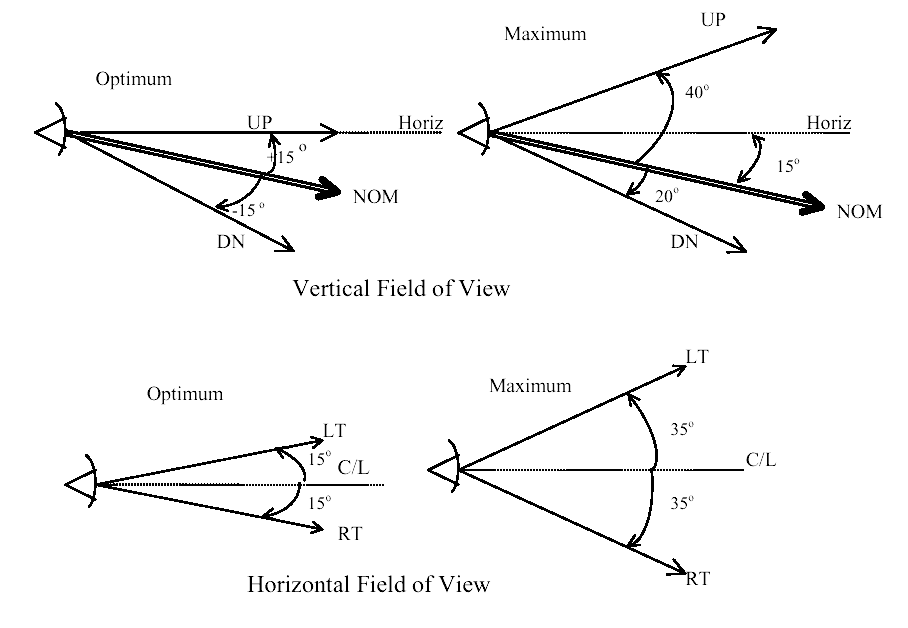
Primary Field of View is based upon the optimum vertical and horizontal visual fields from the design eye reference point that can be accommodated with eye rotation only. The description below and Figure A5-1 provide an example of how this may apply to head-down displays. With the normal line-of-sight established at 15 degrees below the horizontal plane, the values for the vertical (relative to normal line-of-sight forward of the aircraft) are +/-15 degrees optimum, with +40 degrees up and -20 degrees down maximum. For the horizontal visual field (relative to normal line-of-sight forward of the aircraft), the values are +/-15 degrees optimum, and +/-35 degrees maximum. |
|
Figure A5-1. Primary Field of View |
|
|
Status |
A specific aircraft system condition that is recognised using a visual indication, but does not require an alert and does not require flight crew response. These types of messages are sometimes used to determine aeroplane dispatch capability for subsequent flights. |
|
Tactile/haptic information |
An indication means where the stimulus is via physical touch, force feedback, or vibration (for example, a stick shaker). |
|
Time-critical warning |
A subset of warning. The most urgent warning level to maintain the immediate safe operation of the aeroplane. Examples of Time-critical warnings are: Predictive and Reactive Windshear Warnings, Terrain Awareness Warnings (TAWS), Airborne Collision Avoidance System (ACAS) II Resolution Advisories, Overspeed Warnings, and Low Energy Warnings. |
|
Umbrella message |
An Alert message that is presented in lieu of two or more Alert messages that share a common cause. Example: A single Engine Shutdown message in lieu of the multiple messages for electrical generator, generator drive, hydraulic pump and bleed air messages, which would otherwise have been displayed. This is different than a Collector message. A Collector message replaces two or more related Alert messages that do “not share” a common cause or effect. |
|
Unique tone (unique sound) |
An aural indication that is dedicated to specific alerts (for example, fire bell and overspeed). |
|
Visual alert information |
A visual indication that presents the flight crew with data on the exact nature of the alerting situation. For Advisory level alerts it also provides awareness. |
|
Voice information |
A means for informing the flight crew of the nature of a specific condition by using spoken words. |
|
Warning |
The level or category of alert for conditions that require immediate flight crew awareness and immediate flight crew response. |
[Amdt 25/11]