AMC
22.785(f) Seats and safety harnesses
ED Decision 2008/008/R
(1) The arrangement of the safety harness installation should minimise the probability of the occupant’s body from either sliding underneath the belts or sliding laterally when subjected to inertia loads acting in the forward or sideward direction, respectively.
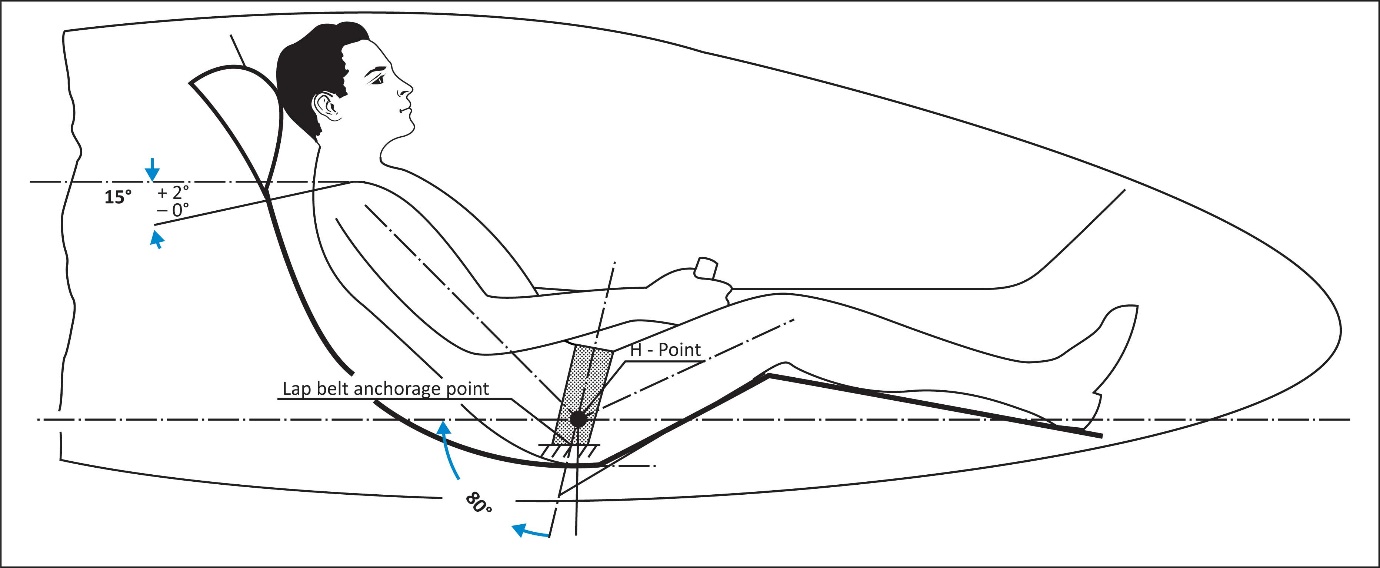
(2) For semi-reclined seating positions the anchorage points of the lap belt should be located well below and behind the H-Point at an angle between 80 ± 10 degrees to the datum line through the H-Point parallel to the longitudinal axis of the sailplane.
The H-Point (Hip-point) is the pivot between the torso centre line and the thigh centre line of the occupant.
The determination of the H-Point, or the anchorage point of the lap belt, should be made by a rational method. An acceptable means is contained in CS-22, Book 1, Appendix J.
(3) The anchorage points of the shoulder belts should be located below and behind the pilots shoulders at an angle of 15° +2°/-0° to a line parallel to the longitudinal axis of the sailplane for a 50 percentile male. The lateral separation should be not more than 200 mm.
(4) The design of the shoulder harness supporting structure has to consider the combination of the occupant ultimate inertia forces corresponding to a forward acceleration from CS 22.561(b)(1) combined with fuselage loads and possible side deformation resulting from the ultimate load defined under CS 22.561(b)(2).
[Amdt 22/1]