GM1 ATS.TR.210(c)(2)(i) Operation
of air traffic control service
ED Decision 2020/008/R
PROCEDURAL
SEPARATION — LONGITUDINAL SEPARATION APPLICATION
(a) Longitudinal separation should be applied so that the spacing between the estimated positions of the aircraft being separated is never less than a prescribed minimum. Longitudinal separation between aircraft following the same or diverging tracks may be maintained by application of speed control, including the Mach number technique. When applicable, use of the Mach number technique should be prescribed on the basis of a regional air navigation agreement.
(b) Longitudinal separation between supersonic aircraft during the transonic acceleration and supersonic phases of flight should normally be established by appropriate timing of the start of transonic acceleration rather than by the imposition of speed restrictions in supersonic flight.
(c) Time-based separation applied in accordance with AMC1 ATS.TR.210(c)(2)(i), AMC2 ATS.TR.210(c)(2)(i) and AMC5 ATS.TR.210(c)(2)(i) may be based on position information and estimates derived from voice reports, controller-pilot data link communications (CPDLC) or ADS-C.
(d) For the purpose of application of longitudinal separation, the terms ‘same track’, ‘reciprocal tracks’ and ‘crossing tracks’ have the following meanings:
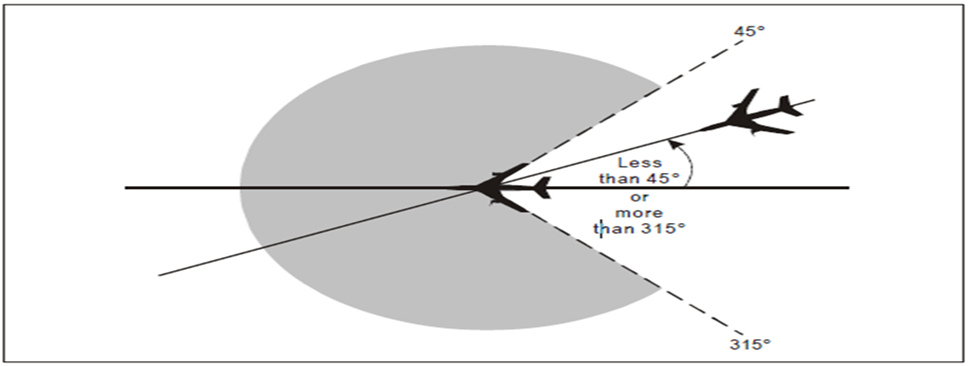
(1) Same track (see Figure 3)
Same direction tracks and intersecting tracks or portions thereof, the angular difference of which is less than 45 degrees or more than 315 degrees, and whose protected airspaces overlap
(2) Reciprocal tracks (see Figure 4)
Opposite tracks and intersecting tracks or portions thereof, the angular difference of which is more than 135 degrees but less than 225 degrees, and whose protected airspaces overlap
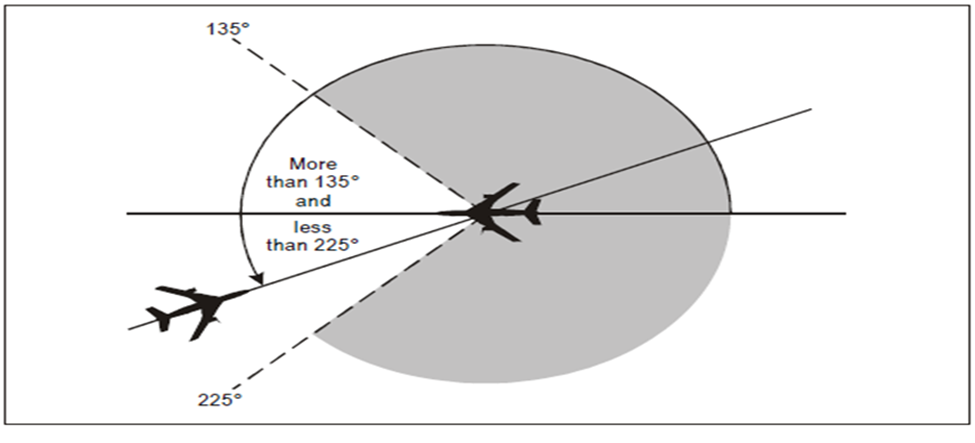
Figure 4: Aircraft on reciprocal tracks
(3) Crossing tracks (see Figure 5)
Intersecting tracks or portions thereof other than those specified in points (1) and (2)
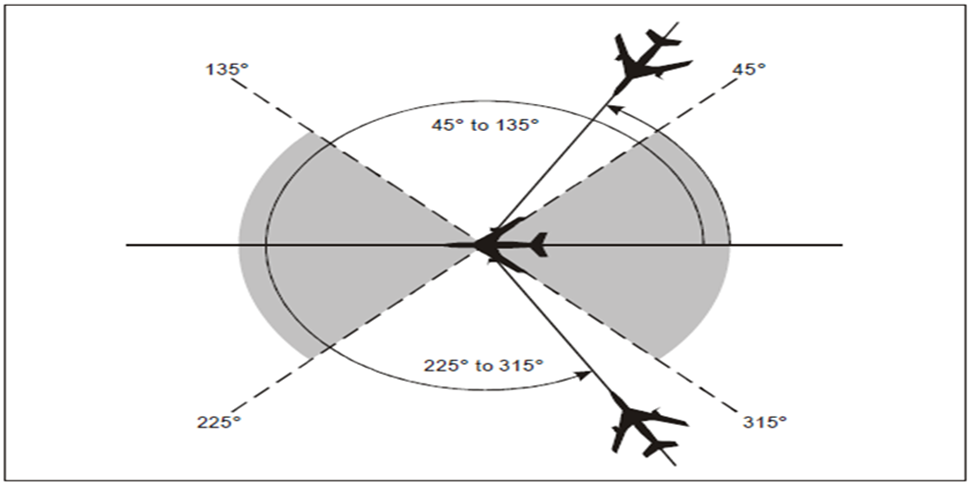
Figure 5: Aircraft on crossing tracks