Light
Dark
System
Log In
Loading...
Compare / EASA/
Incorporated Amendments
/
Compare & Highlight Differences
GM1 ATS.TR.210(c)(2)(i) Operation of air traffic control service
Available versions for ERULES-1963177438-17211
ED Decision 2020/008/R
found in: ATM/ANS Provision of Services (2017/373) (Feb 2023)
From
ATM/ANS Provision ... (Mar 2025)
ATM/ANS Provision ... (Feb 2023)
From section
To
ATM/ANS Provision ... (Mar 2025)
ATM/ANS Provision ... (Feb 2023)
To section
No visible text changes
0 removals
0 additions
View
Rich
Plain
Sync scrolling
Share
From
Show details
Hide details
To
Show details
Hide details
Version
Show side by side
GM1 ATS.TR.210(c)(2)(i) Operation of air traffic control service ED Decision 2020/008/R PROCEDURAL SEPARATION — LONGITUDINAL SEPARATION APPLICATION (a) Longitudinal separation should be applied so that the spacing between the estimated positions of the aircraft being separated is never less than a prescribed minimum. Longitudinal separation between aircraft following the same or diverging tracks may be maintained by application of speed control, including the Mach number technique. When applicable, use of the Mach number technique should be prescribed on the basis of a regional air navigation agreement. (b) Longitudinal separation between supersonic aircraft during the transonic acceleration and supersonic phases of flight should normally be established by appropriate timing of the start of transonic acceleration rather than by the imposition of speed restrictions in supersonic flight. (c) Time-based separation applied in accordance with [AMC1 ATS.TR.210(c)(2)(i)](#_DxCrossRefBm1726555484), [AMC2 ATS.TR.210(c)(2)(i)](#_DxCrossRefBm1726555483) and [AMC5 ATS.TR.210(c)(2)(i)](#_DxCrossRefBm1726555480) may be based on position information and estimates derived from voice reports, controller-pilot data link communications (CPDLC) or ADS-C. (d) For the purpose of application of longitudinal separation, the terms ‘same track’, ‘reciprocal tracks’ and ‘crossing tracks’ have the following meanings: (1) Same track (see Figure 3) Same direction tracks and intersecting tracks or portions thereof, the angular difference of which is less than 45 degrees or more than 315 degrees, and whose protected airspaces overlap ![Aviation.Bot AI suggestion, not from EASA source: [Image caption skipped for debugging]](/static/files/file_gqs63YSDadR/image016.png)Figure 3: Aircraft on same track (2) Reciprocal tracks (see Figure 4) Opposite tracks and intersecting tracks or portions thereof, the angular difference of which is more than 135 degrees but less than 225 degrees, and whose protected airspaces overlap ![Aviation.Bot AI suggestion, not from EASA source: [Image caption skipped for debugging]](/static/files/file_gqs63YSDadR/image017.png) Figure 4: Aircraft on reciprocal tracks (3) Crossing tracks (see Figure 5) Intersecting tracks or portions thereof other than those specified in points (1) and (2) ![Aviation.Bot AI suggestion, not from EASA source: [Image caption skipped for debugging]](/static/files/file_gqs63YSDadR/image018.png) Figure 5: Aircraft on crossing tracks
GM1 ATS.TR.210(c)(2)(i) Operation of air traffic control service ED Decision 2020/008/R PROCEDURAL SEPARATION — LONGITUDINAL SEPARATION APPLICATION (a) Longitudinal separation should be applied so that the spacing between the estimated positions of the aircraft being separated is never less than a prescribed minimum. Longitudinal separation between aircraft following the same or diverging tracks may be maintained by application of speed control, including the Mach number technique. When applicable, use of the Mach number technique should be prescribed on the basis of a regional air navigation agreement. (b) Longitudinal separation between supersonic aircraft during the transonic acceleration and supersonic phases of flight should normally be established by appropriate timing of the start of transonic acceleration rather than by the imposition of speed restrictions in supersonic flight. (c) Time-based separation applied in accordance with [AMC1 ATS.TR.210(c)(2)(i)](#_DxCrossRefBm647742661), [AMC2 ATS.TR.210(c)(2)(i)](#_DxCrossRefBm647742660) and [AMC5 ATS.TR.210(c)(2)(i)](#_DxCrossRefBm647742657) may be based on position information and estimates derived from voice reports, controller-pilot data link communications (CPDLC) or ADS-C. (d) For the purpose of application of longitudinal separation, the terms ‘same track’, ‘reciprocal tracks’ and ‘crossing tracks’ have the following meanings: (1) Same track (see Figure 3) Same direction tracks and intersecting tracks or portions thereof, the angular difference of which is less than 45 degrees or more than 315 degrees, and whose protected airspaces overlap 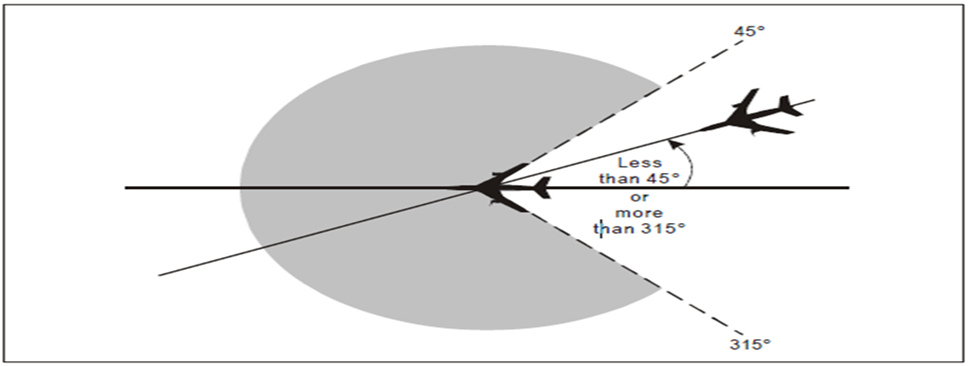 Figure 3: Aircraft on same track (2) Reciprocal tracks (see Figure 4) Opposite tracks and intersecting tracks or portions thereof, the angular difference of which is more than 135 degrees but less than 225 degrees, and whose protected airspaces overlap 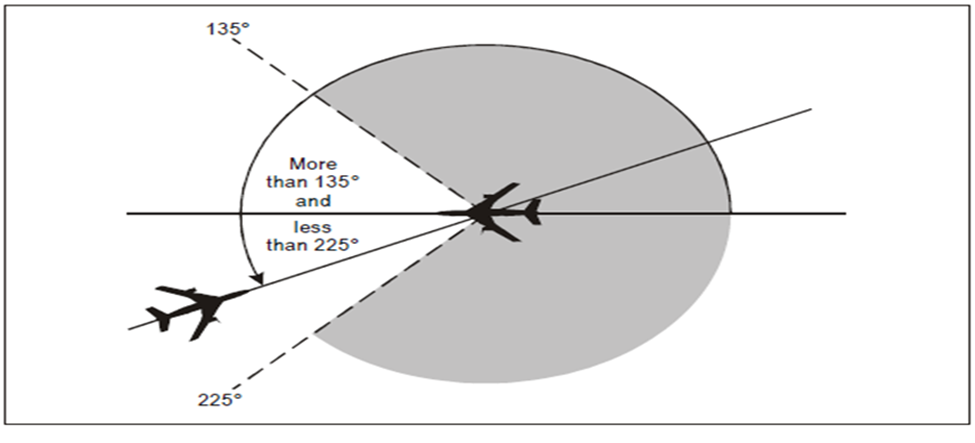 Figure 4: Aircraft on reciprocal tracks (3) Crossing tracks (see Figure 5) Intersecting tracks or portions thereof other than those specified in points (1) and (2) 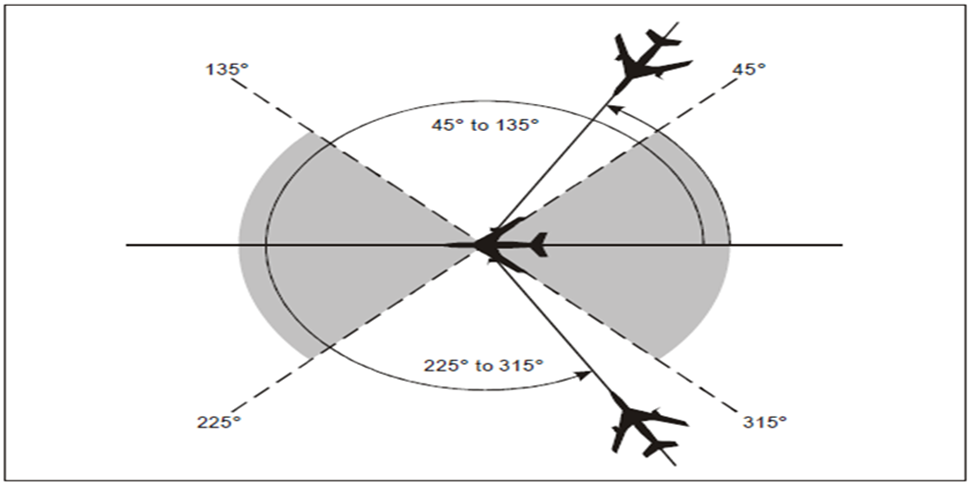 Figure 5: Aircraft on crossing tracks