A. REPORTING
INSTRUCTIONS
1. CONTENTS
OF AIR-REPORTS
1.1. Position reports and special air-reports
1.1.1. Section 1 of the model set out in point A is obligatory for position reports and special air-reports, although Items 5 and 6 thereof may be omitted. Section 2 shall be added, in whole or in part, only when so requested by the operator or its designated representative, or when deemed necessary by the pilot-in-command. Section 3 shall be included in special air-reports.
1.1.2. Condition prompting the issuance of a special air-report are to be selected from the list presented in point SERA.12005(a).
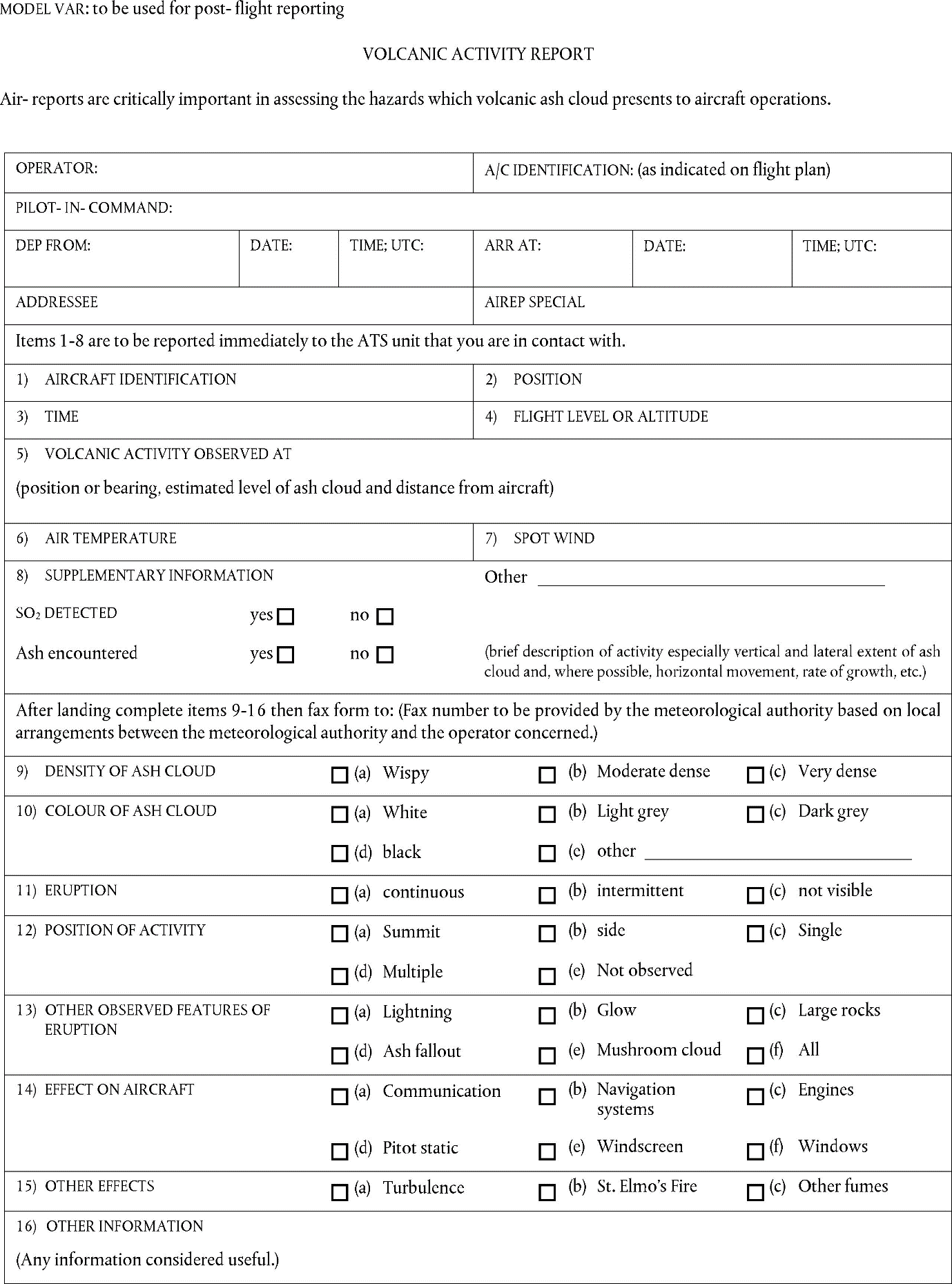
1.1.3. In the case of special air-reports containing information on volcanic activity, a post-flight report shall be made using the volcanic activity reporting form (Model VAR) set out in point B. All elements which are observed shall be recorded and indicated respectively in the appropriate places on the form Model VAR.
1.1.4. Special air-reports shall be issued as soon as practicable after a phenomenon calling for a special air-report has been observed.
2. DETAILED
REPORTING INSTRUCTIONS
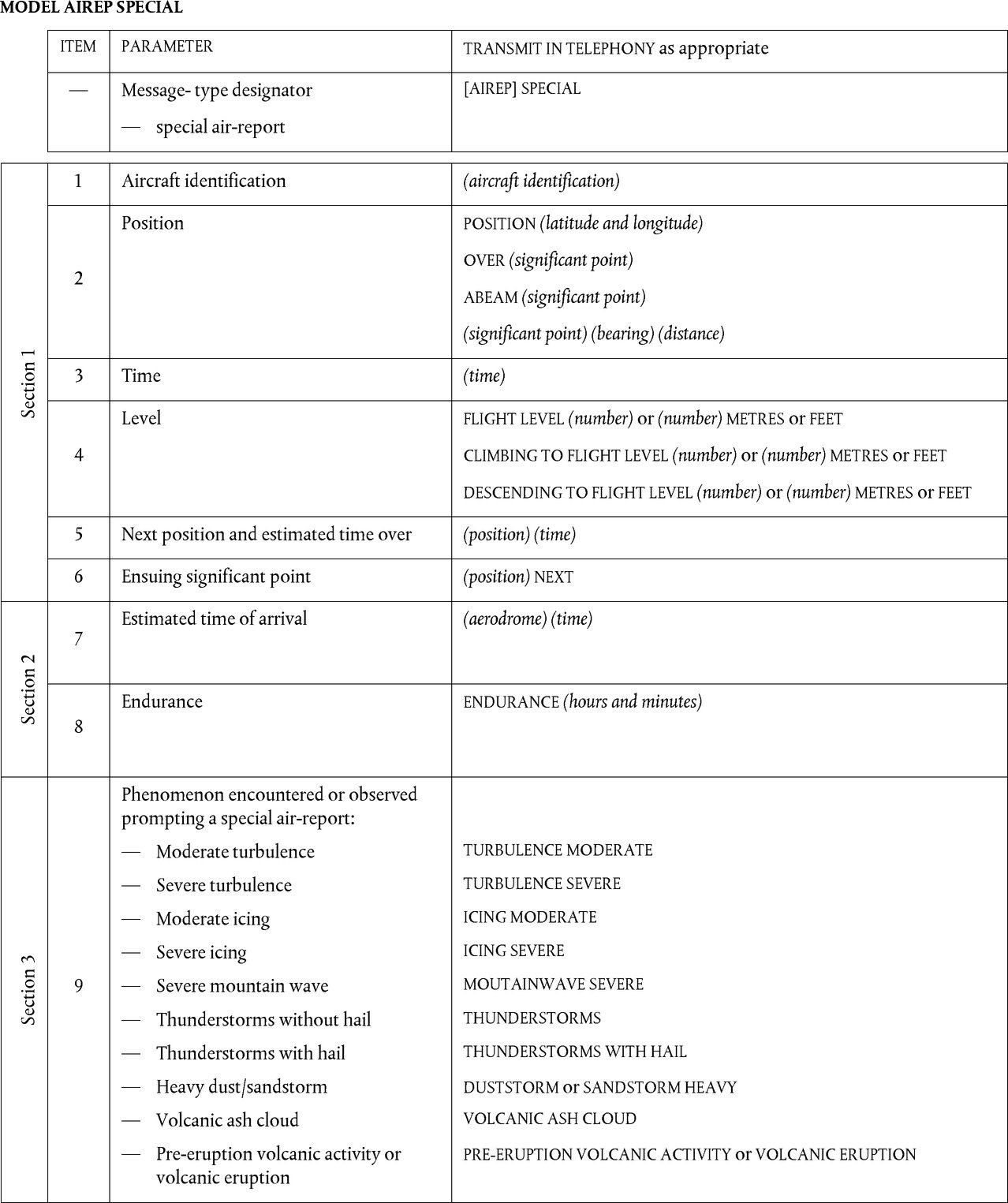
2.1. Items of an air-report shall be reported in the order in which they are listed in the model AIREP SPECIAL form.
MESSAGE TYPE DESIGNATOR. Report ‘SPECIAL’ for a special air-report.
Section 1
Item 1 — AIRCRAFT IDENTIFICATION. Report the aircraft radiotelephony call sign as prescribed in point SERA.14050.
Item 2 — POSITION. Report position in latitude (degrees as 2 numerics or degrees and minutes as 4 numerics, followed by ‘North’ or ‘South’) and longitude (degrees as 3 numerics or degrees and minutes as 5 numerics followed by ‘East’ or ‘West’), or as a significant point identified by a coded designator (2 to 5 characters), or as a significant point followed by magnetic bearing (3 numerics) and distance in nautical miles from the point. Precede significant point with ‘ABEAM’, if applicable.
Item 3 — TIME. Report time in hours and minutes UTC (4 numerics) unless reporting time in minutes past the hour (2 numerics) is prescribed on the basis of regional air navigation agreements. The time reported must be the actual time of the aircraft at the position and not the time of origination or transmission of the report. Time shall always be reported in hours and minutes UTC when issuing a special air-report.
Item 4 — FLIGHT LEVEL OR ALTITUDE. Report flight level by 3 numerics when on standard pressure altimeter setting. Report altitude in metres followed by ‘METRES’ or in feet followed by ‘FEET’ when on QNH. Report ‘CLIMBING’ (followed by the level) when climbing or ‘DESCENDING’ (followed by the level) when descending to a new level after passing the significant point.
Item 5 — NEXT POSITION AND ESTIMATED TIME OVER. Report the next reporting point and the estimated time over such reporting point, or report the estimated position that will be reached one hour later, according to the position reporting procedures in force. Use the data conventions specified in Item 2 for position. Report the estimated time over this position. Report time in hours and minutes UTC (4 numerics) unless reporting time in minutes past the hour (2 numerics) as prescribed by regional air navigation agreements.
Item 6 — ENSUING SIGNIFICANT POINT. Report the ensuing significant point following the ‘next position and estimated time over’.
Section 2
Item 7 — ESTIMATED TIME OF ARRIVAL. Report the name of the aerodrome of the first intended landing, followed by the estimated time of arrival at this aerodrome in hours and minutes UTC (4 numerics).
Item 8 — ENDURANCE. Report ‘ENDURANCE’ followed by fuel endurance in hours and minutes (4 numerics).
Section 3
Item 9 — PHENOMENON PROMPTING A SPECIAL AIR-REPORT. Report one of the following phenomena encountered or observed:
— moderate turbulence as ‘TURBULENCE MODERATE’, and
— severe turbulence as ‘TURBULENCE SEVERE’.
The following specifications apply:
— Moderate - Conditions in which moderate changes in aircraft attitude and/or altitude may occur but the aircraft remains in positive control at all times. Usually, small variations in airspeed. Changes in accelerometer readings of 0,5 g to 1,0 g at the aircraft's centre of gravity. Difficulty in walking. Occupants feel strain against seat belts. Loose objects move about.
— Severe - Conditions in which abrupt changes in aircraft attitude and/or altitude occur; aircraft may be out of control for short periods. Usually, large variations in airspeed. Changes in accelerometer readings greater than 1,0 g at the aircraft's centre of gravity. Occupants are forced violently against seat belts. Loose objects are tossed about.
— moderate icing as ‘ICING MODERATE’, severe icing as ‘ICING SEVERE’;
The following specifications apply:
— Moderate - Conditions in which change of heading and/or altitude may be considered desirable.
— Severe - Conditions in which immediate change of heading and/or altitude is considered essential.
— Severe mountain wave as ‘MOUNTAIN WAVE SEVERE’;
The following specification applies:
— Severe - Conditions in which the accompanying downdraft is 3,0 m/s (600 ft/min) or more and/or severe turbulence is encountered.
— Thunderstorm without hail as ‘THUNDERSTORM’, thunderstorm with hail as ‘THUNDERSTORM WITH HAIL’;
The following specification applies:
Only report those thunderstorms which are:
— obscured in haze, or
— embedded in cloud, or
— widespread, or
— forming a squall line.
— Heavy duststorm or sandstorm as ‘DUSTSTORM HEAVY’ or ‘SANDSTORM HEAVY’;
— Volcanic ash cloud as ‘VOLCANIC ASH CLOUD’;
— Pre-eruption volcanic activity or a volcanic eruption as ‘PRE-ERUPTION VOLCANIC ACTIVITY’ or ‘VOLCANIC ERUPTION’;
The following specification applies:
‘Pre-eruption volcanic activity’ in this context means unusual and/or increasing volcanic activity which could presage a volcanic eruption.
2.2. Information recorded on the volcanic activity reporting form (Model VAR) is not for transmission by RTF but, on arrival at an aerodrome, is to be delivered without delay by the operator or a flight crew member to the aerodrome meteorological office. If such an office is not easily accessible, the completed form shall be delivered in accordance with local arrangements agreed upon between MET and ATS providers and the aircraft operator.
3. FORWARDING
OF METEOROLOGICAL INFORMATION RECEIVED BY VOICE COMMUNICATIONS
When receiving special air-reports, ATS units shall forward these air-reports without delay to the associated meteorological watch office (MWO). In order to ensure assimilation of air-reports in ground-based automated systems, the elements of such reports shall be transmitted using the data conventions specified below and in the order prescribed.
— ADDRESSEE. Record the station called and, when necessary, relay required.
— MESSAGE TYPE DESIGNATOR. Record ‘ARS’ for a special air-report.
— AIRCRAFT IDENTIFICATION. Record the aircraft identification using the data convention specified for Item 7 of the flight plan, without a space between the operator's designator and the aircraft registration or flight identification, if used.
Section 1
Item 0 — POSITION. Record position in latitude (degrees as 2 numerics or degrees and minutes as 4 numerics, followed, without a space, by N or S) and longitude (degrees as 3 numerics or degrees and minutes as 5 numerics, followed without a space by E or W), or as a significant point identified by a coded designator (2 to 5 characters), or as a significant point followed by magnetic bearing (3 numerics) and distance in nautical miles (3 numerics) from the point. Precede significant point with ‘ABEAM’, if applicable.
Item 1 — TIME. Record time in hours and minutes UTC (4 numerics).
Item 2 — FLIGHT LEVEL OR ALTITUDE. Record ‘F’ followed by 3 numerics (e.g. ‘F310’) when a flight level is reported. Record altitude in metres followed by ‘M’ or in feet followed by ‘FT’ when an altitude is reported. Record ‘ASC’ (level) when climbing or ‘DES’ (level) when descending.
Section 2
Item 9 — PHENOMENON PROMPTING A SPECIAL AIR-REPORT. Record the phenomenon reported as follows:
— moderate turbulence as ‘TURB MOD’,
— severe turbulence as ‘TURB SEV’,
— moderate icing as ‘ICE MOD’,
— severe icing as ‘ICE SEV’,
— severe mountain wave as ‘MTW SEV’,
— thunderstorm without hail as ‘TS’,
— thunderstorm with hail as ‘TSGR’,
— heavy duststorm or sandstorm as ‘HVY SS’,
— volcanic ash cloud as ‘VA CLD’,
— pre-eruption volcanic activity or a volcanic eruption as ‘VA’,
— hail as ‘GR’,
— cumulonimbus clouds as ‘CB’.
— TIME TRANSMITTED. Record only when Section 3 is transmitted.
4. SPECIFIC
PROVISIONS RELATED TO REPORTING WIND SHEAR AND VOLCANIC ASH
4.1. Reporting of wind shear
4.1.1. When reporting aircraft observations of wind shear encountered during the climb-out and approach phases of flight, the aircraft type shall be included.
4.1.2. Where wind shear conditions in the climb-out or approach phases of flight were reported or forecast but not encountered, the pilot-in-command shall advise the appropriate ATS unit as soon as practicable unless the pilot-in-command is aware that the appropriate ATS unit has already been so advised by a preceding aircraft.
4.2. Post-flight reporting of volcanic activity
4.2.1. On arrival of a flight at an aerodrome, the completed report of volcanic activity shall be delivered by the aircraft operator or a flight crew member, without delay, to the aerodrome meteorological office, or if such office is not easily accessible to arriving flight crew members, the completed form shall be dealt with in accordance with local arrangements agreed upon between MET and ATS providers and the aircraft operator.
4.2.2. The completed report of volcanic activity received by an aerodrome meteorological office shall be transmitted without delay to the meteorological watch office responsible for the provision of meteorological watch for the flight information region in which the volcanic activity was observed.
[applicable until 30 April 2025 –
Regulation (EU) 2016/1185]
A. REPORTING INSTRUCTIONS
MODEL AIREP SPECIAL
|
|
ITEM |
PARAMETER |
TRANSMIT IN TELEPHONY as
appropriate |
|
|
─ |
Message-type designator |
[AIREP] SPECIAL |
|
|
─ special air-report |
|
|
Section 1 |
1 |
Aircraft identification |
(aircraft identification) |
|
2 |
Position |
POSITION (latitude and
longitude) |
|
|
OVER (significant point) |
|||
|
ABEAM (significant point) |
|||
|
(significant point) (bearing)
(distance) |
|||
|
3 |
Time |
(time) |
|
|
4 |
Level |
FLIGHT LEVEL (number) or
(number) METERS or FEET |
|
|
CLIMBING TO FLIGHT LEVEL
(number) or (number) METERS or FEET |
|||
|
DESCENDING TO FLIGHT LEVEL (number)
or (number) METERS or FEET |
|||
|
5 |
Next position and estimated
time over |
(position) (time) |
|
|
6 |
Ensuing significant point |
(position) NEXT |
|
|
Section 2 |
7 |
Estimated time of arrival |
(aerodrome) (time) |
|
8 |
Endurance |
ENDURANCE (hours and minutes) |
|
|
Section 3 |
9 |
Phenomenon encountered or
observed prompting a special air-report: |
|
|
─ Moderate turbulence |
TURBULENCE MODERATE |
||
|
─ Severe turbulence |
TURBULENCE SEVERE |
||
|
─ Moderate icing |
ICING MODERATE |
||
|
─ Severe icing |
ICING SEVERE |
||
|
─ Severe mountain wave |
MOUNTAIN WAVE SEVERE |
||
|
─ Thunderstorms without hail |
THUNDERSTORMS |
||
|
─ Thunderstorms with hail |
THUNDERSTORMS WITH HAIL |
||
|
─ Heavy dust/sandstorm |
DUSTSTORM or SANDSTORM HEAVY |
||
|
─ Volcanic ash cloud |
VOLCANIC ASH CLOUD |
||
|
─ Pre- eruption volcanic
activity or volcanic eruption |
PRE-ERUPTION VOLCANIC
ACTIVITY or VOLCANIC ERUPTION |
||
|
|
|
||
|
Runway braking action |
|
||
|
• Good |
GOOD |
||
|
• Good to medium |
GOOD TO MEDIUM |
||
|
• Medium |
MEDIUM |
||
|
• Medium to poor |
MEDIUM TO POOR |
||
|
• Poor |
POOR |
||
|
• Less than poor |
LESS THAN POOR |
1. CONTENTS OF AIR-REPORTS
1.1. Position reports and special air-reports
1.1.1. Section 1 of the model set out in point A is obligatory for
position reports and special air-reports, although Items 5 and 6 thereof may
be omitted. Section 2 shall be added, in whole or in part, only when so
requested by the operator or its designated representative, or when deemed
necessary by the pilot-in-command. Section 3 shall be included in special
air-reports.
1.1.2. Condition prompting the issuance of a special air-report are to be
selected from the list presented in point SERA.12005(a).
1.1.3. In the case of special air-reports containing information on
volcanic activity, a post-flight report shall be made using the volcanic
activity reporting form (Model VAR) set out in point B. All elements which are
observed shall be recorded and indicated respectively in the appropriate
places on the form Model VAR.
1.1.4. Special air-reports shall be issued as soon as practicable after a
phenomenon calling for a special air-report has been observed.
2. DETAILED REPORTING INSTRUCTIONS
2.1. Items of an air-report shall be reported in the order in which
they are listed in the model AIREP SPECIAL form.
—
MESSAGE TYPE
DESIGNATOR. Report “SPECIAL” for a special air-report.
Section 1
Item 1 – AIRCRAFT IDENTIFICATION. Report the aircraft
radiotelephony call sign as prescribed in point SERA.14050.
Item 2 – POSITION. Report
position in latitude (degrees as 2 numerics or degrees and minutes as 4
numerics, followed by “North” or “South”) and longitude (degrees as 3 numerics
or degrees and minutes as 5 numerics followed by “East” or “West”), or as a
significant point identified by a coded designator (2 to 5 characters), or as
a significant point followed by magnetic bearing (3 numerics) and distance in
nautical miles from the point. Precede significant point with “ABEAM”, if
applicable.
Item 3 – TIME. Report time in hours and minutes UTC (4 numerics)
unless reporting time in minutes past the hour (2 numerics) is prescribed on
the basis of regional air navigation agreements. The time reported must be the
actual time of the aircraft at the position and not the time of origination or
transmission of the report. Time shall always be reported in hours and minutes
UTC when issuing a special air-report.
Item 4 – FLIGHT LEVEL OR ALTITUDE. Report flight level by 3
numerics when on standard pressure altimeter setting. Report altitude in
metres followed by “METRES” or in feet followed by “FEET” when on QNH. Report
“CLIMBING” (followed by the level) when climbing or “DESCENDING” (followed by
the level) when descending to a new level after passing the significant point.
Item 5 – NEXT POSITION AND ESTIMATED TIME OVER. Report the next
reporting point and the estimated time over such reporting point, or report
the estimated position that will be reached one hour later, according to the
position reporting procedures in force. Use the data conventions specified in
Item 2 for position. Report the estimated time over this position. Report time
in hours and minutes UTC (4 numerics) unless reporting time in minutes past
the hour (2 numerics) as prescribed by regional air navigation agreements.
Item 6 – ENSUING SIGNIFICANT POINT. Report the ensuing
significant point following the “next position and estimated time over”.
Section 2
Item 7 – ESTIMATED TIME OF ARRIVAL. Report the name of the
aerodrome of the first intended landing, followed by the estimated time of
arrival at this aerodrome in hours and minutes UTC (4 numerics).
Item 8 – ENDURANCE. Report “ENDURANCE” followed by fuel/energy endurance in hours and minutes (4 numerics).
Section 3
Item 9 – PHENOMENON PROMPTING A SPECIAL AIR-REPORT. Report one of
the following phenomena encountered or observed:
—
Moderate
turbulence as “TURBULENCE MODERATE”
Severe turbulence as “TURBULENCE
SEVERE”
The following specifications
apply:
—
Moderate –
Conditions in which moderate changes in aircraft attitude and/or altitude may
occur but the aircraft remains in positive control at all times. Usually,
small variations in airspeed. Changes in accelerometer readings of 0,5 g to
1,0 g at the aircraft’s centre of gravity. Difficulty in walking. Occupants
feel strain against seat belts. Loose objects move about.
—
Severe –
Conditions in which abrupt changes in aircraft attitude and/or altitude occur;
aircraft may be out of control for short periods. Usually, large variations in
airspeed. Changes in accelerometer readings greater than 1,0 g at the
aircraft’s centre of gravity. Occupants are forced violently against seat
belts. Loose objects are tossed about.
—
Moderate
icing as “ICING MODERATE”
Severe icing as “ICING SEVERE”
The following specifications
apply:
—
Moderate –
Conditions in which change of heading and/or altitude may be considered
desirable.
—
Severe –
Conditions in which immediate change of heading and/or altitude is considered
essential.
—
Severe
mountain wave as “MOUNTAIN WAVE SEVERE”
The following specification
applies:
—
Severe –
Conditions in which the accompanying downdraft is 3,0 m/s (600 ft/min) or more
and/or severe turbulence is encountered.
—
Thunderstorm
without hail as “THUNDERSTORM”
Thunderstorm with hail as
“THUNDERSTORM WITH HAIL”
The following specification
applies:
Only report those thunderstorms
which are:
—
obscured in
haze, or
—
embedded in
cloud, or
—
widespread,
or
—
forming a
squall line.
—
Heavy
duststorm or sandstorm as “DUSTSTORM HEAVY” or “SANDSTORM HEAVY”
—
Volcanic ash
cloud as “VOLCANIC ASH CLOUD”
—
Pre-eruption
volcanic activity or a volcanic eruption as “PREERUPTION VOLCANIC ACTIVITY” or
“VOLCANIC ERUPTION”
The following specification
applies:
“Pre-eruption volcanic activity”
in this context means unusual and/or increasing volcanic activity which could
presage a volcanic eruption.
—
Good braking
action as “BRAKING ACTION GOOD”
—
Good to
medium braking action as “BRAKING ACTION GOOD TO MEDIUM”
—
Medium
braking action as “BRAKING ACTION MEDIUM”
—
Medium to
poor braking action as “BRAKING ACTION MEDIUM TO POOR”
—
Poor braking
action as “BRAKING ACTION POOR”
—
Less than
poor braking action as “BRAKING ACTION LESS THAN POOR”
The following specifications
apply:
Good – Braking deceleration is
normal for the wheel braking effort applied, and directional control is
normal.
Good to medium – Braking
deceleration or directional control is between good and medium.
Medium – Braking deceleration is
noticeably reduced for the wheel braking effort applied, or directional
control is noticeably reduced.
Medium to poor – Braking
deceleration or directional control is between medium and poor.
Poor – Braking deceleration is
significantly reduced for the wheel braking effort applied, or directional
control is significantly reduced.
Less than poor – Braking
deceleration is minimal to non-existent for the wheel braking effort applied,
or directional control is uncertain.
2.2 Information recorded on the volcanic activity reporting form
(Model VAR) is not for transmission by RTF but, on arrival at an aerodrome, is
to be delivered without delay by the operator or a flight crew member to the
aerodrome meteorological office. If such an office is not easily accessible,
the completed form shall be delivered in accordance with local arrangements
agreed upon between MET and ATS providers and the aircraft operator.
3. FORWARDING OF METEOROLOGICAL INFORMATION RECEIVED BY VOICE
COMMUNICATIONS
When receiving special
air-reports, ATS units shall forward these air-reports without delay to the
associated meteorological watch office (MWO). In order to ensure assimilation
of air-reports in ground-based automated systems, the elements of such reports
shall be transmitted using the data conventions specified below and in the
order prescribed.
—
ADDRESSEE.
Record the station called and, when necessary, relay required.
—
MESSAGE TYPE
DESIGNATOR. Record “ARS” for a special air-report.
—
AIRCRAFT
IDENTIFICATION. Record the aircraft identification using the data convention
specified for Item 7 of the flight plan, without a space between the
operator’s designator and the aircraft registration or flight identification,
if used.
Section 1
Item 0 – POSITION. Record position in latitude (degrees as 2
numerics or degrees and minutes as 4 numerics, followed, without a space, by N
or S) and longitude (degrees as 3 numerics or degrees and minutes as 5
numerics, followed without a space by E or W), or as a significant point
identified by a coded designator (2 to 5 characters), or as a significant
point followed by magnetic bearing (3 numerics) and distance in nautical miles
(3 numerics) from the point. Precede significant point with “ABEAM”, if applicable.
Item 1 – TIME. Record time in hours and minutes UTC (4 numerics).
Item 2 – FLIGHT LEVEL OR ALTITUDE. Record “F” followed by 3
numerics (e.g. “F310”) when a flight level is reported. Record altitude in
metres followed by “M” or in feet followed by “FT” when an altitude is
reported. Record “ASC” (level) when climbing or “DES” (level) when descending.
Section 3
Item 9 – PHENOMENON PROMPTING A SPECIAL AIR-REPORT. Record the
phenomenon reported as follows:
—
moderate
turbulence as “TURB MOD”,
—
severe
turbulence as “TURB SEV”,
—
moderate
icing as “ICE MOD”,
—
severe icing
as “ICE SEV”,
—
severe
mountain wave as “MTW SEV”,
—
thunderstorm
without hail as “TS”,
—
thunderstorm
with hail as “TSGR”,
—
heavy
sandstorm as “HVY SS”,
—
heavy
duststorm as “HVY DS”,
—
volcanic ash
cloud as “VA CLD”,
—
pre-eruption
volcanic activity or a volcanic eruption as “VA”,
—
hail as
“GR”,
—
cumulonimbus
clouds as “CB”.
TIME TRANSMITTED. Record only
when Section 3 is transmitted.
4. SPECIFIC PROVISIONS RELATED TO REPORTING WIND SHEAR AND
VOLCANIC ASH
4.1. Reporting of wind shear
4.1.1. When reporting aircraft observations of wind shear encountered
during the climb-out and approach phases of flight, the aircraft type shall be
included.
4.1.2. Where wind shear conditions in the climb-out or approach phases of
flight were reported or forecast but not encountered, the pilot-in-command
shall advise the appropriate air traffic services unit as soon as practicable
unless the pilot-in-command is aware that the appropriate air traffic services
unit has already been so advised by a preceding aircraft.
4.2. Post-flight reporting of volcanic activity
4.2.1. On arrival of a flight at an aerodrome, the completed report of
volcanic activity shall be delivered by the aircraft operator or a flight crew
member, without delay, to the aerodrome meteorological office, or if such
office is not easily accessible to arriving flight crew members, the completed
form shall be dealt with in accordance with local arrangements agreed upon
between MET and ATS providers and the aircraft operator.
4.2.2. The completed report of volcanic activity received by an aerodrome
meteorological office shall be transmitted without delay to the meteorological
watch office responsible for the provision of meteorological watch for the
flight information region in which the volcanic activity was observed.
[applicable
from 1 May 2025 – Regulation (EU) 2024/404]
[applicable from 1 May 2025 – Regulation (EU) 2024/1111
(for Item 8 – ENDURANCE.)]
B. SPECIAL AIR-REPORT OF VOLCANIC ACTIVITY
FORM (MODEL VAR)