CS ADR-DSN.N.785 Information
signs
ED Decision 2022/006/R
(a) Applicability:
(1) An information sign should be provided where there is an operational need to identify by a sign, a specific location, or routing (direction or destination) information.
(2) Information signs should include: direction signs, location signs, destination signs, runway exit signs, runway vacated signs, and intersection take-off signs.
(3) A runway exit sign should be provided where there is an operational need to identify a runway exit.
(4) A runway vacated sign should be provided where the exit taxiway is not provided with taxiway centre line lights and there is a need to indicate to a pilot leaving a runway the perimeter of the ILS/MLS critical/sensitive area, or the lower edge of the inner transitional surface whichever is farther from the runway centre line.
(5) At runways where intersection take-offs are conducted, an intersection take-off sign should be provided to indicate the remaining take-off run available (TORA) for such take-offs.
(6) Where necessary, a destination sign should be provided to indicate the direction to a specific destination on the aerodrome, such as cargo area, general aviation, etc.
(7) A combined location and direction sign should be provided when it is intended to indicate routing information prior to a taxiway intersection.
(8) A direction sign should be provided when there is an operational need to identify the designation and direction of taxiways at an intersection.
(9) A location sign should be provided at an intermediate holding position.
(10) A location sign should be provided in conjunction with a runway designation sign except at a runway/runway intersection.
(11) A location sign should be provided in conjunction with a direction sign, except that it may be omitted where a safety assessment indicates that it is not needed.
(12) Where necessary, a location sign should be provided to identify taxiways exiting an apron or taxiways beyond an intersection.
(13) Where a taxiway ends at an intersection such as a ‘T’ and it is necessary to identify this, a barricade, direction sign, and/or other appropriate visual aid should be used.
(b) Location:
(1) Except as specified in paragraph (b)(3) below, information signs should wherever practicable, be located on the left-hand side of the taxiway in accordance with Table N-1.
(2) At a taxiway intersection, information signs should be located prior to the intersection and in line with the intermediate holding position marking. Where there is no intermediate holding position marking, the signs should be installed at least 60 m from the centre line of the intersecting taxiway where the code number is 3 or 4, and at least 40 m where the code number is 1 or 2.
(3) A runway exit sign should be located on the same side of the runway as the exit is located (i.e. left or right), and positioned in accordance with Table N-1.
(4) A runway exit sign should be located prior to the runway exit point in line with a position at least 60 m prior to the point of tangency where the code number is 3 or 4, and at least 30 m where the code number is 1 or 2.
(5) A runway vacated sign should be located at least on one side of the taxiway. The distance between the sign and the centre line of a runway should be not less than the greater of the following:
(i) the distance between the centre line of the runway and the perimeter of the ILS/MLS critical/sensitive area; or
(ii) the distance between the centre line of the runway and the lower edge of the inner transitional surface.
(6) Where provided in conjunction with a runway vacated sign, the taxiway location sign should be positioned outboard of the runway vacated sign.
(7) An intersection take-off sign should be located at the left-hand side of the entry taxiway. The distance between the sign and the centre line of the runway should be not less than 60 m where the code number is 3 or 4 and not less than 45 m where the code number is 1 or 2.
(8) A taxiway location sign installed in conjunction with a runway designation sign should be positioned outboard of the runway designation sign.
(9) A destination sign should not normally be collocated with a location or direction sign.
(10) An information sign other than a location sign should not be collocated with a mandatory instruction sign.
(c) Characteristics:
(1) An information sign other than a location sign should consist of an inscription in black on a yellow background.
(2) A location sign should consist of an inscription in yellow on a black background and where it is a stand-alone sign, should have a yellow border.
(3) The inscription on a runway exit sign should consist of the designator of the exit taxiway and an arrow indicating the direction to follow.
(4) The inscription on a runway vacated sign should depict the pattern A runway-holding position marking as shown in Figure N-6.
(5) The inscription on an intersection take-off sign should consist of a numerical message indicating the remaining take-off run available in metres, plus an arrow, appropriately located and oriented, indicating the direction of the take-off as shown in Figure N-6.
(6) The inscription on a destination sign should comprise an alpha, alphanumerical or numerical message identifying the destination, plus an arrow indicating the direction to proceed as shown in Figure N-6.
(7) The inscription on a direction sign should comprise an alpha or alphanumerical message identifying the taxiway(s) , plus an arrow or arrows appropriately oriented as shown in Figure N-6.
(8) The inscription on a location sign should comprise the designation of the location taxiway, runway, or other pavement the aircraft is on or is entering, and should not contain arrows.
(9) Where necessary to identify each of a series of intermediate holding positions on the same taxiway, the location sign should consist of the taxiway designation and a progressive number.
(10) Where a location sign and direction signs are used in combination:
(i) all direction signs related to left turns should be placed on the left side of the location sign and all direction signs related to right turns should be placed on the right side of the location sign, except that where the junction consists of one intersecting taxiway, the location sign may alternatively be placed on the left hand side;
(ii) the direction signs should be placed such that the direction of the arrows departs increasingly from the vertical with increasing deviation of the corresponding taxiway;
(iii) an appropriate direction sign should be placed next to the location sign where the direction of the location taxiway changes significantly beyond the intersection; and
(iv) adjacent direction signs should be delineated by a vertical black line as shown in Figure N-6.
(11) A taxiway should be identified by a designatorthat is used only once on an aerodrome andcomprising a single letter, two letters, or a combination of a letter or letters followed by a number.
(12) When designating taxiways:
(i) the letters I, O, or Xshould not be used to avoid confusion with the numerals 1, 0, and the closed marking;
(ii) the use of words such as ‘inner’ and ‘outer’ should be avoided wherever possible.
(13) The use of numbers alone on the manoeuvring area should be reserved for the designation of runways.
(14) Apron stand designators should not be the same as taxiway designators.
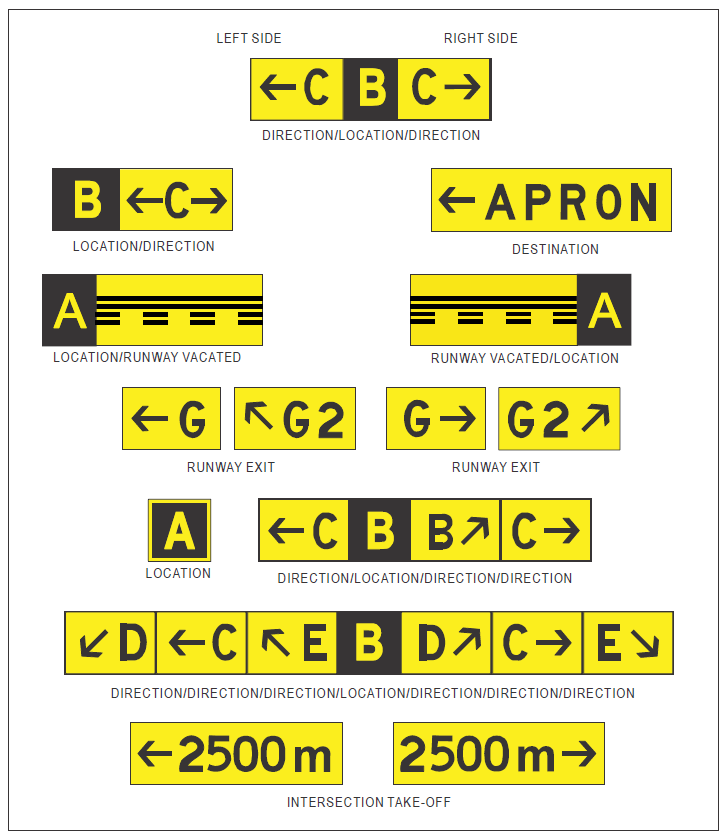
Figure N-6.
Information signs
[Issue: ADR-DSN/3]
[Issue: ADR-DSN/4]
[Issue: ADR-DSN/6]