CS
ADR-DSN.R.855 Closed runways and taxiways, or parts thereof
ED Decision 2021/004/R
(a) Applicability:
A closed marking should be displayed on a runway, or taxiway, or portion thereof which is permanently closed to the use of all aircraft.
(b) Location of closed markings: On a runway, a closed marking should be placed at each end of the runway, or portion thereof, declared closed, and additional markings should be so placed that the maximum interval between markings does not exceed 300 m. On a taxiway a closed marking should be placed at least at each end of the taxiway or portion thereof closed.
(c) Characteristics of closed markings: The closed marking should be of the form and proportions as detailed in Figure R-1, Illustration (a), when displayed on a runway, and should be of the form and proportions as detailed in Figure R-1, Illustration (b), when displayed on a taxiway. The marking should be white when displayed on a runway and should be yellow when displayed on a taxiway.
(d) When a runway, or taxiway, or portion thereof is permanently closed, all normal runway and taxiway markings should be physically removed.
(e) In addition
to closed markings, when the runway, or taxiway, or portion thereof closed is
intercepted by a usable runway or taxiway which is used at night,
unserviceability lights should be placed across the entrance to the closed
area at intervals not exceeding 3 m (see
CS ADR-DSN.R.870(c)(2)).
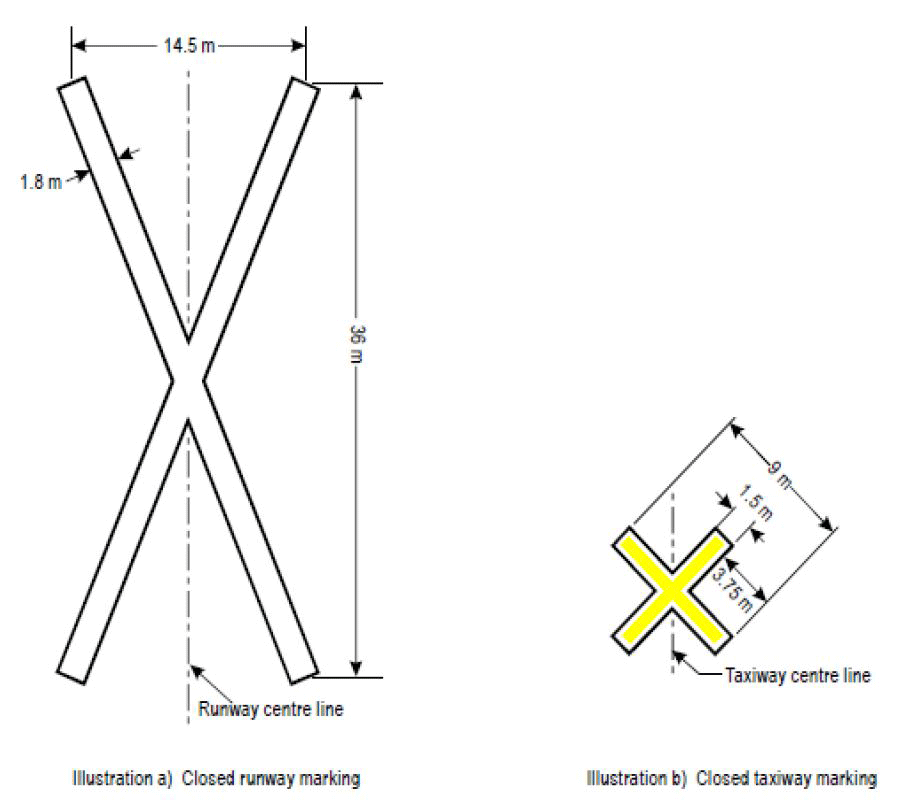
Figure R-1.
Runway and taxiway closed markings
[Issue: ADR-DSN/3]
[Issue: ADR-DSN/5]