ED Decision 2003/18/RM
(a) If compliance with CS-VLA 723(a) is shown by free drop tests, these tests must be made on the complete aeroplane, or on units consisting of wheel, tyre, and shock absorber, in their proper relation, from free drop heights not less than those determined by the following formula:

However, the free drop height may not be less than 0.235 m and need not be more than 0.475 m.
(b) If the effect of wing lift is provided for in free drop tests, the landing gear must be dropped with an effective weight equal to -
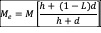
where -
Me = the effective weight to be used in the drop test (kg);
h = specified free drop height (m);
d = deflection under impact of the tyre (at the approved inflation pressure) plus the vertical component of the axle travel relative to the drop mass (m);
M = MM for main gear units (kg), equal to the static weight on that unit with the aeroplane in the level attitude (with the nose wheel clear in the case of nose wheel type aeroplanes);
M = MT for tail gear units (kg), equal to the static weight on the tail unit with the aeroplane in the tail down attitude;
M = MN for nose wheel units (kg), equal to the vertical component of the static reaction that would exist at the nose wheel, assuming that the mass of the aeroplane acts at the centre of gravity and exerts a force of 1.0 g downward and 0.33 g forward;
L = the ratio of the assumed wing lift to the aeroplane weight, but not more than 0.667; and
g = the acceleration due to gravity (m/s2).
(c) The limit inertia load factor must be determined in a rational or conservative manner, during the drop test, using a landing gear unit attitude, and applied drag loads, that represent the landing conditions.
(d) The value of d used in the computation of Me in sub-paragraph (b) of this paragraph may not exceed the value actually obtained in the drop test.
(e) The limit inertia load factor must be determined from the drop test in sub-paragraph (b) of this paragraph according to the following formula:

where -
nj = the load factor developed in the drop test (that is, the acceleration (dv/dt) in g recorded in the drop test) plus 1.0; and
Me, M and L are the same as in the drop test computation.
(f) The value of n determined in accordance with sub-paragraph (e) of this paragraph may not be more than the limit inertia load factor used in the landing conditions in CS-VLA 473.