Light
Dark
System
Log In
Loading...
Compare / EASA/
Incorporated Amendments
/
Compare & Highlight Differences
AMC VLA 619 Special factors (Acceptable Means of Compliance)
Available versions for ERULES-1963177438-7916
ED Decision 2003/18/RM
found in: CS-VLA Amdt 1 - Very Light Aeroplanes (Mar 2009)
Version
CS-VLA Amdt 1 - Ve... (Mar 2009)
Section
Share
Version
Show details
Hide details
Version
AMC VLA 619 Special factors (Acceptable Means of Compliance) ED Decision 2003/18/RM For the substantiation of composite structures, unless more rational means are agreed by the Agency, one of the following may be used: a. An additional factor of 1.2 for moisture conditioned specimen tested at maximum service temperature, providing that a well established manufacturing and quality control procedure is used. b. An additional factor of 1.5 for specimen tested with no specific allowance for moisture and temperature. NOTES: 1 For cold cured structures it may be assumed that the completed structure is fully moisture conditioned. 2 The factor in a. above may be varied based on the coefficient of variation that the manufacturer is able to show for this product. (See Table 1.) TABLE 1 <table border="0" cellpadding="0" cellspacing="0" width="607"><tr><td valign="top" width="303"><p>Coefficient of Variation % </p></td><td valign="top" width="303"><p>Test Factor </p></td></tr><tr><td valign="top" width="303"><p>5 </p></td><td valign="top" width="303"><p>1·00 </p></td></tr><tr><td valign="top" width="303"><p>6 </p></td><td valign="top" width="303"><p>1·03 </p></td></tr><tr><td valign="top" width="303"><p>7 </p></td><td valign="top" width="303"><p>1·06 </p></td></tr><tr><td valign="top" width="303"><p>8 </p></td><td valign="top" width="303"><p>1·10 </p></td></tr><tr><td valign="top" width="303"><p>9 </p></td><td valign="top" width="303"><p>1·12 </p></td></tr><tr><td valign="top" width="303"><p>10 </p></td><td valign="top" width="303"><p>1·15 </p></td></tr><tr><td valign="top" width="303"><p>12 </p></td><td valign="top" width="303"><p>1·22 </p></td></tr><tr><td valign="top" width="303"><p>14 </p></td><td valign="top" width="303"><p>1·30 </p></td></tr><tr><td valign="top" width="303"><p>15 </p></td><td valign="top" width="303"><p>1·33 </p></td></tr><tr><td valign="top" width="303"><p>20 </p></td><td valign="top" width="303"><p>1·55 </p></td></tr></table> Definition: Coefficient of Variation For a population with mean M and standard deviation s, the coefficient of variation, Cv, is defined by -  The coefficient of variation is frequently expressed as a percentage, in which case  Additional Advisory Material: When the population coefficient of variation is estimated from tests of critical structural features, the results from tests of at least 6 specimens should be used. The sample coefficient of variation should be adjusted to obtain a 95% confidence estimate of the population coefficient of variation which may be used in Table 1. In the absence of a more rational method, this may be done by multiplying the sample coefficient of variation by a Factor F, defined by - 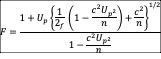 where - Up is the standardised normal variate corresponding to the confidence level being used (for 95% confidence, Up = 1·6452) n is the number of specimens in the Sample f is the number of statistical degree of freedom [=(n-1)] c is the population coefficient of variation. The value of the factor F is relatively relatively insensitive to the value of c used – in the absence of more rational data, a value of 0·2 should be used.