Light
Dark
System
Log In
Loading...
Compare / EASA/
Incorporated Amendments
/
Compare & Highlight Differences
AMC 22.423 Manoeuvring loads
Available versions for ERULES-1963177438-5272
ED Decision 2003/13/RM
found in: Sailplane Rule Book - Part-SAO Part-SFCL CS-22 (Nov 2022)
Version
Sailplane Rule Boo... (Nov 2022)
Section
Share
Version
Show details
Hide details
Version
AMC 22.423 Manoeuvring loads ED Decision 2003/13/RM Method I – The loads should be calculated for instantaneous deflection of the elevator, the following cases being considered: (a) speed VA, maximum upward deflection; (b) speed VA, maximum downward deflection; (c) speed VD, one-third maximum upward deflection; (d) speed VD, one-third maximum downward deflection. The following assumptions should be made: (1) The sailplane is initially in level flight, and its attitude and air speed do not change. (2) The loads are balanced by inertia forces. The sailplanes of Category A, initial conditions of both erect and inverted flight should be considered. Method II – The loads should be calculated for instantaneous deflection of the elevator such as to cause the normal acceleration to change from an initial value to a final value, the following cases being considered (see Figure 3). <table border="1" cellpadding="0" cellspacing="0" width="602"><thead><tr><td colspan="4" valign="top" width="602"><p><b>Category U and A:</b></p></td></tr><tr><td valign="top" width="151"><p><b>Speed </b></p></td><td valign="top" width="151"><p><b>Initial Condition </b></p></td><td valign="top" width="151"><p><b>Final Condition </b></p></td><td valign="top" width="151"><p><b>Load Factor Increment </b></p></td></tr></thead><tr><td rowspan="4" valign="top" width="151"><p><i>V<sub>A </sub></i></p></td><td valign="top" width="151"><p><i>A<sub>1 </sub></i></p></td><td valign="top" width="151"><p><i>A </i></p></td><td valign="top" width="151"><p><i>n<sub>1</sub> - 1 </i></p></td></tr><tr><td valign="top" width="151"><p><i>A </i></p></td><td valign="top" width="151"><p><i>A<sub>1</sub></i></p></td><td valign="top" width="151"><p><i>1 – n<sub>1 </sub></i></p></td></tr><tr><td valign="top" width="151"><p><i>A<sub>1</sub></i></p></td><td valign="top" width="151"><p><i>G </i></p></td><td valign="top" width="151"><p><i>n<sub>4</sub> - 1 </i></p></td></tr><tr><td valign="top" width="151"><p><i>G </i></p></td><td valign="top" width="151"><p><i>A<sub>1</sub></i></p></td><td valign="top" width="151"><p><i>1 – n<sub>4 </sub></i></p></td></tr><tr><td rowspan="4" valign="top" width="151"><p><i>V<sub>D </sub></i></p></td><td valign="top" width="151"><p><i>D<sub>1 </sub></i></p></td><td valign="top" width="151"><p><i>D </i></p></td><td valign="top" width="151"><p><i>n<sub>2</sub> - 1 </i></p></td></tr><tr><td valign="top" width="151"><p><i>D </i></p></td><td valign="top" width="151"><p><i>D<sub>1 </sub></i></p></td><td valign="top" width="151"><p><i>1 – n<sub>2 </sub></i></p></td></tr><tr><td valign="top" width="151"><p><i>D<sub>1 </sub></i></p></td><td valign="top" width="151"><p><i>E </i></p></td><td valign="top" width="151"><p><i>n<sub>3 </sub>- 1 </i></p></td></tr><tr><td valign="top" width="151"><p><i>E </i></p></td><td valign="top" width="151"><p><i>D<sub>1 </sub></i></p></td><td valign="top" width="151"><p><i>1 – n<sub>3 </sub></i></p></td></tr></table> <table border="1" cellpadding="0" cellspacing="0" width="602"><thead><tr><td colspan="4" valign="top" width="602"><p><b>Category A – Additional cases: </b></p></td></tr><tr><td valign="top" width="151"><p><b>Speed </b></p></td><td valign="top" width="151"><p><b>Initial Condition </b></p></td><td valign="top" width="151"><p><b>Final Condition </b></p></td><td valign="top" width="151"><p><b>Load Factor Increment </b></p></td></tr></thead><tr><td rowspan="4" valign="top" width="151"><p><i>V<sub>A </sub></i></p></td><td valign="top" width="151"><p><i>A <sub>-1</sub></i></p></td><td valign="top" width="151"><p><i>A </i></p></td><td valign="top" width="151"><p><i>n<sub>1 </sub>+ 1 </i></p></td></tr><tr><td valign="top" width="151"><p><i>A </i></p></td><td valign="top" width="151"><p><i>A <sub>-1</sub></i></p></td><td valign="top" width="151"><p><i>–(1 + n<sub>1</sub>) </i></p></td></tr><tr><td valign="top" width="151"><p><i>A <sub>-1</sub></i></p></td><td valign="top" width="151"><p><i>G </i></p></td><td valign="top" width="151"><p><i>n<sub>4</sub> + 1 </i></p></td></tr><tr><td valign="top" width="151"><p><i>G </i></p></td><td valign="top" width="151"><p><i>A <sub>-1</sub></i></p></td><td valign="top" width="151"><p><i>–(1 + n<sub>4</sub>) </i></p></td></tr><tr><td rowspan="4" valign="top" width="151"><p><i>V<sub>D </sub></i></p></td><td valign="top" width="151"><p><i>D <sub>-1 </sub></i></p></td><td valign="top" width="151"><p><i>D </i></p></td><td valign="top" width="151"><p><i>n<sub>2</sub> + 1 </i></p></td></tr><tr><td valign="top" width="151"><p><i>D </i></p></td><td valign="top" width="151"><p><i>D <sub>-1 </sub></i></p></td><td valign="top" width="151"><p><i>–(1 + n<sub>2</sub>) </i></p></td></tr><tr><td valign="top" width="151"><p><i>D<sub> -1</sub></i></p></td><td valign="top" width="151"><p><i>E </i></p></td><td valign="top" width="151"><p><i>n<sub>3 </sub>+ 1 </i></p></td></tr><tr><td valign="top" width="151"><p><i>E </i></p></td><td valign="top" width="151"><p><i>D <sub>-1</sub></i></p></td><td valign="top" width="151"><p><i>–(1 + n<sub>3</sub>) </i></p></td></tr></table> For the purpose of this [AMC 22.423](#_DxCrossRefBm2056272145) the difference in air speed between VA and the value corresponding to point G on the manoeuvring envelope should be ignored. The following assumptions should be made: (1) the sailplane is initially in level flight, and its altitude and air speed do not change; (2) the loads are balanced by inertia forces; (3) The aerodynamic tail load increment is given by  where: ∆*P* *=* horizontal tail load increment, positive upwards (N) ∆*n**=* load factor increment *m* *=* mass of the sailplane (kg) *g**=* acceleration due to gravity (m/s2) *xcg* = longitudinal distance of sailplane c.g. aft of aerodynamic centre of sailplane less horizontal tail (m) *St**=* horizontal tail area (m2) *ah**=* slope of horizontal tail lift curve per radian  *=* rate of change of downwash angle with angle of attack  *=* density of air at sea-level (kg/m3)  *=* tail arm (m) *S* *=* wing area (m2) *a**=* slope of wing lift curve per radian 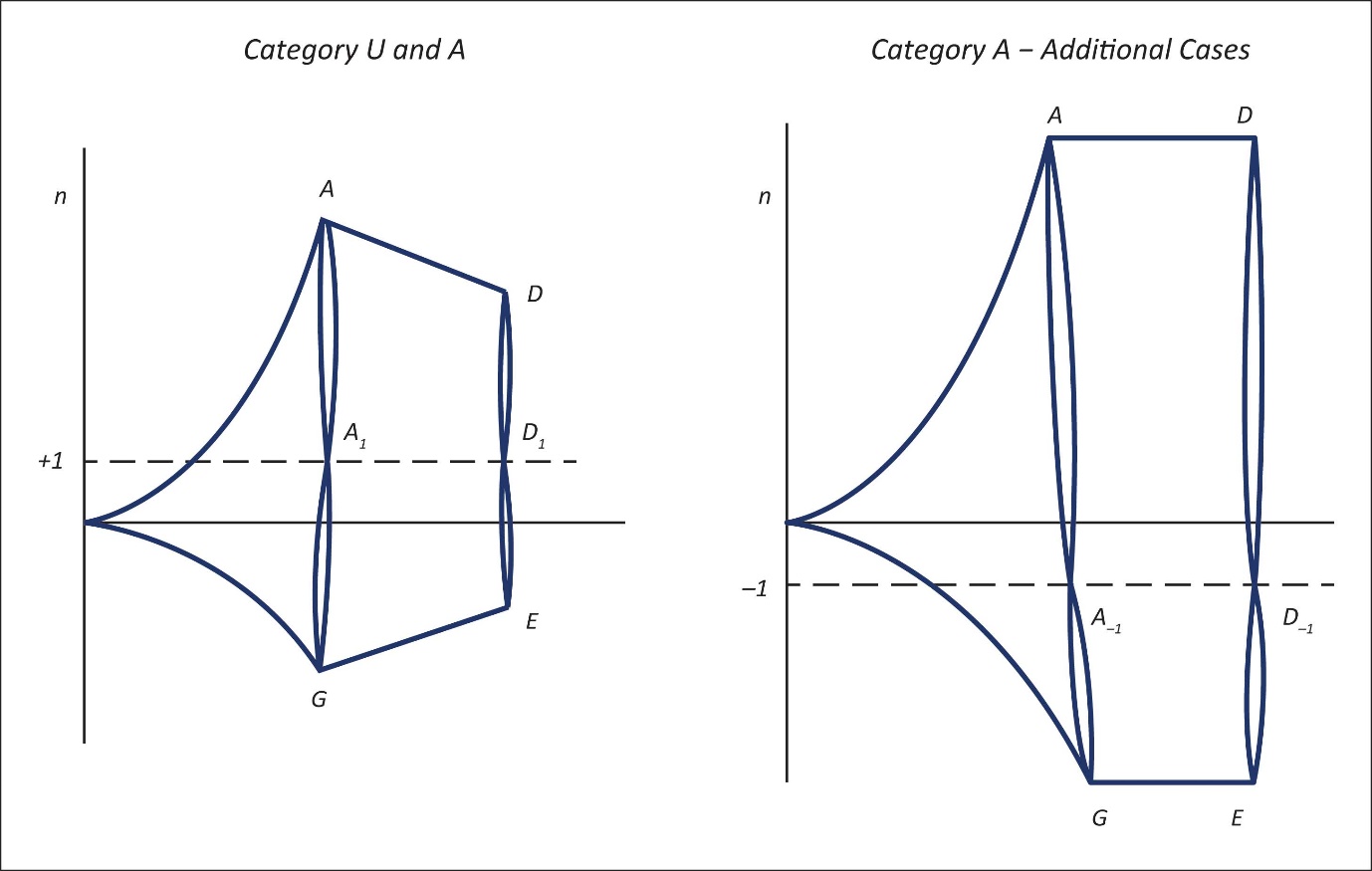 Figure 3 PITCHING MANOEUVRES