Light
Dark
System
Log In
Loading...
Compare / EASA/
Incorporated Amendments
/
Compare & Highlight Differences
GM No 3 to 21.A.15(d) OSD content
Available versions for ERULES-1963177438-3666
ED Decision 2016/007/R
found in: Initial Airworthiness and Environmental Protection (748/2012) Part-21 Part-21L (Jul 2024)
From
Initial Airworthin... (Nov 2025)
Initial Airworthin... (Jul 2024)
From section
To
Initial Airworthin... (Nov 2025)
Initial Airworthin... (Jul 2024)
To section
No visible text changes
0 removals
0 additions
View
Rich
Plain
Sync scrolling
Share
From
Show details
Hide details
To
Show details
Hide details
Version
Show side by side
GM No 3 to 21.A.15(d) OSD content ED Decision 2016/007/R The OSD will typically consist of elements that are required to be included by the TC applicant and elements that can be added at the request of the TC applicant. (See also [GM No 4 to 21.A.15(d)](#_DxCrossRefBm1649096989)). Both the required elements and the additional elements will have a part that is mandatory to be used by the operator or training organisation (status of rule) and a part which is not mandatory to the operator or training organisation (status of AMC). For illustration of this concept, Figure 1 below is included. ![Aviation.Bot AI suggestion, not from EASA source: [Image caption skipped for debugging]](/static/files/file_ocz75zUMmy4/image011.jpg) Figure 1: OSD boxes concept Box 1: required from TC holder; mandatory for end-users. Box 2: required from TC holder; not mandatory (recommendations) for end-users. Box 3: at request of TC holder; mandatory for end-users. The TC applicant may wish to apply for the approval of differences training between variants or types to reduce training, checking or currency requirements for operations of more than one type or variant. This is regarded as an optional element in addition to the required elements of Box 1 and 2. Box 4: at request of TC holder; not mandatory (recommendations) for end-users. The exact content of the four boxes in the above figure is determined by the certification specification that is applicable to the specific OSD constituent or the special condition in case of an ‘other type-related operational suitability element’. The status the data will have on the side of the operator or training organisation should be indicated in the OSD by segregating the data in a section called ‘Mandatory’ and a section called ‘Non-mandatory (recommendations)’.
##### GM No 3 to 21.A.15(d) OSD content *ED Decision 2016/007/R* The OSD will typically consist of elements that are required to be included by the TC applicant and elements that can be added at the request of the TC applicant. (See also [GM No 4 to 21.A.15(d)](#_DxCrossRefBm485230480)). Both the required elements and the additional elements will have a part that is mandatory to be used by the operator or training organisation (status of rule) and a part which is not mandatory to the operator or training organisation (status of AMC). For illustration of this concept, Figure 1 below is included. 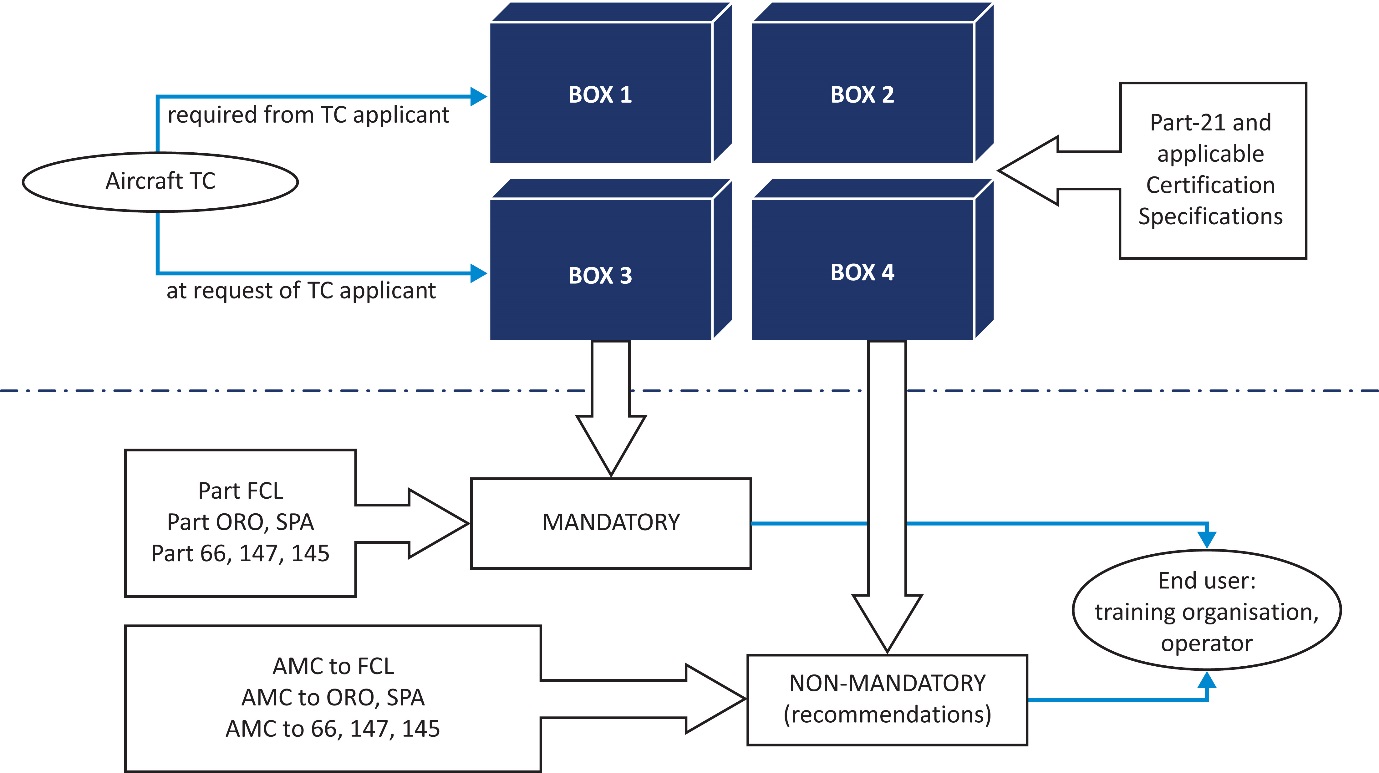 ***Figure 1: OSD boxes concept*** Box 1: required from TC holder; mandatory for end-users. Box 2: required from TC holder; not mandatory (recommendations) for end-users. Box 3: at request of TC holder; mandatory for end-users. The TC applicant may wish to apply for the approval of differences training between variants or types to reduce training, checking or currency requirements for operations of more than one type or variant. This is regarded as an optional element in addition to the required elements of Box 1 and 2. Box 4: at request of TC holder; not mandatory (recommendations) for end-users. The exact content of the four boxes in the above figure is determined by the certification specification that is applicable to the specific OSD constituent or the special condition in case of an ‘other type-related operational suitability element’. The status the data will have on the side of the operator or training organisation should be indicated in the OSD by segregating the data in a section called ‘Mandatory’ and a section called ‘Non-mandatory (recommendations)’.