Light
Dark
System
Log In
Loading...
Compare / EASA/
Incorporated Amendments
/
Compare & Highlight Differences
GM1 ADR-DSN.L.605 Mandatory instruction marking
Available versions for ERULES-1963177438-2470
ED Decision 2017/021/R
found in: Aerodromes (139/2014) Part-ADR.AR Part-ADR.OR Part-ADR.OPS CS-ADR-DSN CS-HPT-DSN (Jun 2023)
From
Easy Access Rules ... (Mar 2026)
Aerodromes (139/20... (Dec 2024)
Aerodromes (139/20... (Jun 2023)
From section
To
Easy Access Rules ... (Mar 2026)
Aerodromes (139/20... (Dec 2024)
Aerodromes (139/20... (Jun 2023)
To section
No visible text changes
0 removals
0 additions
View
Rich
Plain
Sync scrolling
Share
From
Show details
Hide details
To
Show details
Hide details
Version
Show side by side
GM1 ADR-DSN.L.605 Mandatory instruction marking ED Decision 2017/021/R (a) Except where operationally required, a mandatory instruction marking should not be located on a runway. (b) The mandatory instruction markings and information markings on pavements are formed as if shadowed (i.e. stretched) from the characters of an equivalent elevated sign by a factor of 2.5, as illustrated in Figure GM-L-3. The shadowing only affects the vertical dimension. 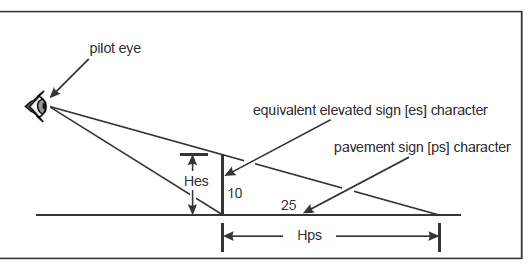 Figure GM-L-3. Illustration of pavement marking spacing calculation (c) The following example illustrates how the pavement marking spacing is to be calculated: (1) in the case of runway designator ‘10’, which is to have a height of 4 000 mm (Hps), the equivalent elevated sign character height is 4 000/2.5 = 1 600 mm (Hes); (2) Table N-3(b) indicates numeral to numeral code 1 and from Table N-3(c) this code has a dimension of 96 mm, for a character height of 400 mm; (3) the pavement marking spacing for ‘10’ is then (1 600/400) x 96 = 384 mm. [Issue: ADR-DSN/4]
GM1 ADR-DSN.L.605 Mandatory instruction marking ED Decision 2017/021/R (a) Except where operationally required, a mandatory instruction marking should not be located on a runway. (b) The mandatory instruction markings and information markings on pavements are formed as if shadowed (i.e. stretched) from the characters of an equivalent elevated sign by a factor of 2.5, as illustrated in Figure GM-L-3. The shadowing only affects the vertical dimension. 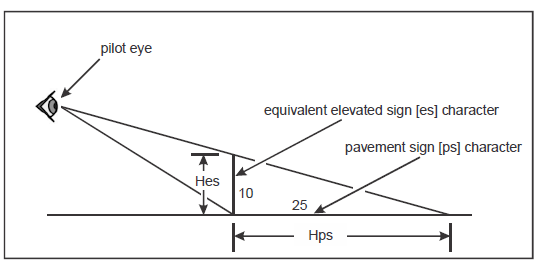 Figure GM-L-3. Illustration of pavement marking spacing calculation (c) The following example illustrates how the pavement marking spacing is to be calculated: (1) in the case of runway designator ‘10’, which is to have a height of 4 000 mm (Hps), the equivalent elevated sign character height is 4 000/2.5 = 1 600 mm (Hes); (2) Table N-3(b) indicates numeral to numeral code 1 and from Table N-3(c) this code has a dimension of 96 mm, for a character height of 400 mm; (3) the pavement marking spacing for ‘10’ is then (1 600/400) x 96 = 384 mm. [Issue: ADR-DSN/4]
##### GM1 ADR-DSN.L.605 Mandatory instruction marking *ED Decision 2017/021/R* (a) Except where operationally required, a mandatory instruction marking should not be located on a runway. (b) The mandatory instruction markings and information markings on pavements are formed as if shadowed (i.e. stretched) from the characters of an equivalent elevated sign by a factor of 2.5, as illustrated in Figure GM-L-3. The shadowing only affects the vertical dimension. 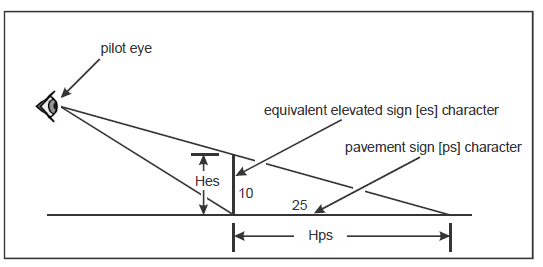 ***Figure GM-L-3. Illustration of pavement marking spacing calculation*** (c) The following example illustrates how the pavement marking spacing is to be calculated: (1) in the case of runway designator ‘10’, which is to have a height of 4 000 mm (Hps), the equivalent elevated sign character height is 4 000/2.5 = 1 600 mm (Hes); (2) Table N-3(b) indicates numeral to numeral code 1 and from Table N-3(c) this code has a dimension of 96 mm, for a character height of 400 mm; (3) the pavement marking spacing for ‘10’ is then (1 600/400) x 96 = 384 mm. [Issue: ADR-DSN/4]