Light
Dark
System
Log In
Loading...
Compare / EASA/
Incorporated Amendments
/
Compare & Highlight Differences
CS ADR-DSN.N.780 Mandatory instruction signs
Available versions for ERULES-1963177438-2304
ED Decision 2022/006/R
found in: Aerodromes (139/2014) Part-ADR.AR Part-ADR.OR Part-ADR.OPS CS-ADR-DSN CS-HPT-DSN (Dec 2024)
From
Easy Access Rules ... (Mar 2026)
Aerodromes (139/20... (Dec 2024)
Aerodromes (139/20... (Jun 2023)
From section
To
Easy Access Rules ... (Mar 2026)
Aerodromes (139/20... (Dec 2024)
Aerodromes (139/20... (Jun 2023)
To section
No visible text changes
0 removals
0 additions
View
Rich
Plain
Sync scrolling
Share
From
Show details
Hide details
To
Show details
Hide details
Version
Show side by side
CS ADR-DSN.N.780 Mandatory instruction signs ED Decision 2022/006/R (a) Applicability: (1) A mandatory instruction sign should be provided to identify a location beyond which an aircraft taxiing or vehicle should not proceed unless authorised by the aerodrome control tower. (2) Mandatory instruction signs should include runway designation signs, Category I, II, or III holding position signs, runway-holding position signs, road-holding position signs, and no‑entry signs. (3) A pattern ‘A’ runway-holding position marking should be supplemented at a taxiway/runway intersection or a runway/runway intersection with a runway designation sign. (4) A pattern ‘B’ runway-holding position marking should be supplemented with a Category I, II, or III holding position sign. (5) A pattern ‘A’ runway-holding position marking at a runway-holding position should be supplemented with a runway-holding position sign. (6) A runway designation sign at a taxiway/runway intersection should be supplemented with a location sign in the outboard (farthest from the taxiway) position as appropriate. (7) A road-holding position sign should be provided at all road entrances to a runway and may also be provided at road entrances to taxiways. (8) A no-entry sign should be provided when entry into an area is prohibited. (b) Location: (1) A runway designation sign at a taxiway/runway intersection or a runway/runway intersection should be located on each side of the runway-holding position marking facing the direction of approach to the runway. (2) A Category I, II, or III holding position sign should be located on each side of the runway-holding position marking facing the direction of the approach to the critical area. (3) A no-entry sign should be located at the beginning of the area to which entrance is prohibited on each side of the taxiway as viewed by the pilot. (4) A runway-holding position sign should be located on each side of the runway-holding position facing the approach to the obstacle limitation surface or ILS/MLS critical/sensitive area as appropriate. (c) Characteristics: (1) A mandatory instruction sign should consist of an inscription in white on a red background. Where, owing to environmental or other factors, the conspicuity of the inscription on a mandatory instruction sign needs to be enhanced, the outside edge of the white inscription should be supplemented by a black outline measuring 10 mm in width for runway code numbers 1 and 2, and 20 mm in width for runway code numbers 3 and 4. (2) The inscription on a runway designation sign should consist of the runway designations of the intersecting runway properly oriented with respect to the viewing position of the sign, except that a runway designation sign installed in the vicinity of a runway extremity may show the runway designation of the concerned runway extremity only. (3) The inscription on a Category I, II, III, joint II/III or joint I/II/III holding position sign should consist of the runway designator followed by CAT I, CAT II, CAT III, CAT II/III or CAT I/II/III, as appropriate. (4) The inscription on a no-entry sign should be in accordance with Figure N-4. (5) The inscription on a runway-holding position sign at a runway-holding position should consist of the taxiway designation and a number. (d) Where installed, the inscriptions/symbol of Figure N-4 should be used: 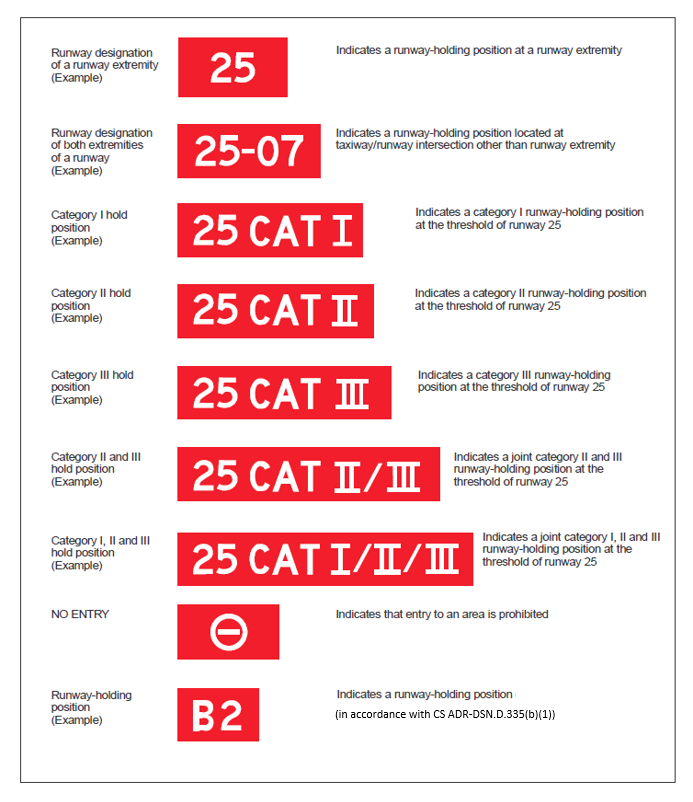 Figure N-4. Mandatory instruction signs 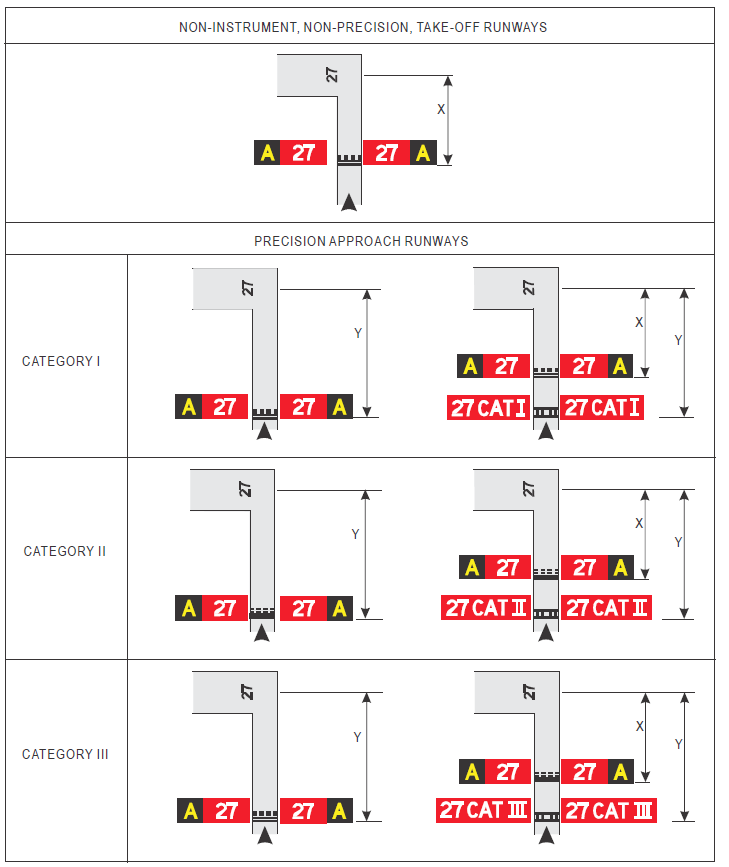 Note: Distance X is established in accordance with Table D-2. Distance Y is established at the edge of ILS/MLS critical/sensitive area Figure N-5. Positions of signs at taxiway/runway intersections [Issue: ADR-DSN/3] [Issue: ADR-DSN/4] [Issue: ADR-DSN/6]
CS ADR-DSN.N.780 Mandatory instruction signs ED Decision 2022/006/R (a) Applicability: (1) A mandatory instruction sign should be provided to identify a location beyond which an aircraft taxiing or vehicle should not proceed unless authorised by the aerodrome control tower. (2) Mandatory instruction signs should include runway designation signs, Category I, II, or III holding position signs, runway-holding position signs, road-holding position signs, and no‑entry signs. (3) A pattern ‘A’ runway-holding position marking should be supplemented at a taxiway/runway intersection or a runway/runway intersection with a runway designation sign. (4) A pattern ‘B’ runway-holding position marking should be supplemented with a Category I, II, or III holding position sign. (5) A pattern ‘A’ runway-holding position marking at a runway-holding position should be supplemented with a runway-holding position sign. (6) A runway designation sign at a taxiway/runway intersection should be supplemented with a location sign in the outboard (farthest from the taxiway) position as appropriate. (7) A road-holding position sign should be provided at all road entrances to a runway and may also be provided at road entrances to taxiways. (8) A no-entry sign should be provided when entry into an area is prohibited. (b) Location: (1) A runway designation sign at a taxiway/runway intersection or a runway/runway intersection should be located on each side of the runway-holding position marking facing the direction of approach to the runway. (2) A Category I, II, or III holding position sign should be located on each side of the runway-holding position marking facing the direction of the approach to the critical area. (3) A no-entry sign should be located at the beginning of the area to which entrance is prohibited on each side of the taxiway as viewed by the pilot. (4) A runway-holding position sign should be located on each side of the runway-holding position facing the approach to the obstacle limitation surface or ILS/MLS critical/sensitive area as appropriate. (c) Characteristics: (1) A mandatory instruction sign should consist of an inscription in white on a red background. Where, owing to environmental or other factors, the conspicuity of the inscription on a mandatory instruction sign needs to be enhanced, the outside edge of the white inscription should be supplemented by a black outline measuring 10 mm in width for runway code numbers 1 and 2, and 20 mm in width for runway code numbers 3 and 4. (2) The inscription on a runway designation sign should consist of the runway designations of the intersecting runway properly oriented with respect to the viewing position of the sign, except that a runway designation sign installed in the vicinity of a runway extremity may show the runway designation of the concerned runway extremity only. (3) The inscription on a Category I, II, III, joint II/III or joint I/II/III holding position sign should consist of the runway designator followed by CAT I, CAT II, CAT III, CAT II/III or CAT I/II/III, as appropriate. (4) The inscription on a no-entry sign should be in accordance with Figure N-4. (5) The inscription on a runway-holding position sign at a runway-holding position should consist of the taxiway designation and a number. (d) Where installed, the inscriptions/symbol of Figure N-4 should be used: 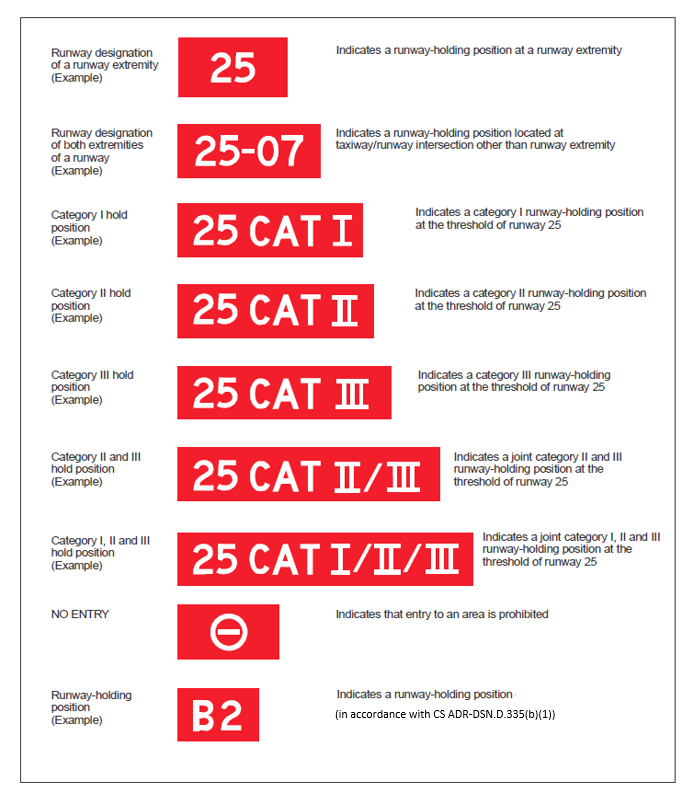 Figure N-4. Mandatory instruction signs 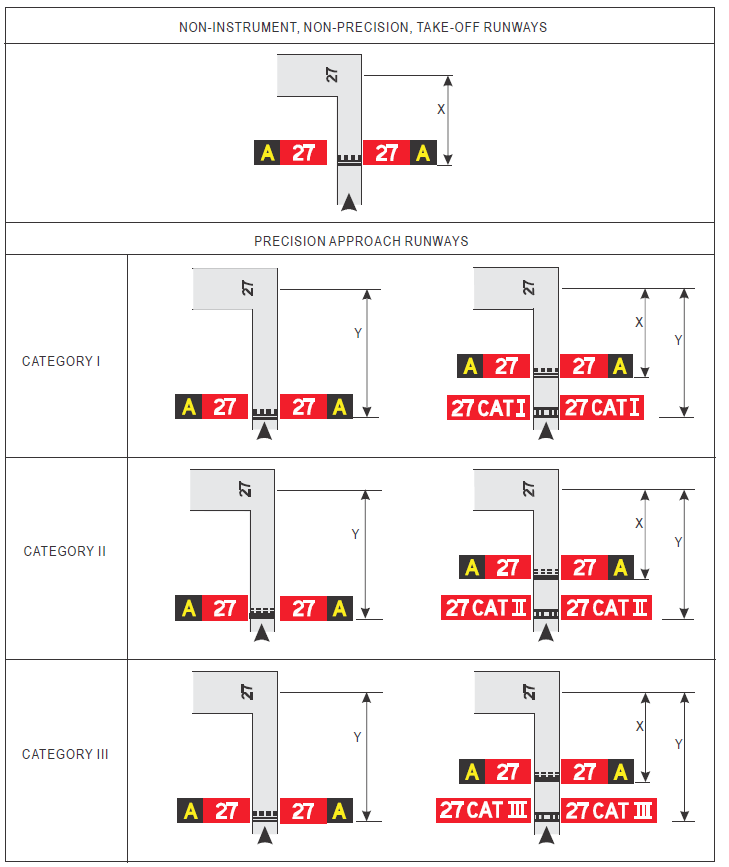 Note: Distance X is established in accordance with Table D-2. Distance Y is established at the edge of ILS/MLS critical/sensitive area Figure N-5. Positions of signs at taxiway/runway intersections [Issue: ADR-DSN/3] [Issue: ADR-DSN/4] [Issue: ADR-DSN/6]
#### CS ADR-DSN.N.780 Mandatory instruction signs *ED Decision 2022/006/R* (a) Applicability: (1) A mandatory instruction sign should be provided to identify a location beyond which an aircraft taxiing or vehicle should not proceed unless authorised by the aerodrome control tower. (2) Mandatory instruction signs should include runway designation signs, Category I, II, or III holding position signs, runway-holding position signs, road-holding position signs, and no‑entry signs. (3) A pattern ‘A’ runway-holding position marking should be supplemented at a taxiway/runway intersection or a runway/runway intersection with a runway designation sign. (4) A pattern ‘B’ runway-holding position marking should be supplemented with a Category I, II, or III holding position sign. (5) A pattern ‘A’ runway-holding position marking at a runway-holding position should be supplemented with a runway-holding position sign. (6) A runway designation sign at a taxiway/runway intersection should be supplemented with a location sign in the outboard (farthest from the taxiway) position as appropriate. (7) A road-holding position sign should be provided at all road entrances to a runway and may also be provided at road entrances to taxiways. (8) A no-entry sign should be provided when entry into an area is prohibited. (b) Location: (1) A runway designation sign at a taxiway/runway intersection or a runway/runway intersection should be located on each side of the runway-holding position marking facing the direction of approach to the runway. (2) A Category I, II, or III holding position sign should be located on each side of the runway-holding position marking facing the direction of the approach to the critical area. (3) A no-entry sign should be located at the beginning of the area to which entrance is prohibited on each side of the taxiway as viewed by the pilot. (4) A runway-holding position sign should be located on each side of the runway-holding position facing the approach to the obstacle limitation surface or ILS/MLS critical/sensitive area as appropriate. (c) Characteristics: (1) A mandatory instruction sign should consist of an inscription in white on a red background. Where, owing to environmental or other factors, the conspicuity of the inscription on a mandatory instruction sign needs to be enhanced, the outside edge of the white inscription should be supplemented by a black outline measuring 10 mm in width for runway code numbers 1 and 2, and 20 mm in width for runway code numbers 3 and 4. (2) The inscription on a runway designation sign should consist of the runway designations of the intersecting runway properly oriented with respect to the viewing position of the sign, except that a runway designation sign installed in the vicinity of a runway extremity may show the runway designation of the concerned runway extremity only. (3) The inscription on a Category I, II, III, joint II/III or joint I/II/III holding position sign should consist of the runway designator followed by CAT I, CAT II, CAT III, CAT II/III or CAT I/II/III, as appropriate. (4) The inscription on a no-entry sign should be in accordance with Figure N-4. (5) The inscription on a runway-holding position sign at a runway-holding position should consist of the taxiway designation and a number. (d) Where installed, the inscriptions/symbol of Figure N-4 should be used: 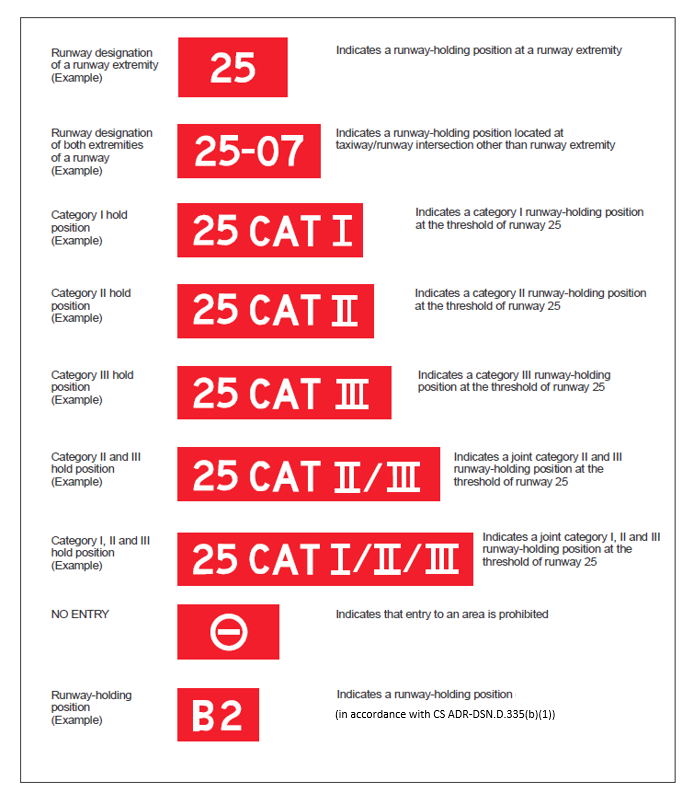 ***Figure N-4. Mandatory instruction signs*** 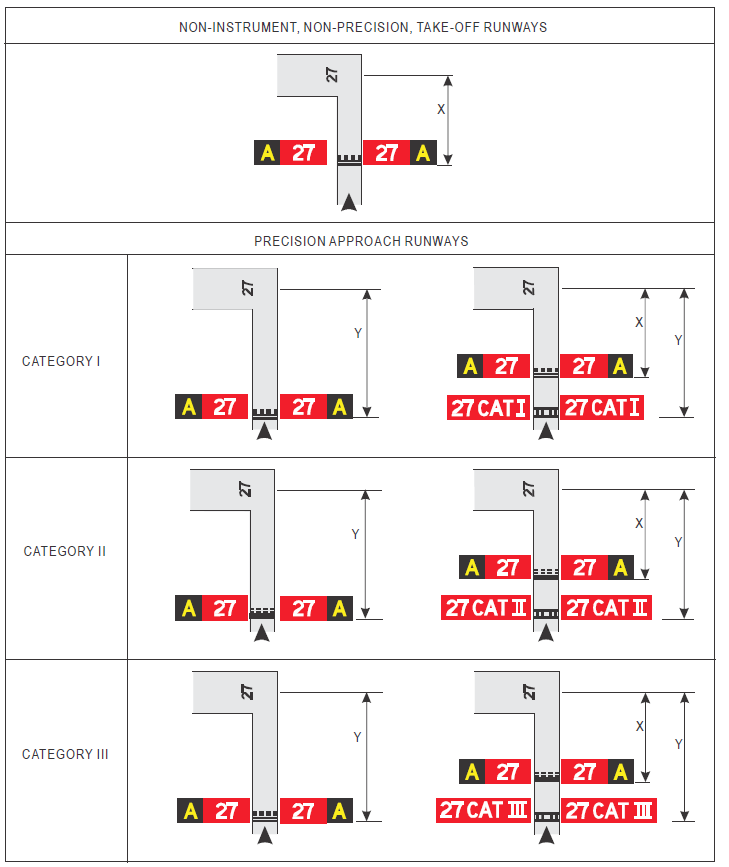 Note: Distance X is established in accordance with Table D-2. Distance Y is established at the edge of ILS/MLS critical/sensitive area ***Figure N-5. Positions of signs at taxiway/runway intersections*** [Issue: ADR-DSN/3] [Issue: ADR-DSN/4] [Issue: ADR-DSN/6]