Light
Dark
System
Log In
Loading...
Compare / EASA/
Incorporated Amendments
/
Compare & Highlight Differences
CS ADR-DSN.D.295 Rapid exit taxiways
Available versions for ERULES-1963177438-2201
ED Decision 2014/013/R
found in: Aerodromes (139/2014) Part-ADR.AR Part-ADR.OR Part-ADR.OPS CS-ADR-DSN CS-HPT-DSN (Jun 2023)
From
Easy Access Rules ... (Mar 2026)
Aerodromes (139/20... (Dec 2024)
Aerodromes (139/20... (Jun 2023)
From section
To
Easy Access Rules ... (Mar 2026)
Aerodromes (139/20... (Dec 2024)
Aerodromes (139/20... (Jun 2023)
To section
No visible text changes
0 removals
0 additions
View
Rich
Plain
Sync scrolling
Share
From
Show details
Hide details
To
Show details
Hide details
Version
Show side by side
CS ADR-DSN.D.295 Rapid exit taxiways ED Decision 2014/013/R (a) The safety objective of rapid exit taxiway is to facilitate safe rapid exit of aeroplanes from a runway. (b) A rapid exit taxiway should be designed with a radius of turn-off curve of at least: (1) 550 m where the code number is 3 or 4; and (2) 275 m where the code number is 1 or 2; to enable under wet conditions exit speeds of: (i) 93 km/h where the code number is 3 or 4; and (ii) 65 km/h where the code number is 1 or 2. (c) The radius of the fillet on the inside of the curve at a rapid exit taxiway should be sufficient to provide a widened taxiway throat in order to facilitate early recognition of the entrance and turn-off onto the taxiway. (d) A rapid exit taxiway should include a straight distance after the turn-off curve sufficient for an exiting aircraft to come to a full stop clear of any intersecting taxiway (Figure D-1). (e) The intersection angle of a rapid exit taxiway with the runway should not be greater than 45°, nor less than 25° and preferably should be 30°. 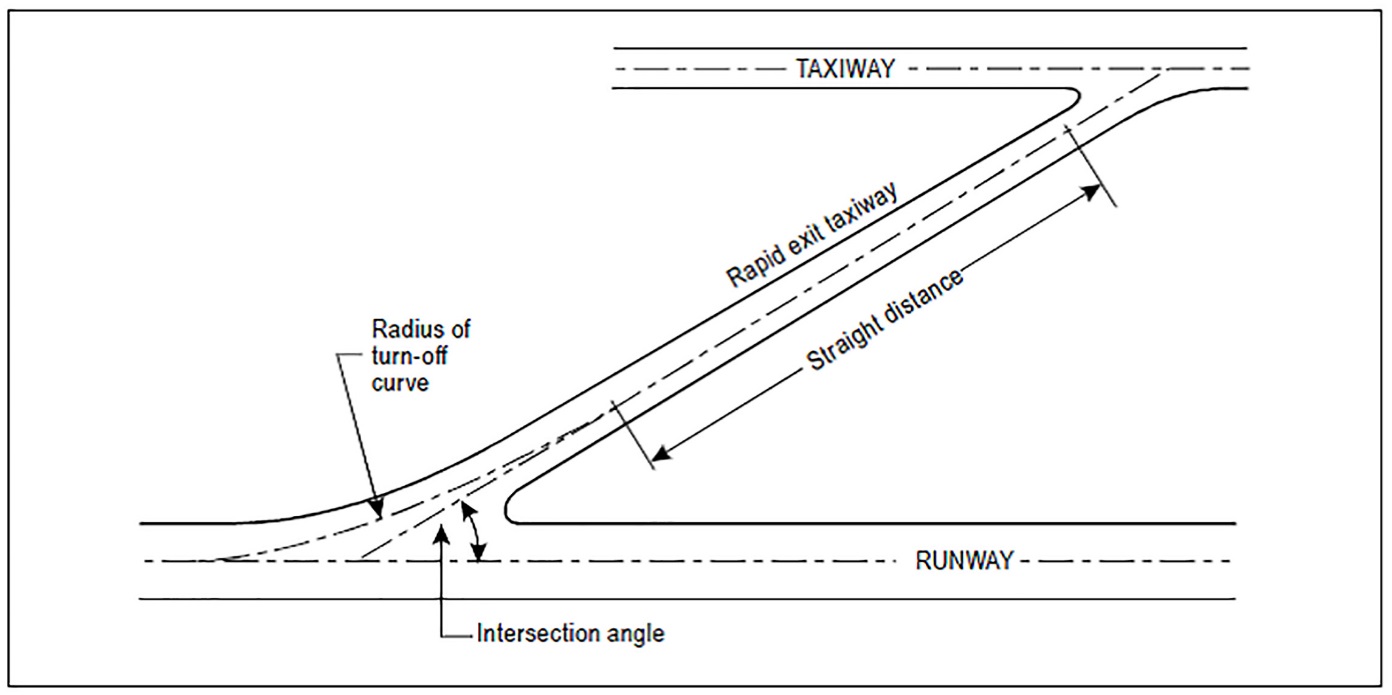 Figure D-1. Rapid exit taxiway
CS ADR-DSN.D.295 Rapid exit taxiways ED Decision 2014/013/R (a) The safety objective of rapid exit taxiway is to facilitate safe rapid exit of aeroplanes from a runway. (b) A rapid exit taxiway should be designed with a radius of turn-off curve of at least: (1) 550 m where the code number is 3 or 4; and (2) 275 m where the code number is 1 or 2; to enable under wet conditions exit speeds of: (i) 93 km/h where the code number is 3 or 4; and (ii) 65 km/h where the code number is 1 or 2. (c) The radius of the fillet on the inside of the curve at a rapid exit taxiway should be sufficient to provide a widened taxiway throat in order to facilitate early recognition of the entrance and turn-off onto the taxiway. (d) A rapid exit taxiway should include a straight distance after the turn-off curve sufficient for an exiting aircraft to come to a full stop clear of any intersecting taxiway (Figure D-1). (e) The intersection angle of a rapid exit taxiway with the runway should not be greater than 45°, nor less than 25° and preferably should be 30°. 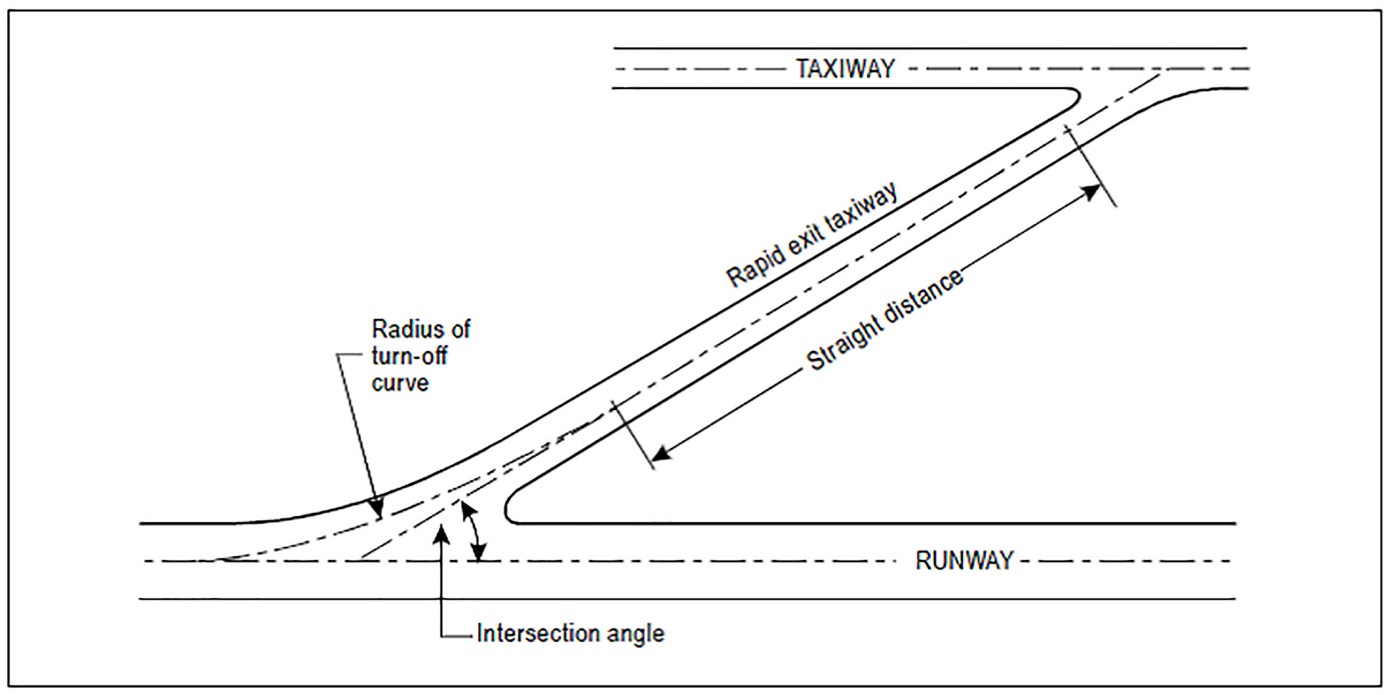 Figure D-1. Rapid exit taxiway
#### CS ADR-DSN.D.295 Rapid exit taxiways *ED Decision 2014/013/R* (a) The safety objective of rapid exit taxiway is to facilitate safe rapid exit of aeroplanes from a runway. (b) A rapid exit taxiway should be designed with a radius of turn-off curve of at least: (1) 550 m where the code number is 3 or 4; and (2) 275 m where the code number is 1 or 2; to enable under wet conditions exit speeds of: (i) 93 km/h where the code number is 3 or 4; and (ii) 65 km/h where the code number is 1 or 2. (c) The radius of the fillet on the inside of the curve at a rapid exit taxiway should be sufficient to provide a widened taxiway throat in order to facilitate early recognition of the entrance and turn-off onto the taxiway. (d) A rapid exit taxiway should include a straight distance after the turn-off curve sufficient for an exiting aircraft to come to a full stop clear of any intersecting taxiway (Figure D-1). (e) The intersection angle of a rapid exit taxiway with the runway should not be greater than 45°, nor less than 25° and preferably should be 30°. 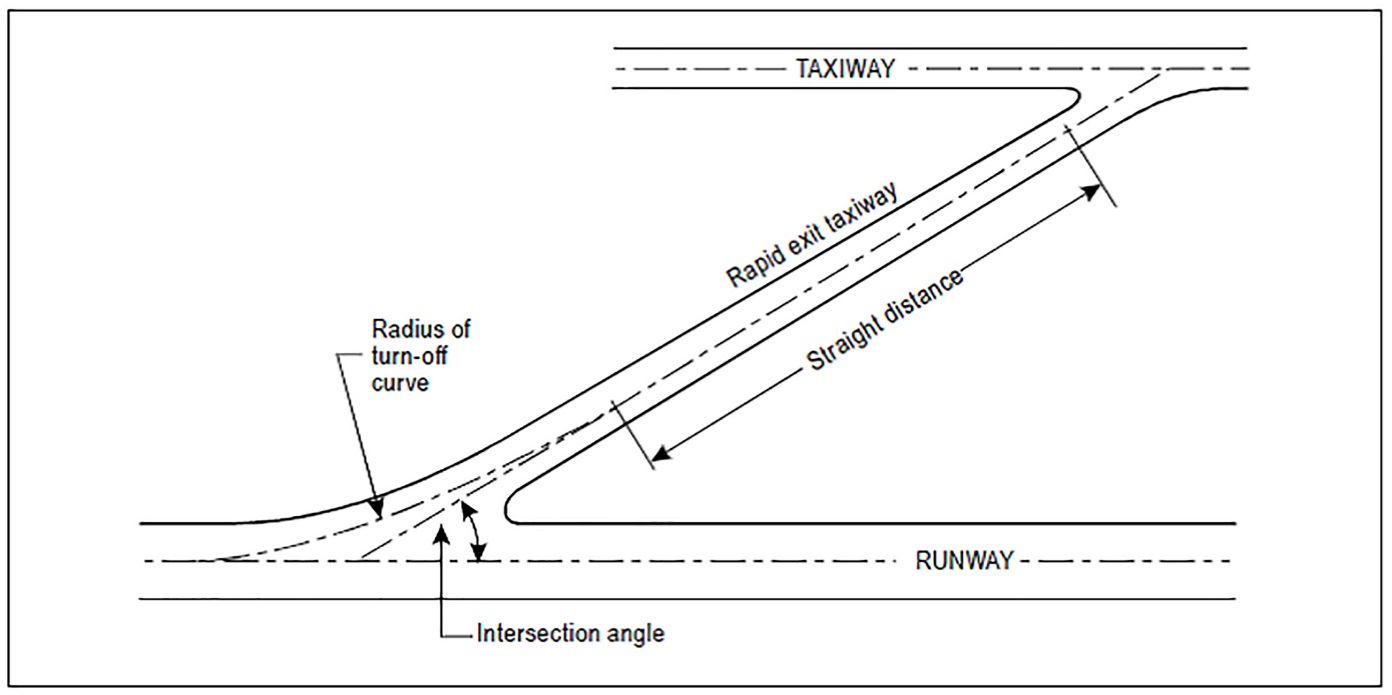 ***Figure D-1. Rapid exit taxiway***