Light
Dark
System
Log In
Loading...
Compare / EASA/
Incorporated Amendments
/
Compare & Highlight Differences
GM1 IS.D.OR.220(b)&(c) Information security incidents -- detection, response and recovery
Available versions for ERULES-1963177438-21607
ED Decision 2023/009/R
found in: Information Security (2023/203 and 2022/1645) Part-IS (Jun 2024)
From
Information Securi... (Dec 2025)
Information Securi... (Jun 2024)
From section
To
Information Securi... (Dec 2025)
Information Securi... (Jun 2024)
To section
No visible text changes
0 removals
0 additions
View
Rich
Plain
Sync scrolling
Share
From
Show details
Hide details
To
Show details
Hide details
Version
Show side by side
GM1 IS.D.OR.220(b)&(c) Information security incidents — detection, response and recovery ED Decision 2023/009/R RECOVERY OBJECTIVES AND TIMING Point [IS.D.OR.220](#_DxCrossRefBm1193569692)(b) addresses event conditions which may develop or have developed into information security incidents, that may have a potential impact on aviation safety, and require response and recovery measures to be in place to ensure that operational safety remains above a minimum acceptable level.. The level of operations and safety may be interrelated, so in some cases when the level of operations is compromised by an information security incident and drops, the level of safety does the same. This is, for instance, the case of air traffic control; if air traffic services are reduced or become unreliable, the safety of flights is reduced too. However, in other cases the relation between the level of operations and safety may be the inverse, or they may be decoupled, so when an incident occurs and the level of operations drops, the level of safety is preserved. One example is the compromise of the software loading process on board the aircraft. In this case, a detected incident followed by the decision to interrupt the software loading operations would preserve the existing level of safety. The following Figure 1 depicts a conceptual framework that may be considered for the definition of the response and recovery objectives, including the recovery time. It represents, in the worst-case scenario, how the expected level of operational safety (safety level) for a process or an activity may vary over time when an information security incident occurs. In this scenario, the safety level is first reduced by the incident and then it degrades as long as the time passes. The figure also shows the expected effect that mitigating measuress and controls should have, respectively: in containing the operational safety drop as soon as an incident occurs, and in improving the recovery, i.e. the return to the expected safety level. ![Aviation.Bot AI suggestion, not from EASA source: [Image caption skipped for debugging]](/static/files/file_Jipzy9KNdRc/image027.png) Figure 1: Conceptual framework for the definition of the response and recovery objectives As mentioned, there might be different relations between the level of operations and safety that would lead to a different representation of the above figure. In certain cases, an incident may have a delayed effect on the safety level (e.g. a compromised development environment) as depicted in Figure 2, or it may have no impact if properly controlled, as in the case of the compromised software loading process mentioned before, which is depicted in Figure 3. ![Aviation.Bot AI suggestion, not from EASA source: [Image caption skipped for debugging]](/static/files/file_Jipzy9KNdRc/image028.png) Moreover, it should be noticed that there might be different ways the same incident can be dealt with, since there are several factors that may affect safety. In practical terms, the objectives for recovery time referred to in [AMC1 IS.D.OR.220(c)](#_DxCrossRefBm1193569742) may be expressed as a list of resources and services to be restored by order of priority, within the scope of the recovery. Guidance about objectives for recovery time can be found in EUROCAE ED-206, Chapter 7.3.5.
##### GM1 IS.D.OR.220(b)&(c) Information security incidents — detection, response and recovery *ED Decision 2023/009/R* **RECOVERY OBJECTIVES AND TIMING** Point [IS.D.OR.220](#_DxCrossRefBm1749084435)(b) addresses event conditions which may develop or have developed into information security incidents, that may have a potential impact on aviation safety, and require response and recovery measures to be in place to ensure that operational safety remains above a minimum acceptable level. The level of operations and safety may be interrelated, so in some cases when the level of operations is compromised by an information security incident and drops, the level of safety does the same. This is, for instance, the case of air traffic control; if air traffic services are reduced or become unreliable, the safety of flights is reduced too. However, in other cases the relation between the level of operations and safety may be the inverse, or they may be decoupled, so when an incident occurs and the level of operations drops, the level of safety is preserved. One example is the compromise of the software loading process on board the aircraft. In this case, a detected incident followed by the decision to interrupt the software loading operations would preserve the existing level of safety. T he following Figure 1 depicts a conceptual framework that may be considered for the definition of the response and recovery objectives, including the recovery time. It represents, in the worst-case scenario, how the expected level of operational safety (safety level) for a process or an activity may vary over time when an information security incident occurs. In this scenario, the safety level is first reduced by the incident and then it degrades as long as the time passes. The figure also shows the expected effect that mitigating measuress and controls should have, respectively: in containing the operational safety drop as soon as an incident occurs, and in improving the recovery, i.e. the return to the expected safety level. 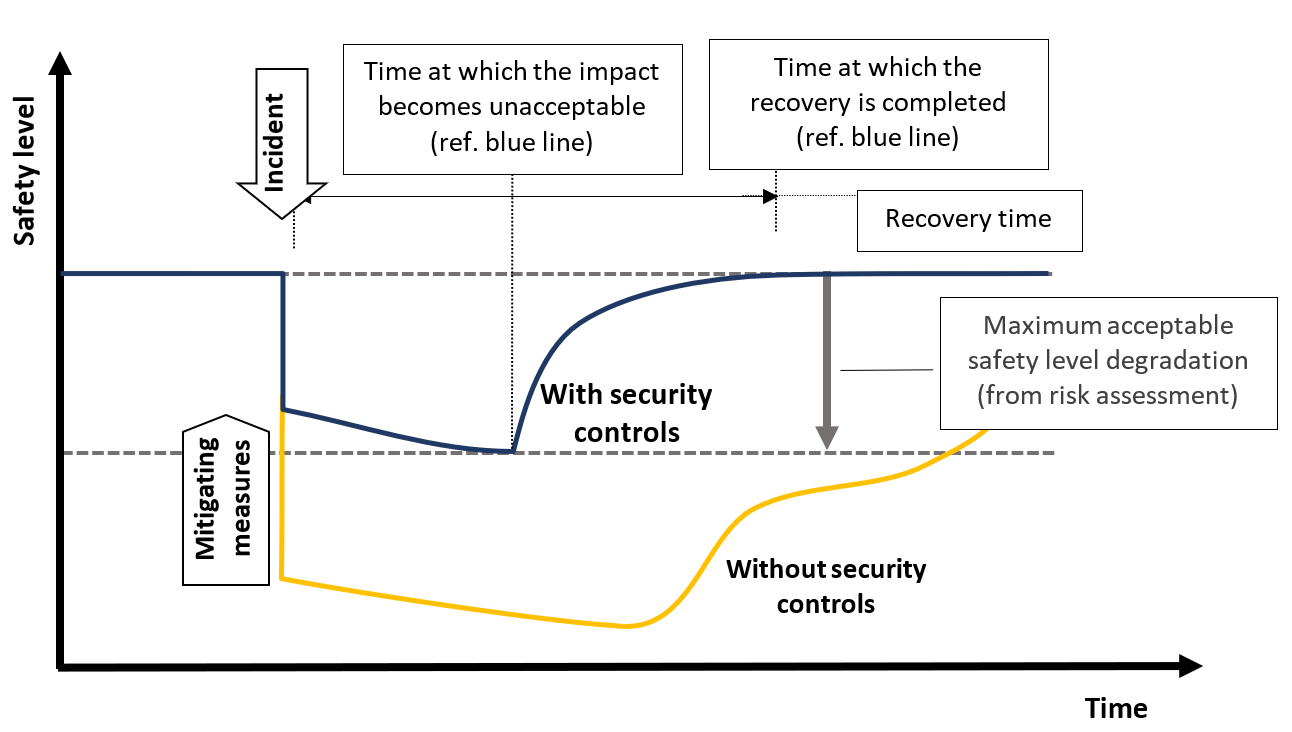 ***Figure 1: Conceptual framework for the definition of the response and recovery objectives*** As mentioned, there might be different relations between the level of operations and safety that would lead to a different representation of the above figure. In certain cases, an incident may have a delayed effect on the safety level (e.g. a compromised development environment) as depicted in Figure 2, or it may have no impact if properly controlled, as in the case of the compromised software loading process mentioned before, which is depicted in Figure 3. 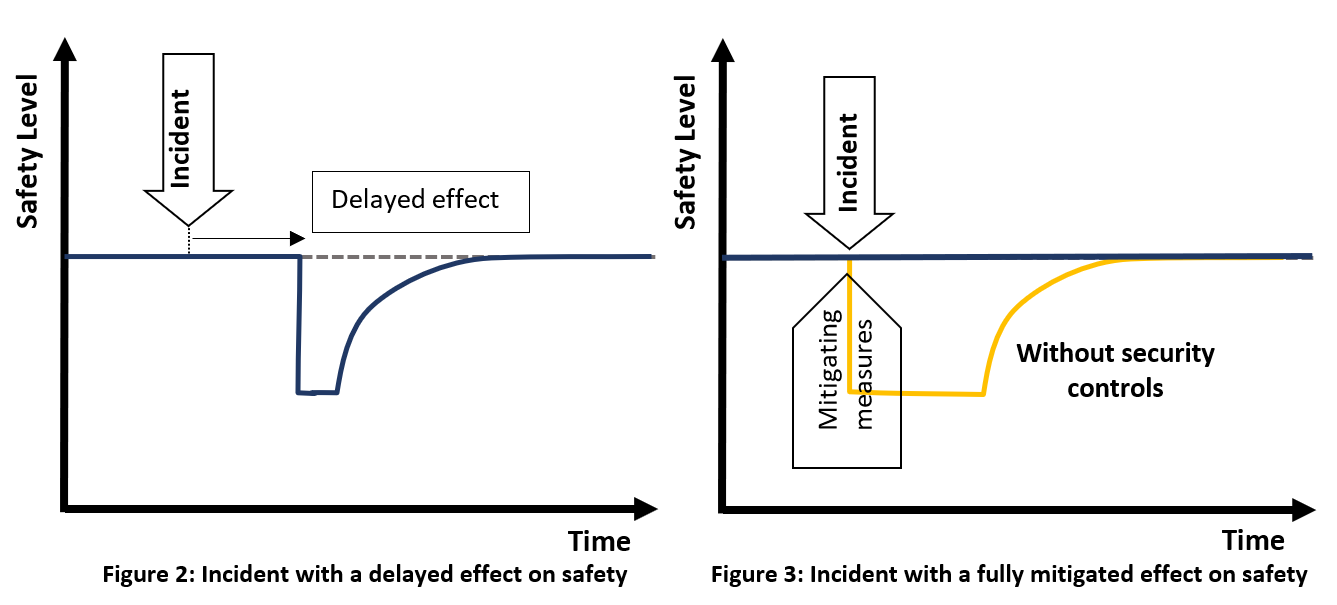 Moreover, it should be noticed that there might be different ways the same incident can be dealt with, since there are several factors that may affect safety. In practical terms, the objectives for recovery time referred to in [AMC1 IS.D.OR.220(c)](#_DxCrossRefBm1749084487) may be expressed as a list of resources and services to be restored by order of priority, within the scope of the recovery. Guidance about objectives for recovery time can be found in EUROCAE ED-206, Chapter 7.3.5.