Light
Dark
System
Log In
Loading...
Compare / EASA/
Incorporated Amendments
/
Compare & Highlight Differences
GM4 Article 18(f) Tasks of the competent authorities
Available versions for ERULES-1963177438-21579
ED Decision 2022/022/R
found in: U-space (2021/664) (May 2024)
Version
U-space (2021/664)... (May 2024)
Section
Share
Version
Show details
Hide details
Version
GM4 Article 18(f) Tasks of the competent authorities ED Decision 2022/022/R COORDINATION MECHANISM — PLANNING, EXECUTION AND REVIEW PHASE **1. The *planning* phase** The *planning* phase follows a screened trigger, or impulse, to create a U-space (see [GM1 to Article 3](#_DxCrossRefBm1226739987) for potential triggers) that subsequently engages the coordination mechanism. The engagement of the coordination mechanism should include as a first task the nomination, or confirmation, of U-space coordinators at national, regional and local level, as applicable. This phase starts either due to a submitted U-space designation request (submitted, for example, by USSPs or UAS operators), or due to the need to develop a U-space designation recommendation. In both cases, the competent authority engages the coordination mechanism to deliver a final recommendation to the Member State that makes the final decision on the U-space deployment. In case of approval (‘green’ light), the U-space is formally designated. (a) Competent authority: The designated competent authority establishes a coordination mechanism, including the nomination of a U-space coordinator. (b) U-space coordinator and the hearing process: The U-space coordinator should be introduced to take the lead in managing the hearing process and, hence, have a role in the identification, coordination and alignment process among cross-sectoral stakeholders. (c) The U-space coordinator should have the proven skills and experience to manage consultations and hearings. Further, knowledge of airspace management or air law could be desirable. (d) The decision taken during the *planning* phase is based on inputs by all (public and private) stakeholders, and thus takes into consideration not only technical requirements (e.g. aviation safety and security) but also political issues and public policies. Therefore, the legal and practical bases for the involvement of the relevant actors/stakeholders are, in addition to the existing aviation laws, the laws and best practices applicable in each Member State for holding public consultations on infrastructure projects of public interest. The U-space coordinator is responsible for managing the necessary hearing process. (e) The hearing process aims to ensure inclusion of and consultation with all stakeholders affected by the U-space deployment. (1) The U-space coordinator should also involve citizens. Public consultation is a necessary step in determining and evaluating the level of the societal acceptance of the planned U‑space airspace. (2) The U-space coordinator should decide the form in which the process itself will take place. Examples could be public hearings and dialogue, or interviews with the affected stakeholders. (3) A crucial aspect is that the U-space coordinator should state its position on the potential U-space deployment, based on the evidence and knowledge gained through the hearing process. The statement should include the recommendation for the design of the U‑space; for example, spatial limits of the designated airspace, specific restrictions regarding areas or types of operation, or required U-space services. (4) The hearing process should end with the submission of the recommendation from the U‑space coordinator to the competent authority, which makes a final recommendation (any deviation from the U-space coordinator has to be justified) to the Member State, which makes the final decision on the U-space airspace designation, establishment of airspace restrictions and determination of the U-space services. 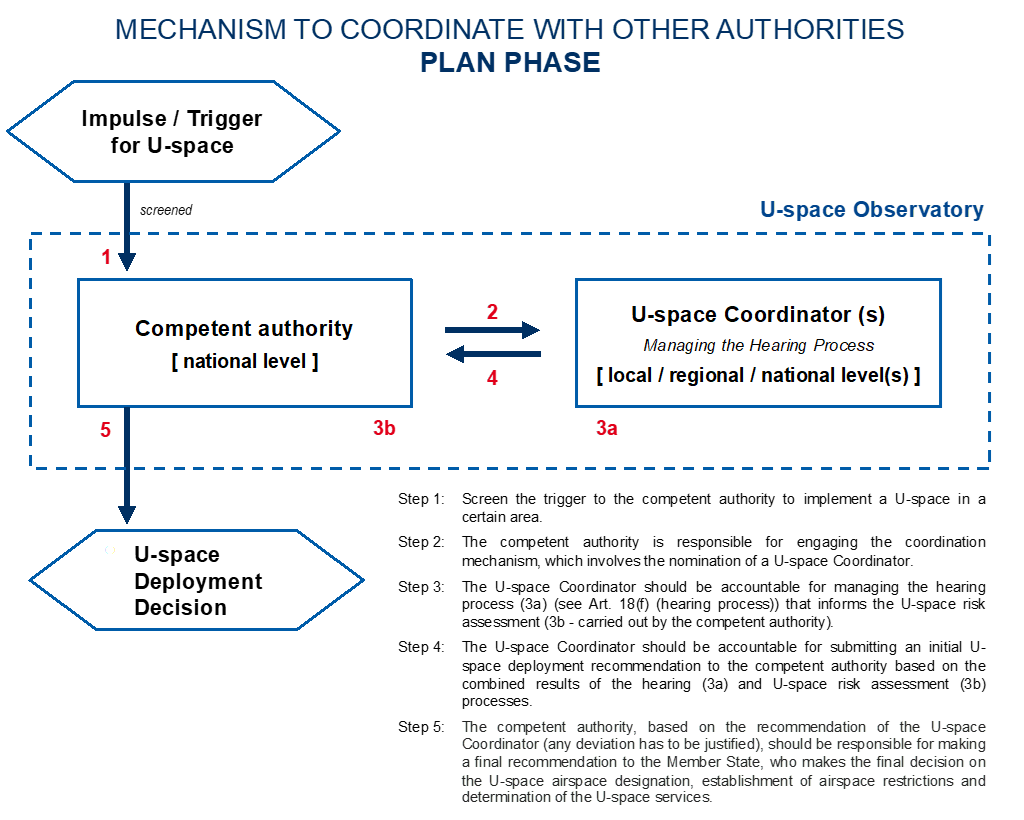 Figure 2: Example of how the coordination mechanism could be implemented. The diagram provides an overview of high‑level steps, the stakeholders, and their relationship during the planning phase. (f) U-space observatory: The set-up of a *U-space observatory* may be introduced as a means to promote the systematic coordination at local and regional level while maintaining alignment at national and supranational level. The dotted lines in Figure 2 are intended to show that the U‑space observatory should not necessarily be a separate entity, but rather to emphasise the need for the competent authority, responsible for making a final recommendation to the Member States on the U-space deployment, to coordinate and align with other authorities and entities through a hearing process managed by the nominated U-space coordinator. (g) In addition to the airspace itself, a U-space airspace also affects portions on the ground of social, cultural and political interest due to the operation of UAS in the lowest parts of the airspace. Therefore, on the one hand, air transport is affected, which is regulated at EU level and requires the application of uniform regulations and rules throughout the Union and, on the other hand, sites of interest on the ground are affected too. Regulatory implementation at Member State level on this matter should be designed to meet the needs of the citizens and the society at local and regional level in a holistic and integrated manner. Therefore, it is considered that the role of the U-space coordinator should exist at different levels of governance (i.e. national, regional, local) and hence it could be assumed by national, regional and local authorities respectively that will need to coordinate and align on relevant policies, approaches and practices. (h) The distinction of the competent authority (at national level), as well as of the U-space coordinator (at national level[[27]](#_ftn27)), and the U-space coordinator (at regional/local level) can mitigate the risks posed by the following: (1) not aligned airspace and ground regulations across the different levels of governance in the Member States; (2) conflicts of interest among the various public and private actors; and (3) compromising the liveability of cities and regions. (i) If multiple local or regional authorities are affected, there may be either one or several U-space coordinators nominated by a competent authority; this is left to the discretion of the given competent authority by evaluating the national governance set-up in conjunction with the capabilities and capacities of the affected authorities. **2. The *execution* phase** (a) The execution phase starts at the time of the actual operations. There is no predetermined end, as long as the U-space is operational. (b) There may be temporary restrictions or limitations applied to specific U-space airspace: (1) The competent authority at national level or specific authorities at all levels may request/demand time-critical changes due to safety or security concerns (emergencies). This may trigger, for example, the dynamic airspace reconfiguration by the ATC. The acting authority may be different depending on the kind of the emergency and the organisational structure of the respective Member State. (2) The temporal restrictions to the U-space are applied only by designating UAS geographical zones according to Article 15 of [Regulation (EU) 2019/947](https://eur-lex.europa.eu/legal-content/EN/TXT/?uri=CELEX%3A32019R0947&qid=1710436971435) which could be established as: (i) dynamic geographical zones in terms of time and activated/deactivated without prior announcement; and (ii) dynamic geographical zones in terms of time and location. (3) The temporal restrictions applied to the U-space could be introduced by triggering dynamic airspace reconfiguration in accordance with point ATS.TR.237 of [Regulation (EU) 2017/373](https://eur-lex.europa.eu/legal-content/EN/TXT/?uri=CELEX%3A32017R0373&qid=1710437004789) amended by [Regulation (EU) 2021/665](https://eur-lex.europa.eu/legal-content/EN/TXT/?uri=CELEX%3A32021R0665&qid=1710437042722). 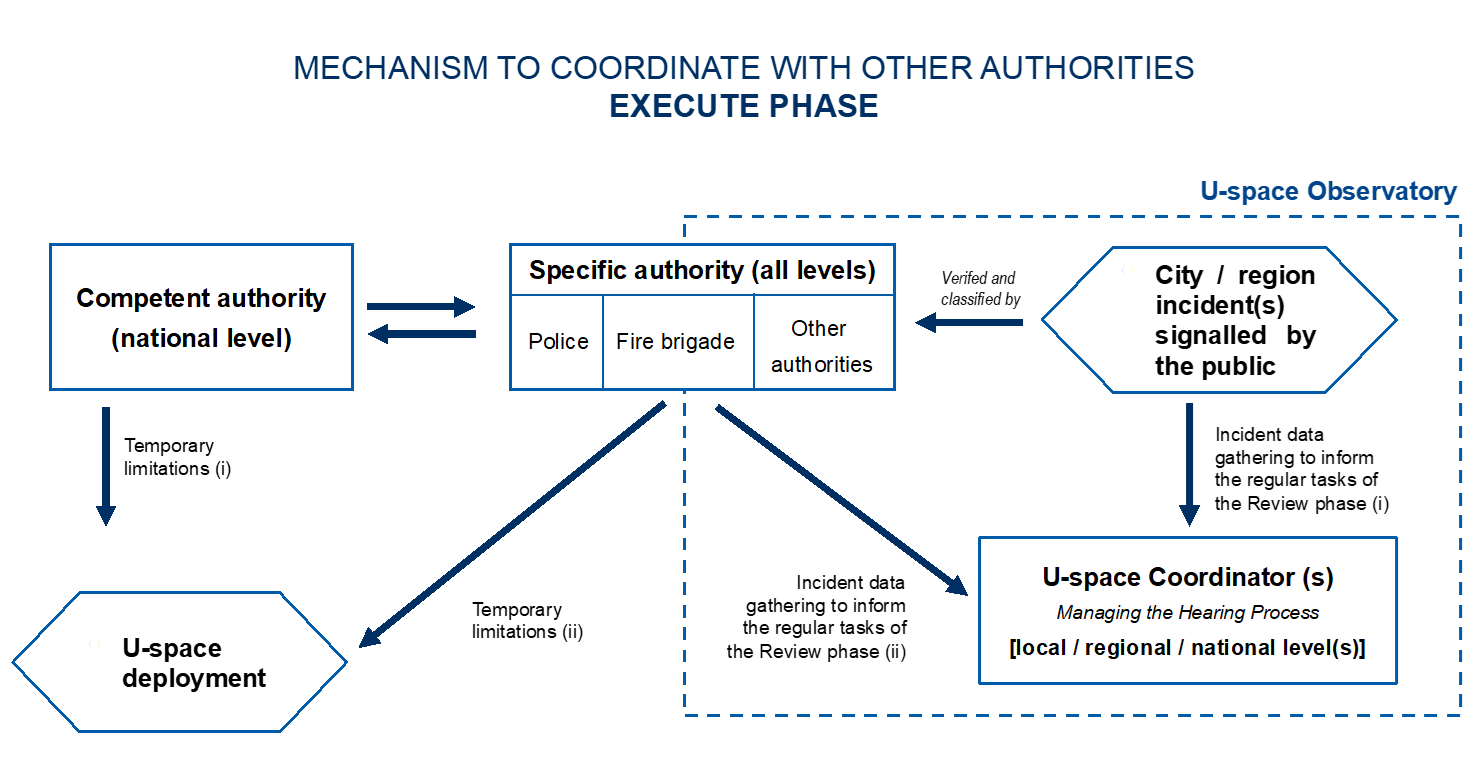 Figure 3: Example of how the coordination mechanism could be implemented. The diagram provides an overview of high-level steps, the stakeholders, and their relationship during the execution phase. (i) Request by specific authorities (all levels): Emergency response authorities like the police, the fire brigade or civil protection agencies may request temporal restrictions depending on the structure (governance / legal basis) of the respective Member State. (ii) Temporary limitations in the U-space: Time-critical restrictions for safety and/or security reasons, e.g. in the event of an emergency or a natural disaster. In this case, the competent authority may directly impose, according to national regulations, temporary limitations on the U-space; for example, restricted or prohibited airspace or limitation on the number of UAS in a specific area. (c) As in manned aviation, the competent authority may always impose temporary limitations (notices to airmen (NOTAMs), airworthiness directives, air exclusion zones) on a UAS operation. (d) Due to the nature of the U-space (low-altitude flights over populated areas), the dynamic response and reporting (including accident reporting) with regard to incidents, or to exceptional cases, is an important prerequisite to gain social trust and acceptance. To that end, incident detection and verification, as well as a streamlined and visible coordination process between aviation and non-aviation authorities, and among stakeholders, could be facilitated by relevant digital infrastructure (see Figure 3, city/region incident signalled by the public). (e) U-space coordinator (all levels): During the *execution* phase, the role of the U-space coordinator is to ensure incident data gathering to inform the regular tasks of the *review* phase of the U‑space deployment. Established accident reporting mechanisms of cities or regions, or purposefully developed tools for the monitoring of the U-space deployment, may link to the incident data gathering task (see Figure 3). **3. The *review* phase** 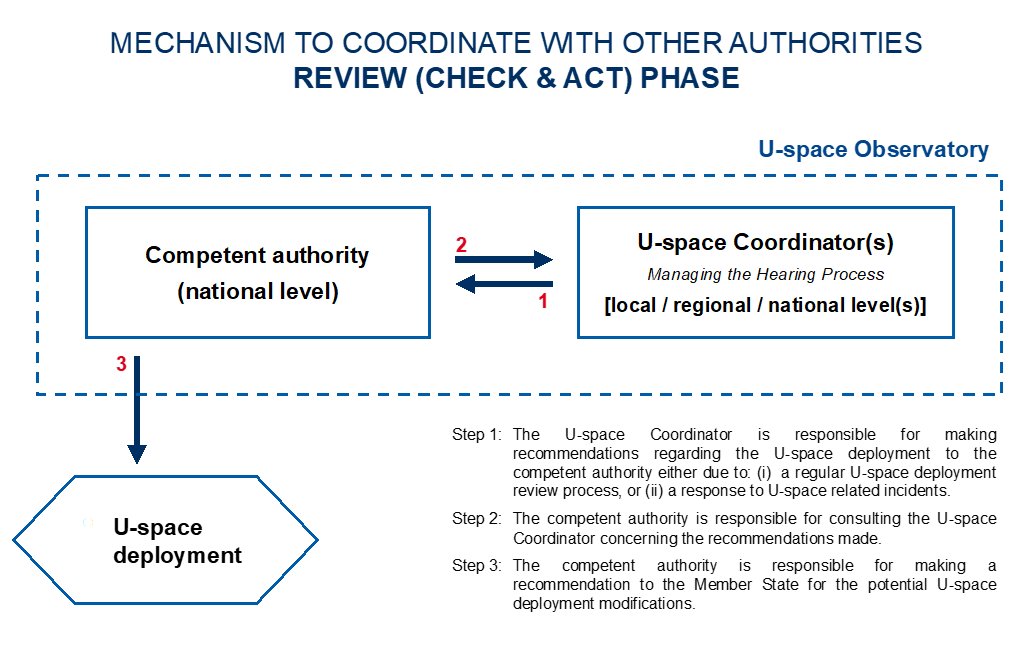 Figure 4: Example of how the coordination mechanism could be implemented. The diagram provides an overview of high-level steps, the stakeholders, and their relationship during the review phase. (a) The *review* phase starts in the form of a regular review (timelines are defined during the *planning* phase) or when a U-space-related incident occurs. Two types of review are proposed to be carried out: (1) a technical review, led by the competent authorities in the context of the U-space oversight process (e.g. safety, security, performance indicators, etc.); and (2) a coordination review, led by the U-space coordinator and involving national, regional, and local authorities together with other stakeholders representing societal, environmental, economic and other areas. (b) The review process should be initiated and managed by the U-space coordinator in the context of the U-space observatory function (Step 1, Figure 4). (c) The U-space coordinator should be entitled to make recommendations on maintaining, restricting, or reshaping (expanding or reducing) the U-space deployment. The competent authority should consider the recommendations (Step 2, Figure 4) in view of making recommendations to the Member States to decide on the potential U-space deployment modifications (Step 3, Figure 4). When the competent authority decides to deviate from the U‑space coordinator recommendations, the deviations must be justified. (1) The result of the *review* phase could lead to maintaining or restricting certain operations in the U-space airspace as well as to reshaping the U-space deployment in terms of either opening new opportunities for its expansion or even its decommissioning in case more extreme, negative situations are identified during the *execution* phase. (2) The *review* phase aims for continuous U-space improvement (*check & act*) through a feedback loop on topics dealt with during the *planning* phase. If the modification creates new concerns, the *planning* phase should start again (see Figure 1). (d) The *review* phase allows for closing the loop not only in terms of technical and operational performance but also the overall societal acceptance of the U-space deployment with all key stakeholders. --- [[27]](#_ftnref27) Depending on the governance model of the respective Member State, the U-space coordinator at national level could be, for example, any authority or entity as described in AMC1 and GM1 to Article 18(f) of [Regulation (EU) 2021/664](https://eur-lex.europa.eu/legal-content/EN/TXT/?uri=CELEX%3A32021R0664&qid=1710437124677). The choice of a military organisation as U-space coordinator for a U-space where civil operations take place may be done only if the same organisation is not exempted from the application of [Regulation (EU) 2018/1139](https://eur-lex.europa.eu/legal-content/EN/TXT/?uri=CELEX%3A32018R1139&qid=1710436348953) and its delegated and implementing acts, as well as from Commission decisions.