Light
Dark
System
Log In
Loading...
Compare / EASA/
Incorporated Amendments
/
Compare & Highlight Differences
Appendix 1 to ETSO-C153a - Integrated Modular Avionics (IMA) Overview, Definition and Examples
Available versions for ERULES-1963177438-18122
ED Decision 2020/011/R
found in: CS-ETSO Amdt 17 - European Technical Standard Orders (Oct 2026)
Version
CS-ETSO Amdt 17 - ... (Oct 2026)
Section
Share
Version
Show details
Hide details
Version
###### Appendix 1 to ETSO-C153a – Integrated Modular Avionics (IMA) Overview, Definition and Examples *ED Decision 2020/011/R* This Appendix provides: — Chapter 1: an overview of Integrated Modular Avionics (IMA); — Chapter 2: applicable definitions; — Chapter 3: a definition of the Minimum Performance Standard (MPS) classes; and — Chapter 4: examples of IMA platforms using IMA modules. **Chapter 1: Integrated Modular Avionics overview** In this ETSO, Integrated Modular Avionics (IMA) is defined according to EUROCAE ED-124 (equivalent to the RTCA document DO-297): Integrated modular avionics (IMA): is a shared set of flexible, reusable, and interoperable hardware and software resources that, when integrated, form a platform that provides services, designed and verified to meet a defined set of safety and performance requirements, to host applications performing aircraft functions. The IMA architecture integrates many aircraft functions on the same platform. Those functions are provided by several hosted applications that have historically been contained in functionally and physically separated ‘boxes’ or LRUs. IMA platforms are composed of modules which are designed to be reusable in order to reduce development costs and occasionally facilitate certification programmes. Some modules provide only mechanical, possibly cooling and electrical power supply functions. Others include core software and the associated computing capabilities. IMA modules are usually both generic and configurable, therefore, the same platform could be used on different aircraft models. **Chapter 2 — Applicable definitions** Legend — [ED-124]: Definitions from EUROCAE ED-124 (equivalent to RTCA document DO-297). — [C153a]: Definitions provided or adjusted in the frame of the ETSO. Aircraft function [ED-124]**:** The capability of the aircraft that may be provided by the hardware and software of the systems on the aircraft. Application [ED-124]**:** Software and/or application-specific hardware with a defined set of interfaces that, when integrated with the platform, performs a function. Cabinet [C153a]**:** Result of the integration of hardware modules mounted within one rack. Characterisation item [C153a]**:** Identified module characteristics towards which the IMA module developer needs to determine the module performance, with full verification and documentation in the user guide/installation manual as appropriate. Component [ED-124]**:** A self-contained hardware, software part, database or combination thereof that is configuration-controlled. A component does not provide an aircraft function by itself. Configuration data [ED-124]**:** See Paragraph 3.7.1. **Core Software [ED-124]:** The operating system and support software that manage resources to provide an environment in which applications can be executed. Core software is a necessary component of a platform and is typically comprised of one or more modules (such as, for example, libraries, drivers, kernel, data-loading, boot, etc.). IMA Platform [ED-124]**:** A module or group of modules, including core software, which manage resources in a manner sufficient to support at least one application. IMA hardware resources and core software are designed and managed in a way that provides computational, communication and interface capabilities for hosting at least one application. Platforms by themselves do not provide any aircraft functionality. The IMA platform may be accepted independently of hosted applications. IMA System [ED-124]**:** It consists of (an) IMA platform(s) and a defined set of hosted applications. LRM (Line Replaceable Module) [C153a]**:** An IMA platform element identified in aircraft configuration and replaceable by aircraft line maintenance to restore the aircraft into an operational ready condition. An IMA LRM is a stand-alone item of equipment which does not provide any aircraft function until hosted applications are integrated. LRU (Line Replaceable Unit) [C153a]**:** An element supporting an aircraft function identified in aircraft configuration and replaceable by aircraft line maintenance to restore the aircraft into an operational ready condition. An LRU is usually a stand-alone item of equipment such as a [radio](http://en.wikipedia.org/wiki/Radio), a Flight Management Computer or any kind of functional equipment. IMA Module [C153a]**:** A component or collection of components that may be hardware or a combination of hardware and software, which provide resources to the IMA-hosted applications. Software application and module configuration data are not covered by this definition. Modules may be distributed across the aircraft or may be co-located. Operating System[ED-124]**:** 1) The same as executive software. 2) The software kernel that services only the underlying hardware platform. 3) Software that directs the operations of a computer, resource allocation and data management, controlling and scheduling the execution of computer-hosted applications, managing memory, storage, input/output, and communication resources. Rack [C153a]**:** A physical package able to contain at least two hardware modules, which may provide partial protection from environmental effects (shielding) and may enable installation on and removal of the mounted modules from the aircraft without physically altering other aircraft systems or equipment. Resources/Shared resources [ED-124]**:** Any object (processor, memory, software, data, etc.) or component used by an IMA platform or application. A resource may be shared by multiple applications or dedicated to a specific application. A resource may be physical (a hardware device) or logical (a piece of information). Support software [C153a]**:** Embedded software necessary as a complement to the operating system to provide general services such as contributing to the intended function of resources sharing, handling hardware, drivers, software loading, health monitoring, boot strap, etc. Unit [C153a]**:** Set of physical components (hardware and/or software) inside an item of equipment in charge of providing a resource. Usage Domain [C153a]**:** The usage domain of an IMA module is defined as an exhaustive list of conditions (such as configuration settings, usage rules etc.) to be respected by the user(s) to ensure that the IMA module continues to meet the performance characteristics and requirements of the ETSO Minimum Performance Standard. Compliance with usage domain ensures that: — the module is compliant with its functional, performance, safety and environmental requirements specified for all implemented intended functions; — the module characteristics documented in the User Guide (as required by Appendix 2) are guaranteed by manufacturer; and — the module is compliant with the applicable airworthiness requirements (including continuing airworthiness aspects). (\*) (\*) Note: In the context of this IMA modules/platforms ETSO standard, this last sentence refers to requirements as described in Section 2 of CS-ETSO Subpart A. **Chapter 3 — Definition of intended function classes** To apply for an ETSO-C153a authorisation, the IMA module shall comply with applicable common requirements and implement at least one Intended Function Class. If a manufacturer applies for an ETSO-C153a authorisation, all the classes for which the Intended Function is implemented shall be compliant. CLASS RH: Rack Housing For ETSO-C153a Class RH: 1.3.RH.1: The IMA module is a physical package able to contain at least two hardware modules that may provide protection from environmental effects (shielding, etc.) and enable the installation and removal of those module(s) from the aircraft without physically altering other aircraft systems or equipment. 1.3.RH.2: The IMA module may be a simple mechanical enclosure, or it may incorporate communication interfaces, backplanes for data and power supplies, active cooling or any combination of these features. 1.3.RH.3: The IMA module does not offer the capability to host applications unless combined with a Class PR approval. 1.3.RH.4: The IMA module may be configurable. CLASS PR: Processing For ETSO-C153a Class PR: 1.3.PR.1: The IMA module contains a processing component, a memory component, interface devices and the associated Core Software which constitute one or several Processing Unit(s). *Note: Containing memory components or interfaces devices does not lead automatically to having class DS and/or IF in the certification basis; DS or IF classes need to be applied for only if concurrent access to these interface or data storage resources is offered as a shared resource (as described in Class DS and IF).* 1.3.PR.2: The intended function of such an IMA module is to share Processing, Data and Information between at least two hosted applications, modules and/or components. 1.3.PR.3: The IMA module offers the capability to host applications. 1.3.PR.4: The IMA module may be an association of hardware and Core Software. — Hardware may (or may not) contain resident (not field-loadable) software to enable electronic part marking and/or future loading of Field-Loadable Software parts. — Core Software may be resident or a Field-Loadable Software part. 1.3.PR.5: The IMA module may be configurable. CLASS GP: Graphical Processing For ETSO-C153a Class GP: 1.3.GP.1: The IMA module contains a graphical engine component and an optional video engine component, memories, interfaces and potentially associated Core Software which constitute one or several Graphical Unit(s). 1.3.GP.2: The intended function of such an IMA module is to share graphics and optional video signal processing between at least two hosted applications, modules and/or components. 1.3.GP.3: The IMA module does not offer the capability to host software applications unless combined with a Class PR approval. 1.3.GP.4: The IMA module may be an association of hardware and Core Software. Hardware may (or may not) contain resident (not field-loadable) software to enable electronic part marking and/or future loading of Field-Loadable Software parts. Core Software may be resident or a Field-Loadable Software part 1.3.GP.5: The IMA module may be configurable. CLASS DS: Data Storage For ETSO-C153a Class DS: 1.3.DS.1: The IMA module contains memory (volatile or non-volatile), an interface component and potentially associated Core Software which constitute one or several Data Storage Unit(s). 1.3.DS.2: The intended function of such an IMA module is to share stored data (e.g. databases, files, etc.) between several applications, modules and/or components. 1.3.DS.3: The IMA module does not offer the capability to host applications, unless combined with a Class PR approval. 1.3.DS.4: The IMA module may be an association of hardware and a Core Software. — Hardware may (or may not) contain resident (not field-loadable) software to enable electronic part marking and/or future loading of Field-Loadable Software parts. — Core Software may be resident or a Field-Loadable Software part. 1.3.DS.5: The IMA module may be configurable. CLASS IF: Interface For ETSO-C153a Class IF: 1.3.IF.1: The IMA module contains input/output component(s) and potentially associated Core Software which constitute one or several Interface Unit(s). These interfaces can be discrete, analogue, a serial interface, a digital bus, etc.. 1.3.IF.2: The intended function of such an IMA module is to share information between several aircraft functions or applications. 1.3.IF.3: The IMA module does not offer the capability to host applications unless combined with a Class PR approval. 1.3.IF.4: The IMA module may be an association of hardware and a Core Software. — Hardware may (or may not) contain resident (not field-loadable) software to enable electronic part marking and/or future loading of Field-Loadable Software parts. — Core Software may be resident or a Field-Loadable Software part. 1.3.IF.5: The IMA module may be configurable. CLASS PS: Power Supply For ETSO-C153a Class PS: 1.3.PS.1: The IMA module contains a set of components (hardware and/or software) which constitute one or several Power Supply Unit(s) in charge of managing electric power. 1.3.PS.2: The intended function of such an IMA module installed into a rack (Class RH module) is to provide power supplied from an airborne electrical network to one or more hardware modules embedded into the same rack. 1.3.PS.3: The IMA module does not offer the capability to host applications unless combined with a Class PR approval. 1.3.PS.4: The IMA module may be configurable. 1.3.PS.5: The IMA module may be an association of hardware and a Core Software. Hardware may (or may not) contain resident (not field-loadable) software to enable electronic part marking and/or future loading of Field-Loadable Software parts. Core Software may be resident or a Field-Loadable Software part. CLASS DH: Display Head For ETSO-C153a Class DH: 1.3.DH.1: The IMA module contains a set of components (hardware and/or software) in charge of managing a displayed area which constitutes one or several Display Unit(s). 1.3.DH.2: The intended function of such an IMA module is to offer the capability to depict graphical information received from IMA Application(s), component(s) and/or module(s) on one Display Area. 1.3.DH.3: The IMA module does not offer the capability to host applications unless combined with a Class PR approval. 1.3.DH.4: The IMA module may be an association of hardware and a Core Software. — Hardware may (or may not) contain resident (not field-loadable) software to enable electronic part marking and/or future loading of Field-Loadable Software parts. — Core Software may be resident or a Field-Loadable Software part. 1.3.DH.5: The IMA module may be configurable. **Chapter 4 — Example of an IMA platform using IMA modules** EUROCAE ED-124/RTCA document DO-297 contains some examples relating to the definition of the IMA module and platform, which can be completed by some additional examples related to Chapter 3 ‘Definitions’. Example 1: Single LRU platform (as per EUROCAE ED-124/RTCA document DO-297) This example illustrates the sharing of computational and Input/Output (I/O) resources within a single Line Replaceable Unit (LRU). Such IMA system key characteristics include: — hosting of multiple applications (not part of the IMA platform); — platform configuration data and data loading; and — a defined API between the IMA platform and hosted applications. 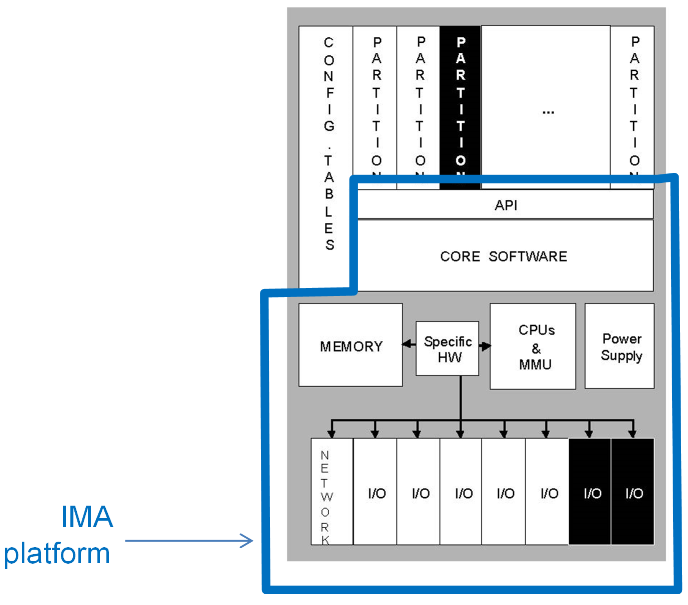 ***Figure 1: Single LRU platform (as per EUROCAE ED-124/RTCA DO-297)*** At one level, this example illustrates a single platform providing core computational resources. At another level, it illustrates a module to be used within a larger IMA platform. If sharing of processing, memory, and I/O resources is implemented within the LRU, such a single LRU platform will be eligible for CLASS PR, DS and IF. Example 2: Single LRU A664 switch equipment This example illustrates the sharing of ARINC Specification 664 I/O resources within a single Line Replaceable Unit (LRU). 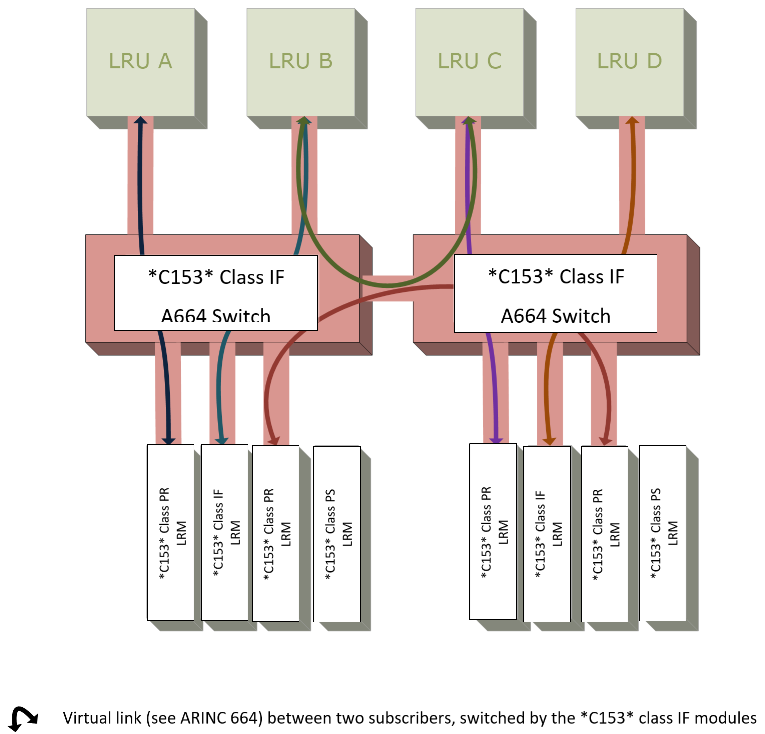  Virtual link (see ARINC 664) between two subscribers, switched by the \*C153\* class IF modules ***Figure 2: Example of an architecture based on two ETSO-\*C153\* class IF modules each implementing an ARINC 664 switch*** Note: ETSO-\*C153\* is intended to identify any existing amendment of this ETSO including its first release as ETSO-2C153. In this architecture, the two ETSO-C153a class IF modules switch A664 frames, providing each of the subscribers shared access to the network. Network subscribers can be other ETSO-C153a modules as the lower row of modules shows, or non-IMA equipment (top row) such as displays/radio transceivers. If sharing of ARINC Specification 664 I/O resources is implemented within the LRU, such a single LRU platform shall be eligible for CLASS IF. Example 3: IMA modules installed in a Rack Module (Line Replaceable Module) 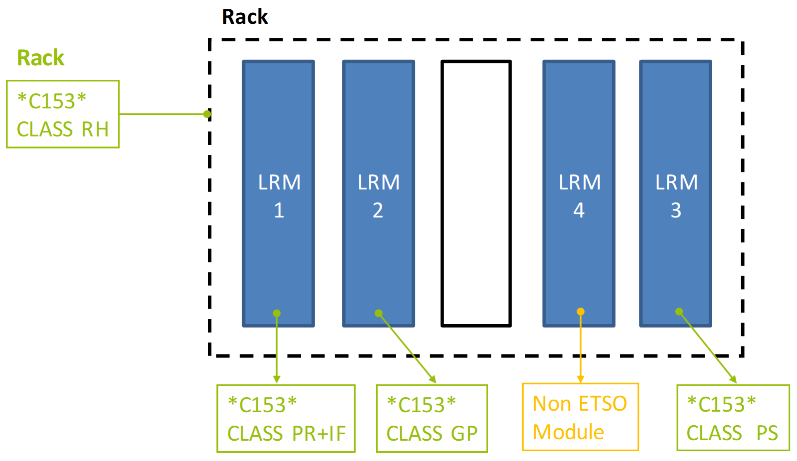 ***Figure 3: IMA modules installed in a Rack Module*** This example illustrates the sharing of resources within several single Line Replaceable Modules (LRMs) installed in a Rack: — a Rack is an IMA module and will be eligible for CLASS RH; — LRM 1 provides shared Processing and Input/Output and shall be eligible for CLASS PR+IF; — LRM 2 provides shared Graphical Processing and shall be eligible for CLASS GP; — LRM 3 provides shared a Power Supply to LRMs embedded into the same rack, and shall be eligible for CLASS PS; and — LRM 4 does not provide shared resources. This module shall be considered as a non-ETSO-C153a module. All these modules are considered to be parts. [Amdt ETSO/10] [Amdt ETSO/16]
Contact support