Light
Dark
System
Log In
Loading...
Compare / EASA/
Incorporated Amendments
/
Compare & Highlight Differences
GM1 to AMC2 ATS.TR.255
Available versions for ERULES-1963177438-17314
ED Decision 2020/008/R
found in: ATM/ANS Provision of Services (2017/373) (Mar 2025)
From
ATM/ANS Provision ... (Mar 2025)
ATM/ANS Provision ... (Feb 2023)
From section
To
ATM/ANS Provision ... (Mar 2025)
ATM/ANS Provision ... (Feb 2023)
To section
No visible text changes
0 removals
0 additions
View
Rich
Plain
Sync scrolling
Share
From
Show details
Hide details
To
Show details
Hide details
Version
Show side by side
GM1 to AMC2 ATS.TR.255; AMC3 ATS.TR.255 and AMC4 ATS.TR.255 Operations on parallel or near-parallel runways ED Decision 2020/008/R DETERMINATION THAT AN AIRCRAFT IS ESTABLISHED ON RNP AR APCH (a) An aircraft conducting an RNP AR APCH procedure (in accordance with Regulation (EU) 2018/1048) is considered to be established for the entire approach procedure after the IAF or the IF, as applicable, provided that: (1) the aircraft confirms that it is established on the RNP AR APCH procedure prior to a designated point, the location of which is to be determined by the competent authority; 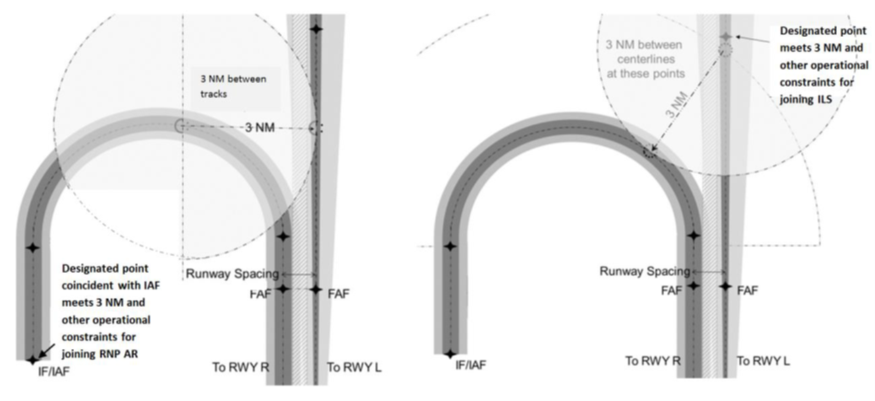 (2) the designated point is positioned on the RNP AR APCH to ensure the applicable horizontal separation minimum (e.g. 5.6 km (3 NM)) from the adjacent approach procedure (see Figure 59). The designated point may normally be coincident with the IAF; and Figure 59: Established on RNP AR APCH concept (RNP AR APCH/precision approach with 3 NM separation minimum example) (3) the designated point is readily apparent to the approach and monitoring air traffic controllers, to facilitate the application of the procedure. The designated point may be depicted on the situation display. (b) Attention is drawn to the application of the appropriate wake turbulence separation between aircraft on the same approach, as established in ATS.TR.220. (c) If, after reporting that it is established on the RNP AR APCH procedure, the aircraft is unable to execute the procedure, the pilot is expected to notify the air traffic controller immediately with a proposed course of action, and thereafter follow ATC instructions (e.g. break-out procedure). (d) In circumstances where a break-out procedure becomes necessary during the application of the independent parallel approach procedure (for example, an aircraft penetrating the NTZ), monitoring controllers may issue climb and/or heading instructions to an aircraft established on an RNP AR APCH. Guidance on break-out procedures is contained in ICAO Doc 9643 ‘Manual on Simultaneous Operations on Parallel or Near-Parallel Instrument Runways (SOIR)’. (e) To support a break-out instruction, an obstacle assessment is to be completed, in accordance with Regulation (EU) 2017/373. Guidance on obstacle assessment is contained in ICAO Doc 9643 ‘Manual on Simultaneous Operations on Parallel or Near-Parallel Instrument Runways (SOIR)’. (f) Where appropriate, break-out procedures are published in the AIP and in the local instructions.
GM1 to AMC2 ATS.TR.255; AMC3 ATS.TR.255 and AMC4 ATS.TR.255 Operations on parallel or near-parallel runways ED Decision 2020/008/R DETERMINATION THAT AN AIRCRAFT IS ESTABLISHED ON RNP AR APCH (a) An aircraft conducting an RNP AR APCH procedure (in accordance with Regulation (EU) 2018/1048) is considered to be established for the entire approach procedure after the IAF or the IF, as applicable, provided that: (1) the aircraft confirms that it is established on the RNP AR APCH procedure prior to a designated point, the location of which is to be determined by the competent authority; (2) the designated point is positioned on the RNP AR APCH to ensure the applicable horizontal separation minimum (e.g. 5.6 km (3 NM)) from the adjacent approach procedure (see Figure 59). The designated point may normally be coincident with the IAF; and ![Aviation.Bot AI suggestion, not from EASA source: [Image caption skipped for debugging]](/static/files/file_gqs63YSDadR/image076.png) Figure 59: Established on RNP AR APCH concept (RNP AR APCH/precision approach with 3 NM separation minimum example) (3) the designated point is readily apparent to the approach and monitoring air traffic controllers, to facilitate the application of the procedure. The designated point may be depicted on the situation display. (b) Attention is drawn to the application of the appropriate wake turbulence separation between aircraft on the same approach, as established in ATS.TR.220. (c) If, after reporting that it is established on the RNP AR APCH procedure, the aircraft is unable to execute the procedure, the pilot is expected to notify the air traffic controller immediately with a proposed course of action, and thereafter follow ATC instructions (e.g. break-out procedure). (d) In circumstances where a break-out procedure becomes necessary during the application of the independent parallel approach procedure (for example, an aircraft penetrating the NTZ), monitoring controllers may issue climb and/or heading instructions to an aircraft established on an RNP AR APCH. Guidance on break-out procedures is contained in ICAO Doc 9643 ‘Manual on Simultaneous Operations on Parallel or Near-Parallel Instrument Runways (SOIR)’. (e) To support a break-out instruction, an obstacle assessment is to be completed, in accordance with Regulation (EU) 2017/373. Guidance on obstacle assessment is contained in ICAO Doc 9643 ‘Manual on Simultaneous Operations on Parallel or Near-Parallel Instrument Runways (SOIR)’. (f) Where appropriate, break-out procedures are published in the AIP and in the local instructions.