Light
Dark
System
Log In
Loading...
Compare / EASA/
Incorporated Amendments
/
Compare & Highlight Differences
AMC3 ATS.TR.255 Operations on parallel or near-parallel runways
Available versions for ERULES-1963177438-17309
ED Decision 2020/008/R
found in: ATM/ANS Provision of Services (2017/373) (Mar 2025)
From
ATM/ANS Provision ... (Mar 2025)
ATM/ANS Provision ... (Feb 2023)
From section
To
ATM/ANS Provision ... (Mar 2025)
ATM/ANS Provision ... (Feb 2023)
To section
No visible text changes
0 removals
0 additions
View
Rich
Plain
Sync scrolling
Share
From
Show details
Hide details
To
Show details
Hide details
Version
Show side by side
AMC3 ATS.TR.255 Operations on parallel or near-parallel runways ED Decision 2020/008/R REQUIREMENTS AND PROCEDURES FOR DEPENDENT PARALLEL APPROACHES Dependent parallel approaches should only be conducted to parallel runways when the following conditions are met: (a) separate air traffic controllers are responsible for the sequencing and spacing of arriving aircraft to each runway; (b) the runway centre lines are spaced by 915 m (3 000 ft) or more; (c) the final approach course or track is intercepted by use of: (1) vectoring; or (2) a published arrival and approach procedures that intercepts with the IAF or the IF. (d) an ATS surveillance system with a minimum SSR azimuth accuracy of 0.3 degrees (one sigma), or for MLAT or ADS-B a performance capability equivalent to or better than the SSR requirement can be demonstrated and an update period of 5 seconds or less is available; (e) the instrument flight procedure that aligns the aircraft with the extended runway centre line is one of the following: (1) a precision approach procedure; (2) an APV procedure designed using the RNP AR APCH navigation specification, provided that the RNP value for B, and the RNP value for C if that segment of the approach is within the horizontal separation minimum of a parallel approach, does not exceed one quarter of the distance between runway centre lines (A) (See Figure 52); (3) an APV procedure designed using the RNP AR APCH navigation specification that does not meet the provisions in point (2) above or an RNP APCH, provided that: (i) an appropriate, documented safety assessment has shown that an acceptable level of safety can be met; and (ii) operations are approved by the competent authority; 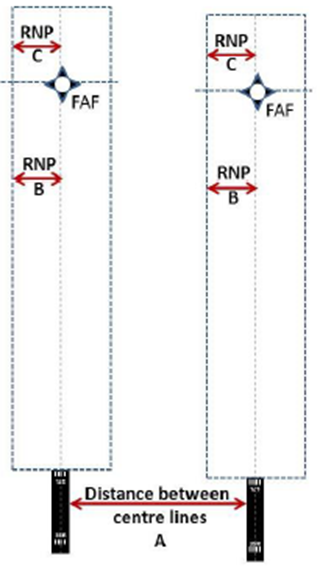 Figure 52: RNP value and distance between centre lines (f) aircraft are advised that approaches are in use to both runways; (g) the nominal tracks of the missed approach procedures diverge by at least 30 degrees; (h) the approach control unit has the capability to override the frequencies used by the aerodrome control tower; (i) a minimum of nominal 300 m (1 000 ft) vertical separation or a minimum of 5.6 km (3.0 NM) horizontal separation is provided between aircraft until established on the final approach courses or tracks of parallel approaches; (j) the minimum horizontal separation to be provided between aircraft established on the same final approach course or track is 5.6 km (3.0 NM), or 4.6 km (2.5 NM) horizontal separation if so determined in accordance with ATS.TR.215, unless increased longitudinal separation is required due to wake turbulence; (k) the minimum horizontal separation to be provided diagonally between successive aircraft on adjacent final approach courses or tracks is: (1) 3.7 km (2.0 NM) between successive aircraft on adjacent final approach courses or tracks more than 2 529 m (8 300 ft) apart (See figure 53); or 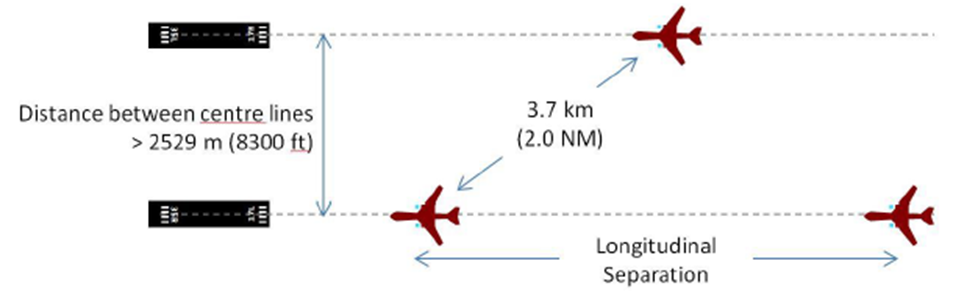 Figure 53: Diagonal separation for distance between centre lines greater than 2 529 m (8 300 ft) (2) 2.8 km (1.5 NM) between successive aircraft on adjacent final approach courses or tracks more than 1 097 m (3 600 ft) but not more than 2 529 m (8 300 ft) apart (see Figure 54); or 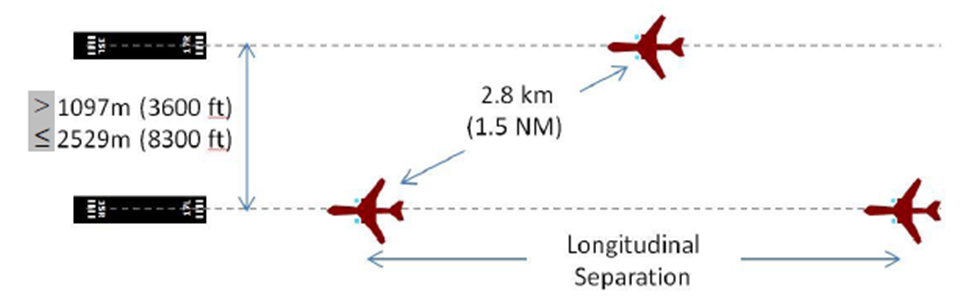 Figure 54: Diagonal separation for distance between centre lines greater than 1 097 m (3 600 ft) but less than or equal to 2 529 m (8 300 ft) (3) 1.9 km (1.0 NM) between successive aircraft on adjacent final approach courses or tracks more than 915 m (3 000 ft) but not more than 1 097 m (3 600 ft) apart (see Figure 55). 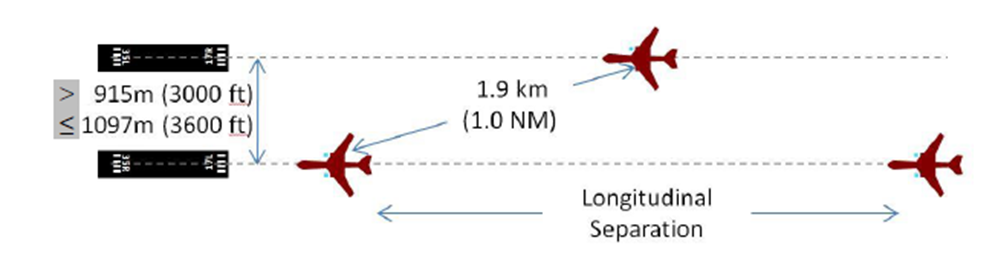 Figure 55: Diagonal separation for distance between centre lines greater than 915 m (3 000 ft) but less than or equal to 1 097 m (3 600 ft)
AMC3 ATS.TR.255 Operations on parallel or near-parallel runways ED Decision 2020/008/R REQUIREMENTS AND PROCEDURES FOR DEPENDENT PARALLEL APPROACHES Dependent parallel approaches should only be conducted to parallel runways when the following conditions are met: (a) separate air traffic controllers are responsible for the sequencing and spacing of arriving aircraft to each runway; (b) the runway centre lines are spaced by 915 m (3 000 ft) or more; (c) the final approach course or track is intercepted by use of: (1) vectoring; or (2) a published arrival and approach procedures that intercepts with the IAF or the IF. (d) an ATS surveillance system with a minimum SSR azimuth accuracy of 0.3 degrees (one sigma), or for MLAT or ADS-B a performance capability equivalent to or better than the SSR requirement can be demonstrated and an update period of 5 seconds or less is available; (e) the instrument flight procedure that aligns the aircraft with the extended runway centre line is one of the following: (1) a precision approach procedure; (2) an APV procedure designed using the RNP AR APCH navigation specification, provided that the RNP value for B, and the RNP value for C if that segment of the approach is within the horizontal separation minimum of a parallel approach, does not exceed one quarter of the distance between runway centre lines (A) (See Figure 52); (3) an APV procedure designed using the RNP AR APCH navigation specification that does not meet the provisions in point (2) above or an RNP APCH, provided that: (i) an appropriate, documented safety assessment has shown that an acceptable level of safety can be met; and (ii) operations are approved by the competent authority; ![Aviation.Bot AI suggestion, not from EASA source: [Image caption skipped for debugging]](/static/files/file_gqs63YSDadR/image069.png) Figure 52: RNP value and distance between centre lines (f) aircraft are advised that approaches are in use to both runways; (g) the nominal tracks of the missed approach procedures diverge by at least 30 degrees; (h) the approach control unit has the capability to override the frequencies used by the aerodrome control tower; (i) a minimum of nominal 300 m (1 000 ft) vertical separation or a minimum of 5.6 km (3.0 NM) horizontal separation is provided between aircraft until established on the final approach courses or tracks of parallel approaches; (j) the minimum horizontal separation to be provided between aircraft established on the same final approach course or track is 5.6 km (3.0 NM), or 4.6 km (2.5 NM) horizontal separation if so determined in accordance with ATS.TR.215, unless increased longitudinal separation is required due to wake turbulence; (k) the minimum horizontal separation to be provided diagonally between successive aircraft on adjacent final approach courses or tracks is: (1) 3.7 km (2.0 NM) between successive aircraft on adjacent final approach courses or tracks more than 2 529 m (8 300 ft) apart (See figure 53); or ![Aviation.Bot AI suggestion, not from EASA source: [Image caption skipped for debugging]](/static/files/file_gqs63YSDadR/image070.png) Figure 53: Diagonal separation for distance between centre lines greater than 2 529 m (8 300 ft) (2) 2.8 km (1.5 NM) between successive aircraft on adjacent final approach courses or tracks more than 1 097 m (3 600 ft) but not more than 2 529 m (8 300 ft) apart (see Figure 54); or ![Aviation.Bot AI suggestion, not from EASA source: [Image caption skipped for debugging]](/static/files/file_gqs63YSDadR/image071.png) Figure 54: Diagonal separation for distance between centre lines greater than 1 097 m (3 600 ft) but less than or equal to 2 529 m (8 300 ft) (3) 1.9 km (1.0 NM) between successive aircraft on adjacent final approach courses or tracks more than 915 m (3 000 ft) but not more than 1 097 m (3 600 ft) apart (see Figure 55). ![Aviation.Bot AI suggestion, not from EASA source: [Image caption skipped for debugging]](/static/files/file_gqs63YSDadR/image072.png) Figure 55: Diagonal separation for distance between centre lines greater than 915 m (3 000 ft) but less than or equal to 1 097 m (3 600 ft)