Light
Dark
System
Log In
Loading...
Compare / EASA/
Incorporated Amendments
/
Compare & Highlight Differences
AMC7 ATS.TR.220 Application of wake turbulence separation
Available versions for ERULES-1963177438-17242
ED Decision 2020/008/R
found in: ATM/ANS Provision of Services (2017/373) (Mar 2025)
From
ATM/ANS Provision ... (Mar 2025)
ATM/ANS Provision ... (Feb 2023)
From section
To
ATM/ANS Provision ... (Mar 2025)
ATM/ANS Provision ... (Feb 2023)
To section
No visible text changes
0 removals
0 additions
View
Rich
Plain
Sync scrolling
Share
From
Show details
Hide details
To
Show details
Hide details
Version
Show side by side
AMC7 ATS.TR.220 Application of wake turbulence separation ED Decision 2020/008/R RECAT-EU WAKE TURBULENCE SEPARATION MINIMA (a) As an alternative to the wake turbulence separation minima prescribed in [AMC1 to AMC6 ATS.TR.220](#_DxCrossRefBm647742685), an air traffic services provider may decide to implement RECAT-EU or parts thereof, subject to the approval of the competent authority. (b) The following wake vortex aircraft groupings, based on the allocation of aircraft types to six categories according to both maximum certificated take-off mass and wingspan, and associated separation minima should be used when applying RECAT-EU: (1) ‘SUPER HEAVY’ — all aircraft types of 100 000 kg or more, and a wingspan between 72 m and 80 m; (2) ‘UPPER HEAVY’ — all aircraft types of 100 000 kg or more, and a wingspan between 60 m and 72 m; (3) ‘LOWER HEAVY’ — all aircraft types of 100 000 kg or more, and a wingspan below 52 m; (4) ‘UPPER MEDIUM’ — aircraft types less than 100 000 kg but more than 15 000 kg, and a wingspan above 32 m; (5) ‘LOWER MEDIUM’ — aircraft types less than 100 000 kg but more than 15 000 kg, and a wingspan below 32 m; (6) ‘LIGHT’ — all aircraft types of 15 000 kg or less (without wingspan criterion). (c) Aircraft types with maximum certificated take-off mass of 100 000 kg or more, and wingspan between 52 m and 60 m are included in one of the above categories on the basis of specific analyses. (d) RECAT-EU wake turbulence distance-based separation minima for arriving and departing aircraft when ATS surveillance service is provided should be: 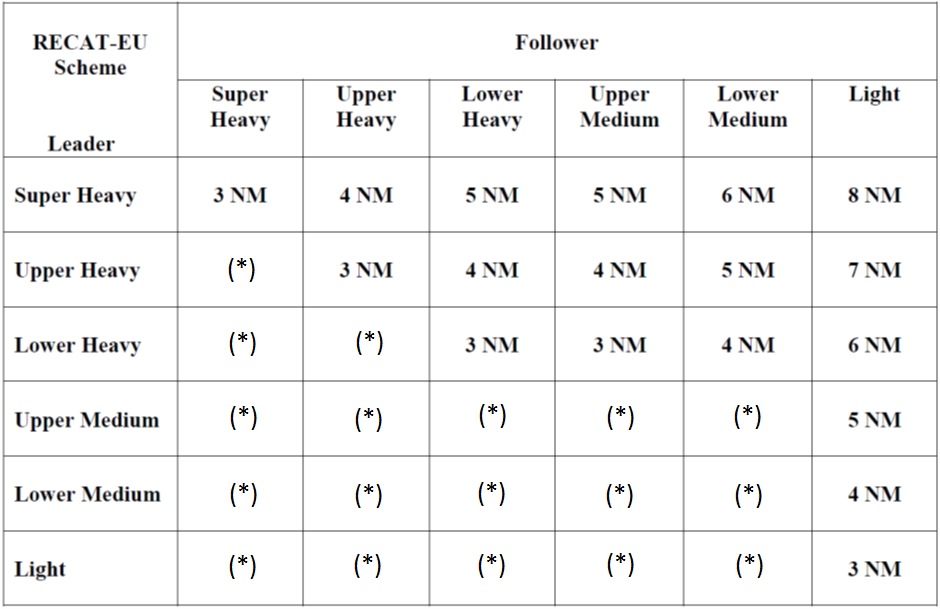 (\*) means that the separation minimum to be applied is the horizontal separation minimum based on an ATS surveillance system (established in accordance with [AMC1 ATS.TR.210(c)(2)](#_DxCrossRefBm647742655)), and should remain compatible with runway capacity. (e) RECAT-EU wake turbulence time-based separation minima between departing aircraft should be: 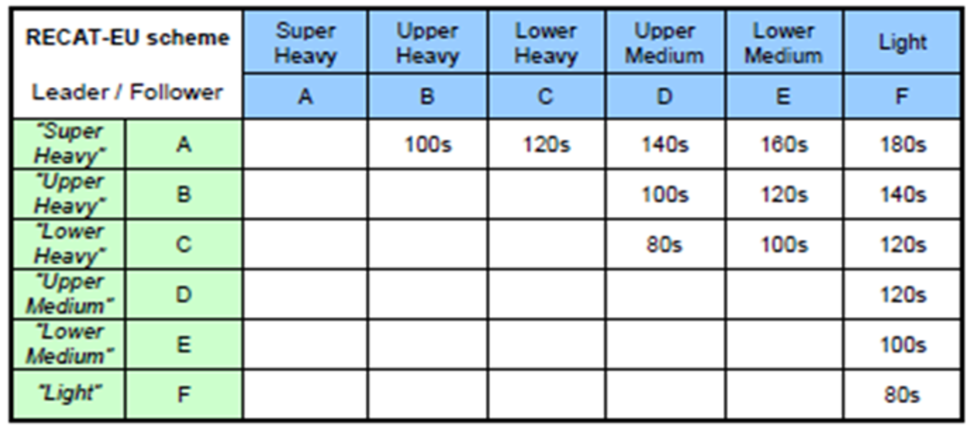 (f) Wake turbulence time-based separation minima between departing aircraft should be applied by determining airborne times between successive aircraft. (g) An additional 60 seconds should be applied to all the wake turbulence time-based separation minima above when taking off from: (1) an intermediate part of the same runway; or (2) an intermediate part of a parallel runway separated by less than 760 m (2 500 ft).
AMC7 ATS.TR.220 Application of wake turbulence separation ED Decision 2020/008/R RECAT-EU WAKE TURBULENCE SEPARATION MINIMA (a) As an alternative to the wake turbulence separation minima prescribed in [AMC1 to AMC6 ATS.TR.220](#_DxCrossRefBm1726555508), an air traffic services provider may decide to implement RECAT-EU or parts thereof, subject to the approval of the competent authority. (b) The following wake vortex aircraft groupings, based on the allocation of aircraft types to six categories according to both maximum certificated take-off mass and wingspan, and associated separation minima should be used when applying RECAT-EU: (1) ‘SUPER HEAVY’ — all aircraft types of 100 000 kg or more, and a wingspan between 72 m and 80 m; (2) ‘UPPER HEAVY’ — all aircraft types of 100 000 kg or more, and a wingspan between 60 m and 72 m; (3) ‘LOWER HEAVY’ — all aircraft types of 100 000 kg or more, and a wingspan below 52 m; (4) ‘UPPER MEDIUM’ — aircraft types less than 100 000 kg but more than 15 000 kg, and a wingspan above 32 m; (5) ‘LOWER MEDIUM’ — aircraft types less than 100 000 kg but more than 15 000 kg, and a wingspan below 32 m; (6) ‘LIGHT’ — all aircraft types of 15 000 kg or less (without wingspan criterion). (c) Aircraft types with maximum certificated take-off mass of 100 000 kg or more, and wingspan between 52 m and 60 m are included in one of the above categories on the basis of specific analyses. (d) RECAT-EU wake turbulence distance-based separation minima for arriving and departing aircraft when ATS surveillance service is provided should be: ![Aviation.Bot AI suggestion, not from EASA source: [Image caption skipped for debugging]](/static/files/file_gqs63YSDadR/image063.png) (\*) means that the separation minimum to be applied is the horizontal separation minimum based on an ATS surveillance system (established in accordance with [AMC1 ATS.TR.210(c)(2)](#_DxCrossRefBm1726555478)), and should remain compatible with runway capacity. (e) RECAT-EU wake turbulence time-based separation minima between departing aircraft should be: ![Aviation.Bot AI suggestion, not from EASA source: [Image caption skipped for debugging]](/static/files/file_gqs63YSDadR/image064.png) (f) Wake turbulence time-based separation minima between departing aircraft should be applied by determining airborne times between successive aircraft. (g) An additional 60 seconds should be applied to all the wake turbulence time-based separation minima above when taking off from: (1) an intermediate part of the same runway; or (2) an intermediate part of a parallel runway separated by less than 760 m (2 500 ft).