Light
Dark
System
Log In
Loading...
Compare / EASA/
Incorporated Amendments
/
Compare & Highlight Differences
AMC11 ATS.TR.210(c)(2)(i) Operation of air traffic control service
Available versions for ERULES-1963177438-17230
ED Decision 2020/008/R
found in: ATM/ANS Provision of Services (2017/373) (Mar 2025)
From
ATM/ANS Provision ... (Mar 2025)
ATM/ANS Provision ... (Feb 2023)
From section
To
ATM/ANS Provision ... (Mar 2025)
ATM/ANS Provision ... (Feb 2023)
To section
No visible text changes
0 removals
0 additions
View
Rich
Plain
Sync scrolling
Share
From
Show details
Hide details
To
Show details
Hide details
Version
Show side by side
AMC11 ATS.TR.210(c)(2)(i) Operation of air traffic control service ED Decision 2020/008/R PROCEDURAL CONTROL — SEPARATION OF DEPARTING AIRCRAFT FROM ARRIVING AIRCRAFT The following separation should be applied when take-off clearance is based on the position of an arriving aircraft: (a) If an arriving aircraft is making a complete instrument approach, a departing aircraft may take off: (1) in any direction until an arriving aircraft has started its procedure turn or base turn leading to final approach; (2) in a direction which is different by at least 45 degrees from the reciprocal of the direction of approach after the arriving aircraft has started procedure turn or base turn leading to final approach, provided that the take-off will be made at least 3 minutes before the arriving aircraft is estimated to be over the beginning of the instrument runway (see Figure 37). 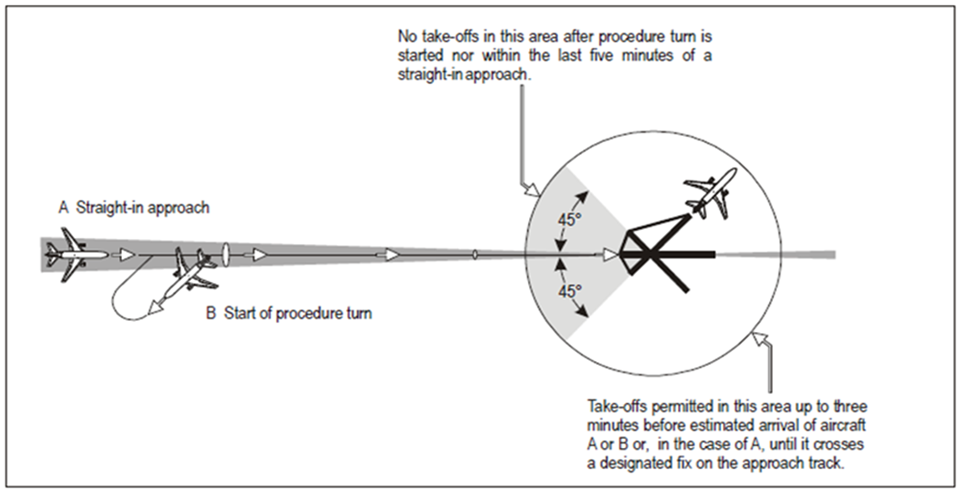 Figure 37: Separation of departing aircraft from arriving aircraft (b) If an arriving aircraft is making a straight-in approach, a departing aircraft may take off: (1) in any direction until 5 minutes before the arriving aircraft is estimated to be over the instrument runway; (2) in a direction which is different by at least 45 degrees from the reciprocal of the direction of approach of the arriving aircraft: (i) until 3 minutes before the arriving aircraft is estimated to be over the beginning of the instrument runway (see Figure 37); or (ii) before the arriving aircraft crosses a designated fix on the approach track; the location of such fix should be determined by the air traffic services provider after consultation with the operators, and approved by the competent authority.
AMC11 ATS.TR.210(c)(2)(i) Operation of air traffic control service ED Decision 2020/008/R PROCEDURAL CONTROL — SEPARATION OF DEPARTING AIRCRAFT FROM ARRIVING AIRCRAFT The following separation should be applied when take-off clearance is based on the position of an arriving aircraft: (a) If an arriving aircraft is making a complete instrument approach, a departing aircraft may take off: (1) in any direction until an arriving aircraft has started its procedure turn or base turn leading to final approach; (2) in a direction which is different by at least 45 degrees from the reciprocal of the direction of approach after the arriving aircraft has started procedure turn or base turn leading to final approach, provided that the take-off will be made at least 3 minutes before the arriving aircraft is estimated to be over the beginning of the instrument runway (see Figure 37). ![Aviation.Bot AI suggestion, not from EASA source: [Image caption skipped for debugging]](/static/files/file_gqs63YSDadR/image050.png) Figure 37: Separation of departing aircraft from arriving aircraft (b) If an arriving aircraft is making a straight-in approach, a departing aircraft may take off: (1) in any direction until 5 minutes before the arriving aircraft is estimated to be over the instrument runway; (2) in a direction which is different by at least 45 degrees from the reciprocal of the direction of approach of the arriving aircraft: (i) until 3 minutes before the arriving aircraft is estimated to be over the beginning of the instrument runway (see Figure 37); or (ii) before the arriving aircraft crosses a designated fix on the approach track; the location of such fix should be determined by the air traffic services provider after consultation with the operators, and approved by the competent authority.