Light
Dark
System
Log In
Loading...
Compare / EASA/
Incorporated Amendments
/
Compare & Highlight Differences
AMC2 ATS.TR.210(c)(2)(i) Operation of air traffic control service
Available versions for ERULES-1963177438-17216
ED Decision 2020/008/R
found in: ATM/ANS Provision of Services (2017/373) (Feb 2023)
From
ATM/ANS Provision ... (Mar 2025)
ATM/ANS Provision ... (Feb 2023)
From section
To
ATM/ANS Provision ... (Mar 2025)
ATM/ANS Provision ... (Feb 2023)
To section
No visible text changes
0 removals
0 additions
View
Rich
Plain
Sync scrolling
Share
From
Show details
Hide details
To
Show details
Hide details
Version
Show side by side
AMC2 ATS.TR.210(c)(2)(i) Operation of air traffic control service ED Decision 2020/008/R PROCEDURAL SEPARATION — LONGITUDINAL SEPARATION MINIMA BASED ON TIME — AIRCRAFT CLIMBING OR DESCENDING For aircraft climbing or descending, the longitudinal separation minima based on time should be one of the following: a) Aircraft on the same track When an aircraft will pass through the level of another aircraft on the same track, the following minimum longitudinal separation should be provided: (1) 15 minutes while vertical separation does not exist (see Figures 12 and 13); or ![Aviation.Bot AI suggestion, not from EASA source: [Image caption skipped for debugging]](/static/files/file_gqs63YSDadR/image025.png) Figure 12: 15-minute separation between aircraft climbing and on the same track ![Aviation.Bot AI suggestion, not from EASA source: [Image caption skipped for debugging]](/static/files/file_gqs63YSDadR/image026.png) Figure 13: 15-minute separation between aircraft descending and on the same track (2) 10 minutes while vertical separation does not exist, provided that such separation is authorised only where ground-based navigation aids or GNSS permit frequent determination of position and speed (see Figures 14 and 15); or ![Aviation.Bot AI suggestion, not from EASA source: [Image caption skipped for debugging]](/static/files/file_gqs63YSDadR/image027.png) Figure 14: 10-minute separation between aircraft climbing and on the same track ![Aviation.Bot AI suggestion, not from EASA source: [Image caption skipped for debugging]](/static/files/file_gqs63YSDadR/image028.png) Figure 15: 10-minute separation between aircraft descending and on the same track (3) 5 minutes while vertical separation does not exist, provided that: (i) the level change is commenced within 10 minutes of the time the second aircraft has reported over a common point which should be derived from ground-based navigation aids or by GNSS; and (ii) when issuing the clearance through third-party communication or CPDLC, a restriction should be added to the clearance to ensure that the 10-minute condition is satisfied (see Figures 16 and 17). ![Aviation.Bot AI suggestion, not from EASA source: [Image caption skipped for debugging]](/static/files/file_gqs63YSDadR/image029.png) Figure 16: 5-minute separation between aircraft climbing and on the same track ![Aviation.Bot AI suggestion, not from EASA source: [Image caption skipped for debugging]](/static/files/file_gqs63YSDadR/image030.png) Figure 17: 5-minute separation between aircraft descending and on the same track b) Aircraft on crossing tracks (1) 15 minutes while vertical separation does not exist (see Figures 18 and 19); or ![Aviation.Bot AI suggestion, not from EASA source: [Image caption skipped for debugging]](/static/files/file_gqs63YSDadR/image031.png) Figure 18: 15-minute separation between aircraft climbing and on crossing tracks ![Aviation.Bot AI suggestion, not from EASA source: [Image caption skipped for debugging]](/static/files/file_gqs63YSDadR/image032.png) Figure 19: 15-minute separation between aircraft descending and on crossing tracks (2) 10 minutes while vertical separation does not exist if navigation aids permit frequent determination of position and speed (see Figures 20 and 21). ![Aviation.Bot AI suggestion, not from EASA source: [Image caption skipped for debugging]](/static/files/file_gqs63YSDadR/image033.png) Figure 20: 10-minute separation between aircraft climbing and on crossing tracks ![Aviation.Bot AI suggestion, not from EASA source: [Image caption skipped for debugging]](/static/files/file_gqs63YSDadR/image034.png) Figure 21: 10-minute separation between aircraft descending and on crossing tracks c) Aircraft on reciprocal tracks Where lateral separation is not provided, vertical separation should be provided for at least 10 minutes prior to and after the time the aircraft are estimated to pass, or are estimated to have passed (see Figure 22). Provided it has been determined that the aircraft have passed each other, this minimum need not apply. ![Aviation.Bot AI suggestion, not from EASA source: [Image caption skipped for debugging]](/static/files/file_gqs63YSDadR/image035.png) Figure 22: 10-minute separation between aircraft on reciprocal tracks
AMC2 ATS.TR.210(c)(2)(i) Operation of air traffic control service ED Decision 2020/008/R PROCEDURAL SEPARATION — LONGITUDINAL SEPARATION MINIMA BASED ON TIME — AIRCRAFT CLIMBING OR DESCENDING For aircraft climbing or descending, the longitudinal separation minima based on time should be one of the following: a) Aircraft on the same track When an aircraft will pass through the level of another aircraft on the same track, the following minimum longitudinal separation should be provided: (1) 15 minutes while vertical separation does not exist (see Figures 12 and 13); or 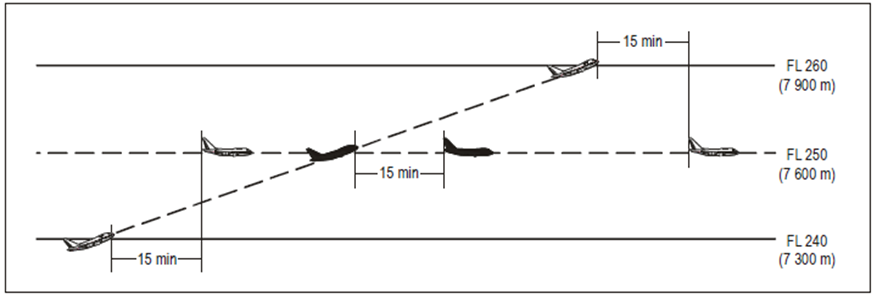 Figure 12: 15-minute separation between aircraft climbing and on the same track 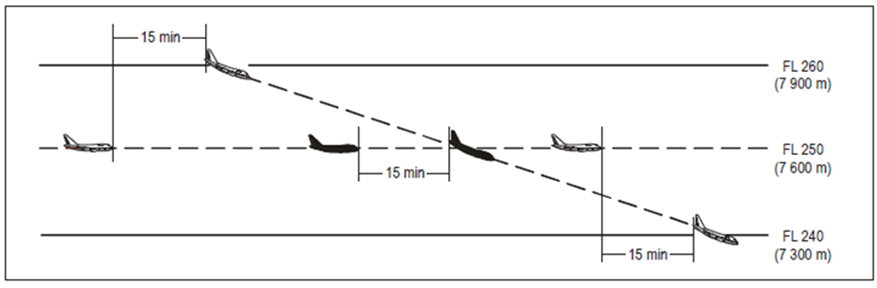 Figure 13: 15-minute separation between aircraft descending and on the same track (2) 10 minutes while vertical separation does not exist, provided that such separation is authorised only where ground-based navigation aids or GNSS permit frequent determination of position and speed (see Figures 14 and 15); or 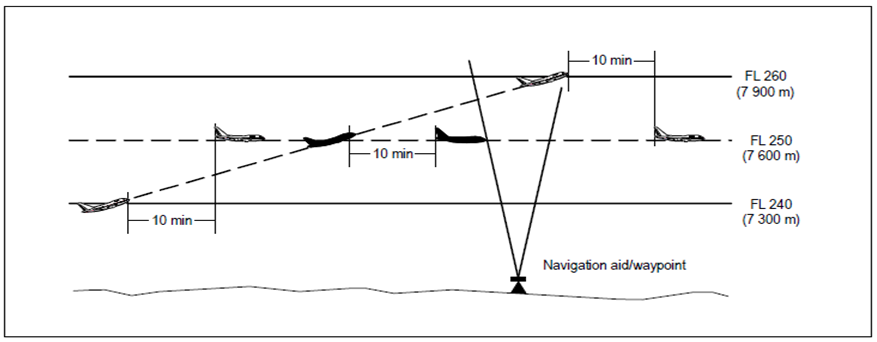 Figure 14: 10-minute separation between aircraft climbing and on the same track 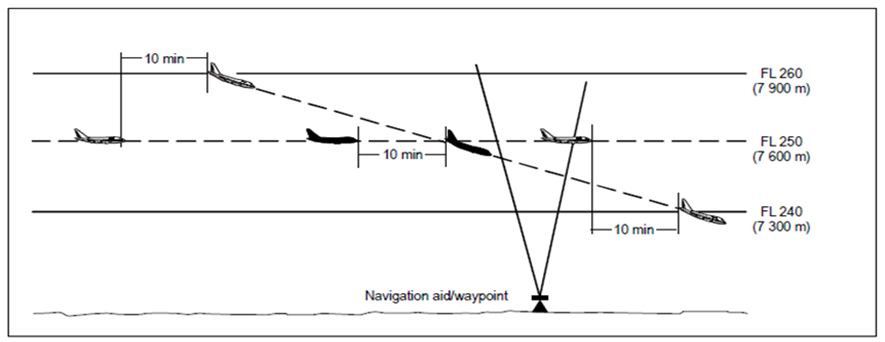 Figure 15: 10-minute separation between aircraft descending and on the same track (3) 5 minutes while vertical separation does not exist, provided that: (i) the level change is commenced within 10 minutes of the time the second aircraft has reported over a common point which should be derived from ground-based navigation aids or by GNSS; and (ii) when issuing the clearance through third-party communication or CPDLC, a restriction should be added to the clearance to ensure that the 10-minute condition is satisfied (see Figures 16 and 17). 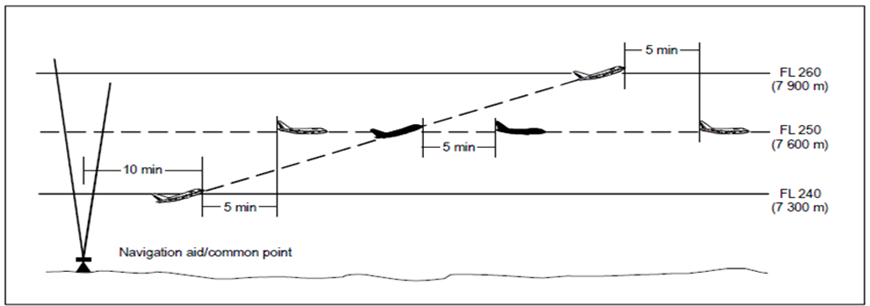 Figure 16: 5-minute separation between aircraft climbing and on the same track 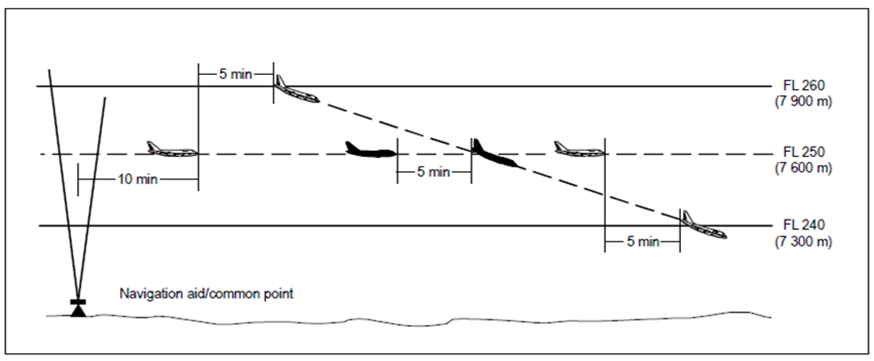 Figure 17: 5-minute separation between aircraft descending and on the same track b) Aircraft on crossing tracks (1) 15 minutes while vertical separation does not exist (see Figures 18 and 19); or 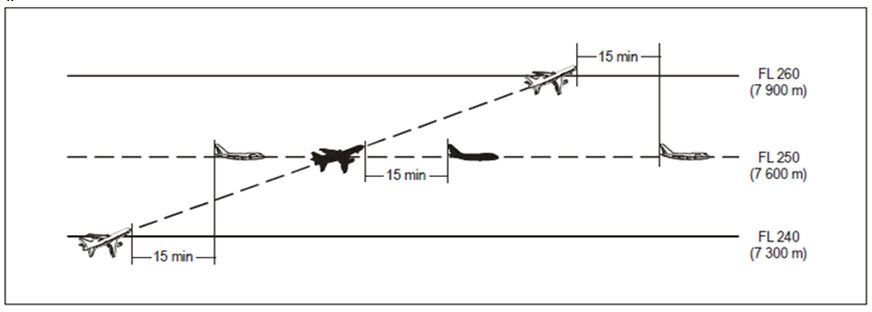 Figure 18: 15-minute separation between aircraft climbing and on crossing tracks 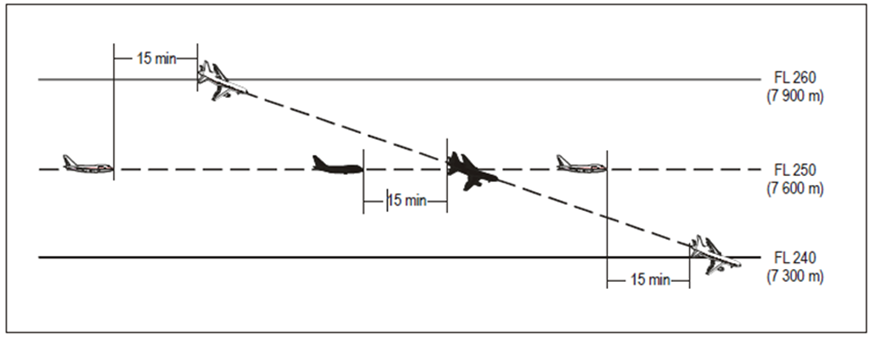 Figure 19: 15-minute separation between aircraft descending and on crossing tracks (2) 10 minutes while vertical separation does not exist if navigation aids permit frequent determination of position and speed (see Figures 20 and 21). 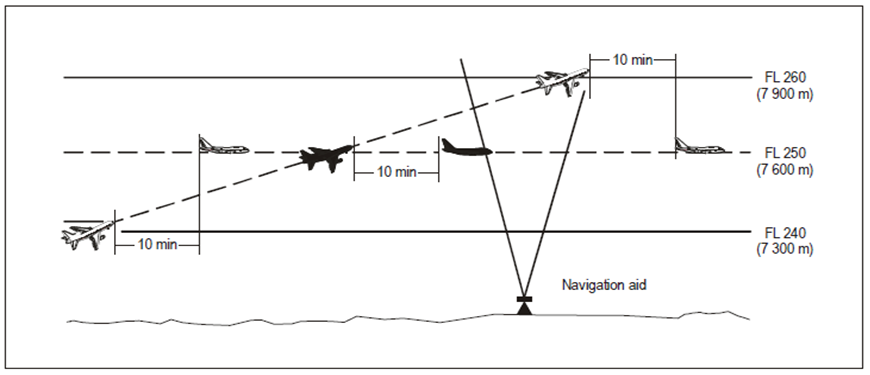 Figure 20: 10-minute separation between aircraft climbing and on crossing tracks 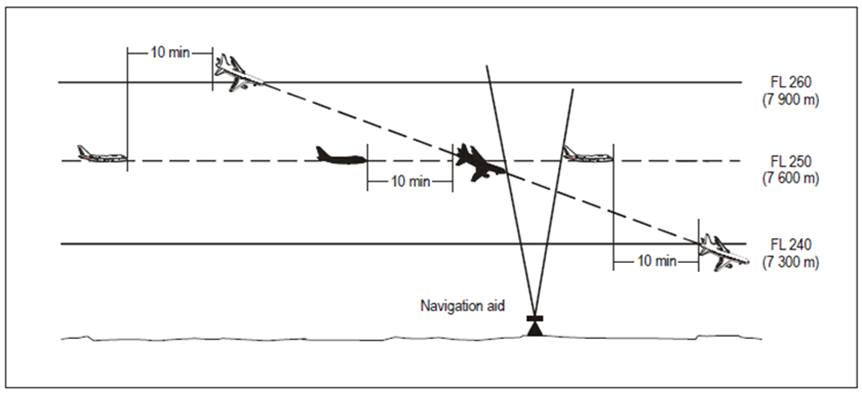 Figure 21: 10-minute separation between aircraft descending and on crossing tracks c) Aircraft on reciprocal tracks Where lateral separation is not provided, vertical separation should be provided for at least 10 minutes prior to and after the time the aircraft are estimated to pass, or are estimated to have passed (see Figure 22). Provided it has been determined that the aircraft have passed each other, this minimum need not apply. 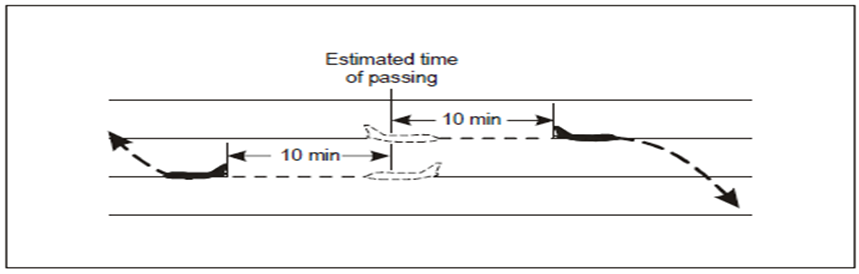 Figure 22: 10-minute separation between aircraft on reciprocal tracks