Light
Dark
System
Log In
Loading...
Compare / EASA/
Incorporated Amendments
/
Compare & Highlight Differences
GM1 UAS.OPEN.010 General provisions
Available versions for ERULES-1963177438-15575
ED Decision 2022/002/R
found in: Unmanned Aircraft Systems (2019/947 and 2019/945) Part-UAS (Jul 2024)
From
Unmanned Aircraft ... (Jun 2026)
Unmanned Aircraft ... (Jul 2024)
From section
To
Unmanned Aircraft ... (Jun 2026)
Unmanned Aircraft ... (Jul 2024)
To section
No visible text changes
0 removals
0 additions
View
Rich
Plain
Sync scrolling
Share
From
Show details
Hide details
To
Show details
Hide details
Version
Show side by side
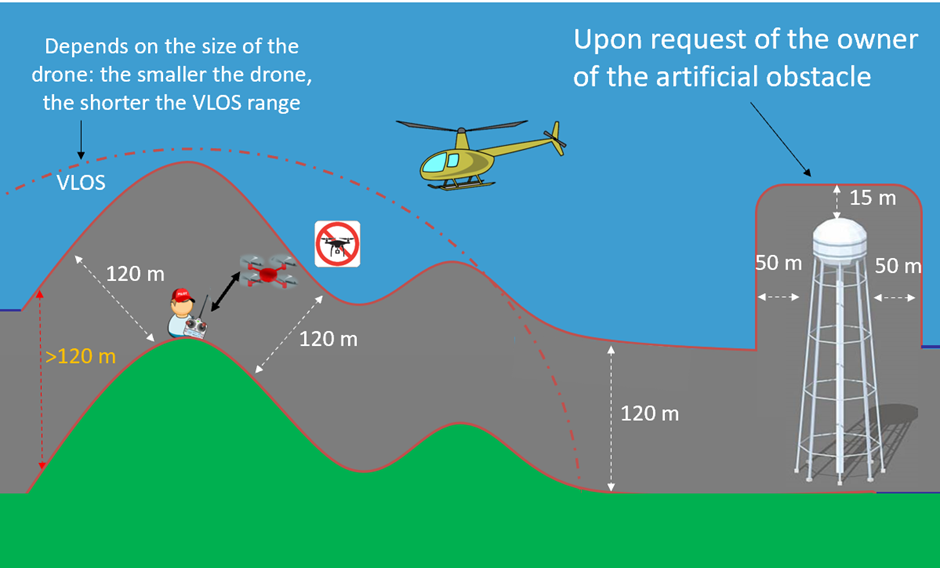
GM1 UAS.OPEN.010 General provisions ED Decision 2022/002/R MAXIMUM HEIGHT The remote pilot must ensure that he or she keeps the unmanned aircraft (UA) at a distance less than 120 m (400 ft) from the terrain, and the picture below shows how the maximum height that the UA may reach changes according to the topography of the terrain. In addition, when the Member State (MS) has defined a geographical zone with a lower maximum height, the remote pilot must ensure that the UA always complies with the requirements of the geographical zone. The entity responsible for the artificial obstacle referred to in point [UAS.OPEN.010(3)](#_DxCrossRefBm1106656868) needs to explicitly grant the unmanned aircraft system (UAS) operator permission to conduct an operation close to a tall man-made obstacle, e.g. a building, or antenna. No UAS operator should conduct an operation close to such an obstacle without permission from the entity responsible for the obstacle. 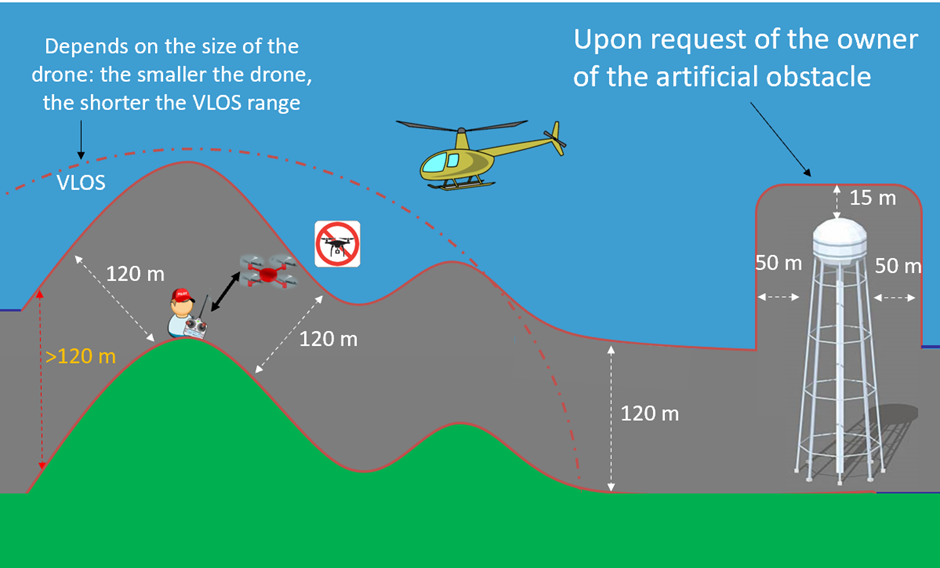
##### GM1 UAS.OPEN.010 General provisions *ED Decision 2022/002/R* **MAXIMUM HEIGHT** The remote pilot must ensure that he or she keeps the unmanned aircraft (UA) at a distance less than 120 m (400 ft) from the terrain, and the picture below shows how the maximum height that the UA may reach changes according to the topography of the terrain. In addition, when the Member State (MS) has defined a geographical zone with a lower maximum height, the remote pilot must ensure that the UA always complies with the requirements of the geographical zone. The entity responsible for the artificial obstacle referred to in point [UAS.OPEN.010(3)](#_DxCrossRefBm1295819186) needs to explicitly grant the unmanned aircraft system (UAS) operator permission to conduct an operation close to a tall man-made obstacle, e.g. a building, or antenna. No UAS operator should conduct an operation close to such an obstacle without permission from the entity responsible for the obstacle.