Light
Dark
System
Log In
Loading...
Compare / EASA/
Incorporated Amendments
/
Compare & Highlight Differences
GM1 Article 18(h) Tasks of the competent authority
Available versions for ERULES-1963177438-15571
ED Decision 2019/021/R
found in: Unmanned Aircraft Systems (2019/947 and 2019/945) Part-UAS (Jul 2024)
From
Unmanned Aircraft ... (Jun 2026)
Unmanned Aircraft ... (Jul 2024)
From section
To
Unmanned Aircraft ... (Jun 2026)
Unmanned Aircraft ... (Jul 2024)
To section
No visible text changes
0 removals
0 additions
View
Rich
Plain
Sync scrolling
Share
From
Show details
Hide details
To
Show details
Hide details
Version
Show side by side
GM1 Article 18(h) Tasks of the competent authority ED Decision 2019/021/R GUIDELINES FOR RISK-BASED OVERSIGHT (RBO) NOTE: The guidelines below are based on the document ‘Practices for risk-based oversight’, which may be found at the address below, and where further information may also be found: <https://www.easa.europa.eu/document-library/general-publications/practices-risk-based-oversight> That document: — highlights the relationship between RBO and the (safety) management system, the management of change, the overall performance of the organisation and the oversight cycle; — describes the interconnection, availability and exchange of data, which will significantly change the relationship between the authority and their regulated entities, as well as their ongoing management of safety; — does not constitute regulatory material nor means of compliance nor guidance material. It reflects the RBO state of play to date, in an effort to gain a common understanding and to look ahead; and — can be used as guidelines for competent authorities who have to implement RBO. (a) General Definitions: (1) Oversight: the function by means of which a competent authority ensures that the applicable requirements are met by regulated entities. (2) Risk profile: the element of risks that are inherent to the nature and operations of the regulated entity, this includes the: — specific nature of the organisation; — complexity of its activities; and — risks stemming from the activities carried out. (3) Safety performance: the demonstration of how effectively a regulated entity can mitigate its risks, substantiated through the proven ability to: — comply with the applicable requirements; — implement and maintain effective safety management; — identify and manage safety risks; and — achieve and maintain safe operations. The results of past certification or oversight also need to be taken into account. (4) RBO: a way of performing oversight, in which: — planning is driven by the combination of the risk profile and safety performance; and — execution focuses on the management of risk, besides ensuring compliance. (b) The RBO scheme is summed-up by the drawing below: 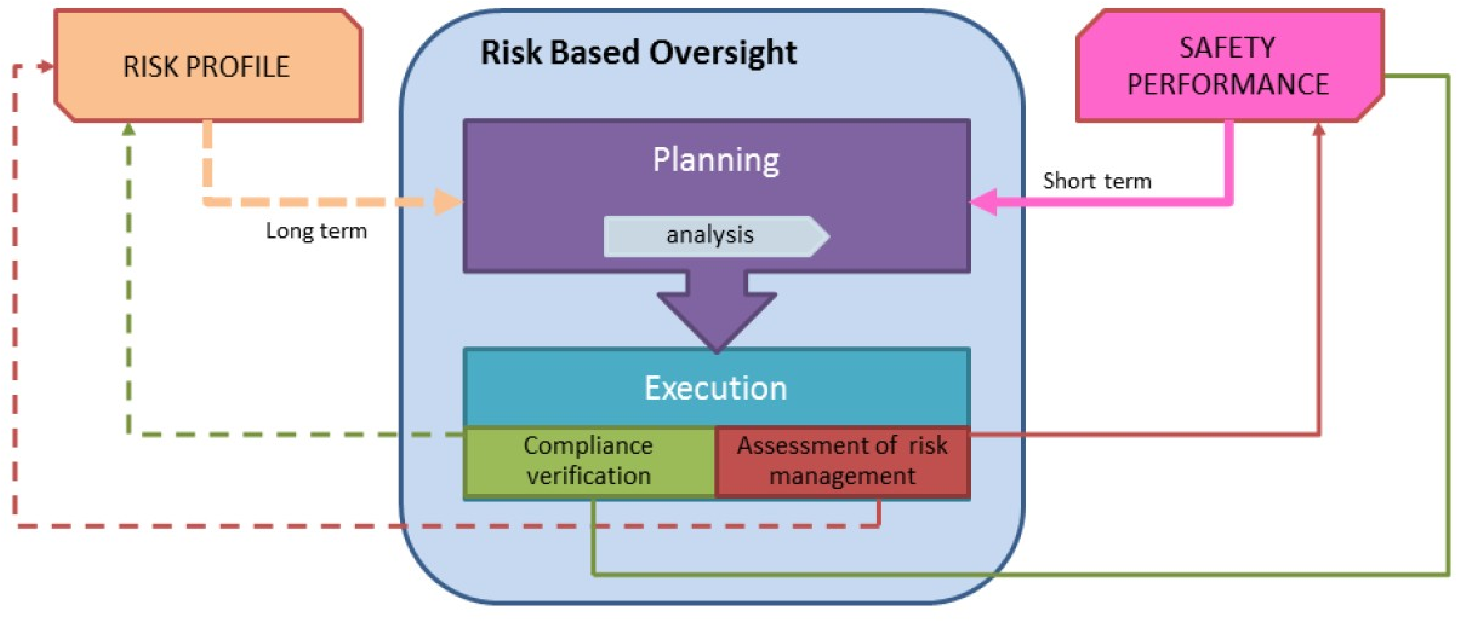 (1) the risk profile and oversight are described in paragraph 3 of the ‘Practices for risk-based oversight’; (2) the management of safety information and information sharing with other authorities are described in paragraph 4 of ‘Practices for risk-based oversight’; (3) the training and qualification of inspectors are described in paragraph 4.3 of ‘Practices for risk-based oversight’; (4) conducting risk-based audits is described in paragraph 5 of ‘Practices for risk-based oversight’.
##### GM1 Article 18(h) Tasks of the competent authority *ED Decision 2019/021/R* **GUIDELINES FOR RISK-BASED OVERSIGHT (RBO)** NOTE: The guidelines below are based on the document ‘Practices for risk-based oversight’, which may be found at the address below, and where further information may also be found: <https://www.easa.europa.eu/document-library/general-publications/practices-risk-based-oversight> That document: — highlights the relationship between RBO and the (safety) management system, the management of change, the overall performance of the organisation and the oversight cycle; — describes the interconnection, availability and exchange of data, which will significantly change the relationship between the authority and their regulated entities, as well as their ongoing management of safety; — does not constitute regulatory material nor means of compliance nor guidance material. It reflects the RBO state of play to date, in an effort to gain a common understanding and to look ahead; and — can be used as guidelines for competent authorities who have to implement RBO. (a) General Definitions: (1) Oversight: the function by means of which a competent authority ensures that the applicable requirements are met by regulated entities. (2) Risk profile: the element of risks that are inherent to the nature and operations of the regulated entity, this includes the: — specific nature of the organisation; — complexity of its activities; and — risks stemming from the activities carried out. (3) Safety performance: the demonstration of how effectively a regulated entity can mitigate its risks, substantiated through the proven ability to: — comply with the applicable requirements; — implement and maintain effective safety management; — identify and manage safety risks; and — achieve and maintain safe operations. The results of past certification or oversight also need to be taken into account. (4) RBO: a way of performing oversight, in which: — planning is driven by the combination of the risk profile and safety performance; and — execution focuses on the management of risk, besides ensuring compliance. (b) The RBO scheme is summed-up by the drawing below: 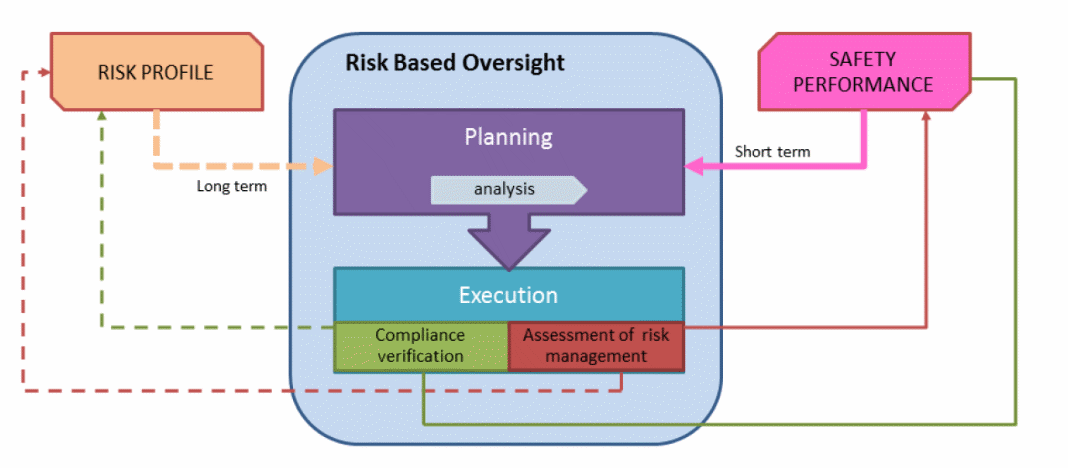 (1) the risk profile and oversight are described in paragraph 3 of the ‘Practices for risk-based oversight’; (2) the management of safety information and information sharing with other authorities are described in paragraph 4 of ‘Practices for risk-based oversight’; (3) the training and qualification of inspectors are described in paragraph 4.3 of ‘Practices for risk-based oversight’; (4) conducting risk-based audits is described in paragraph 5 of ‘Practices for risk-based oversight’.