Light
Dark
System
Log In
Loading...
Compare / EASA/
Incorporated Amendments
/
Compare & Highlight Differences
GM1 Article 13 Cross-border operations or operations outside the state of registration
Available versions for ERULES-1963177438-15562
ED Decision 2019/021/R
found in: Unmanned Aircraft Systems (2019/947 and 2019/945) Part-UAS (Jul 2024)
From
Unmanned Aircraft ... (Jun 2026)
Unmanned Aircraft ... (Jul 2024)
From section
To
Unmanned Aircraft ... (Jun 2026)
Unmanned Aircraft ... (Jul 2024)
To section
No visible text changes
0 removals
0 additions
View
Rich
Plain
Sync scrolling
Share
From
Show details
Hide details
To
Show details
Hide details
Version
Show side by side
GM1 Article 13 Cross-border operations or operations outside the state of registration ED Decision 2019/021/R GENERAL The picture below illustrates an example of an authorisation, already provided by the competent authority, to conduct an operation in the Member State of registration, which is used to conduct the same operation in another Member State: 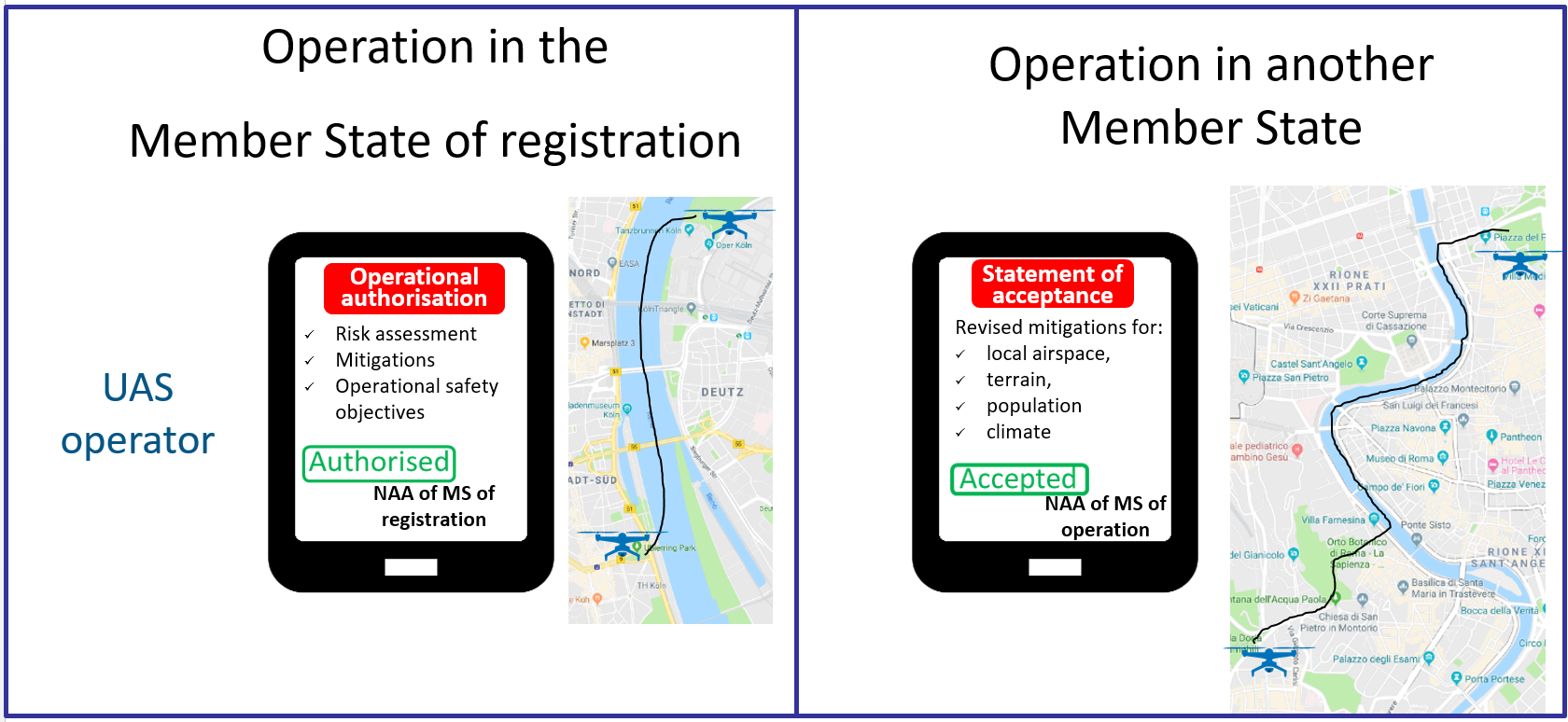 In the example, the UAS operator receives the authorisation from the competent authority of the Member State of registration where the mitigation measures are listed, and they may be adapted to the characteristics of the area of operation (e.g. the ground risk may be mitigated by flying over a river). When the UAS operator intends to conduct the same operation in another Member State, a copy of the authorisation issued by the competent authority of the Member State of registration needs to be sent to the NAA of the Member State of the UAS operations. A number of elements of the mitigation measures may remain valid, such as the way the operator is organised, the competences of the pilot, or the characteristics of the UAS, for example. Other elements instead need to be adapted to the geography of the area of operation (e.g. the operations cannot be conducted mostly over the river, or it is necessary to identify a flight path meeting the equivalent conditions in terms of the ground risk, the local airspace, terrain and climate). On these points and also on the airspace, terrain and climate, the UAS operators are expected to review and possibly update the mitigation means, but only in relation to those elements. The competent authority of the Member State of operation is not expected to review the full risk assessment, but to limit its activity to checking and providing the UAS operator and the competent authority of the Member State of registration with confirmation that the updated mitigation measures are satisfactory. Upon receipt of the confirmation, the UAS operator may start operating immediately, and the competent authority of registration will update the authorisation. The picture below illustrates an example of the case when an operation complying with one of the STSs listed in Appendix 1 to the UAS Regulation is conducted in a Member State other than the state of registration: 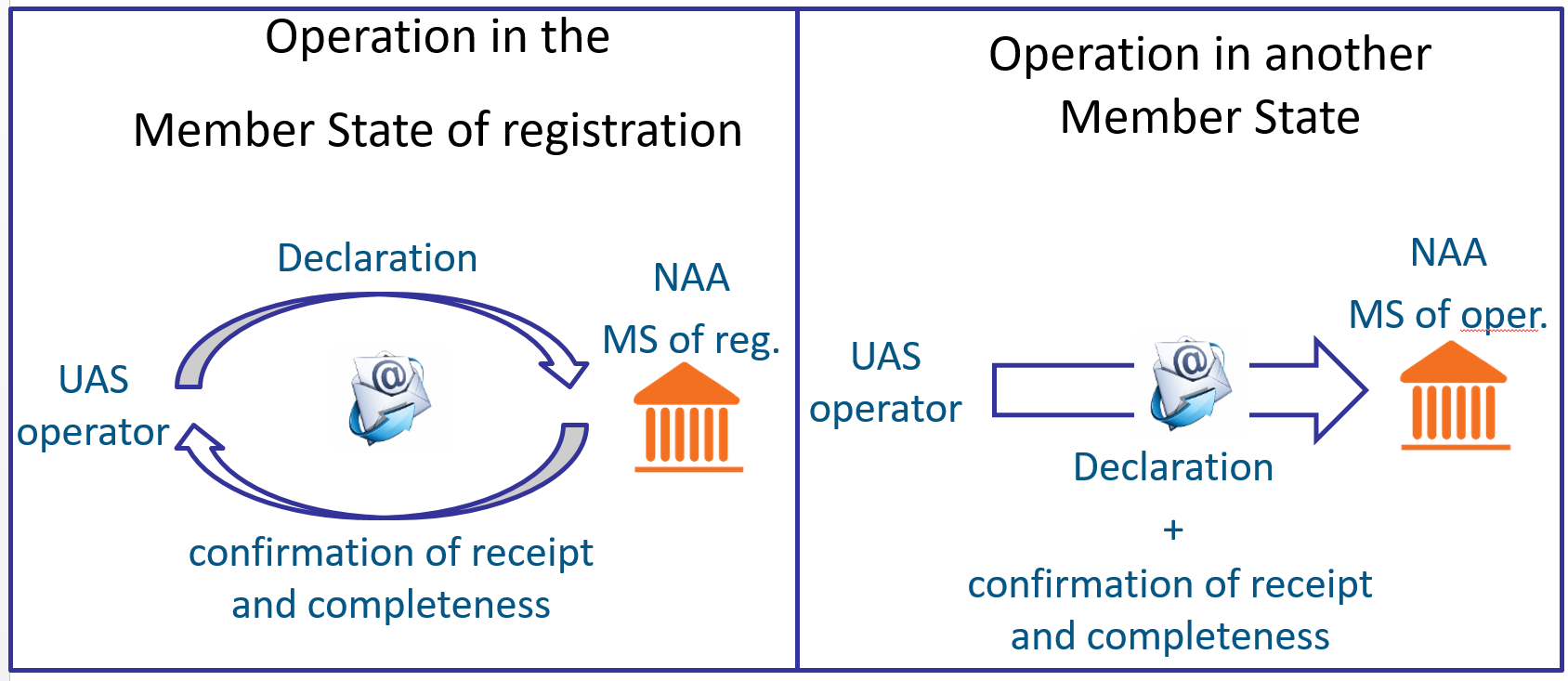 The UAS operator firstly submits the declaration to the competent authority of the Member State of registration, which, if the declaration complies with the UAS Regulation, issues a confirmation of receipt and completeness. The UAS operator will then provide the competent authority of the Member State of operations with a copy of the declaration and the confirmation of completeness received by the competent authority of the Member State of registration. There is no need for further verification.
##### GM1 Article 13 Cross-border operations or operations outside the state of registration *ED Decision 2019/021/R* **GENERAL** The picture below illustrates an example of an authorisation, already provided by the competent authority, to conduct an operation in the Member State of registration, which is used to conduct the same operation in another Member State: 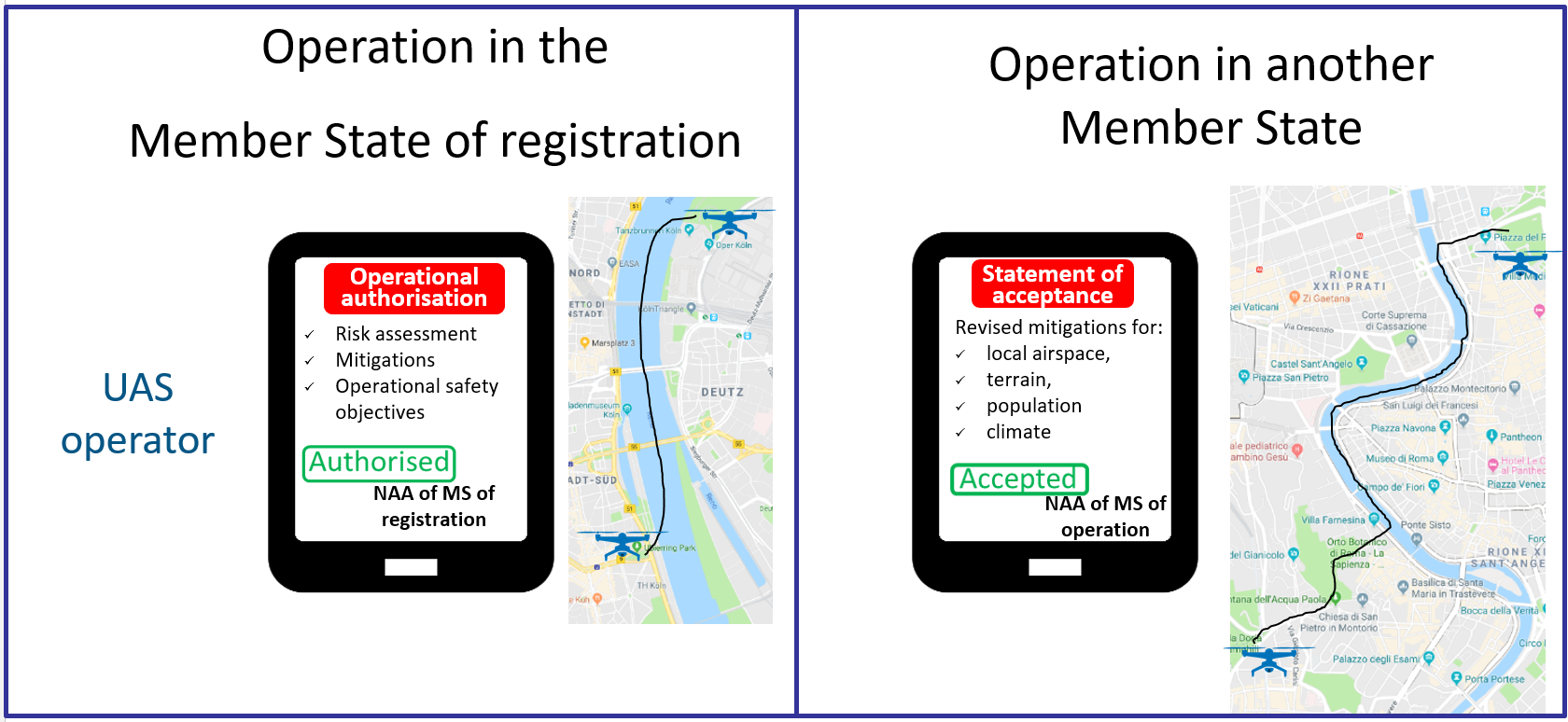 In the example, the UAS operator receives the authorisation from the competent authority of the Member State of registration where the mitigation measures are listed, and they may be adapted to the characteristics of the area of operation (e.g. the ground risk may be mitigated by flying over a river). When the UAS operator intends to conduct the same operation in another Member State, a copy of the authorisation issued by the competent authority of the Member State of registration needs to be sent to the NAA of the Member State of the UAS operations. A number of elements of the mitigation measures may remain valid, such as the way the operator is organised, the competences of the pilot, or the characteristics of the UAS, for example. Other elements instead need to be adapted to the geography of the area of operation (e.g. the operations cannot be conducted mostly over the river, or it is necessary to identify a flight path meeting the equivalent conditions in terms of the ground risk, the local airspace, terrain and climate). On these points and also on the airspace, terrain and climate, the UAS operators are expected to review and possibly update the mitigation means, but only in relation to those elements. The competent authority of the Member State of operation is not expected to review the full risk assessment, but to limit its activity to checking and providing the UAS operator and the competent authority of the Member State of registration with confirmation that the updated mitigation measures are satisfactory. Upon receipt of the confirmation, the UAS operator may start operating immediately, and the competent authority of registration will update the authorisation. The picture below illustrates an example of the case when an operation complying with one of the STSs listed in Appendix 1 to the UAS Regulation is conducted in a Member State other than the state of registration: 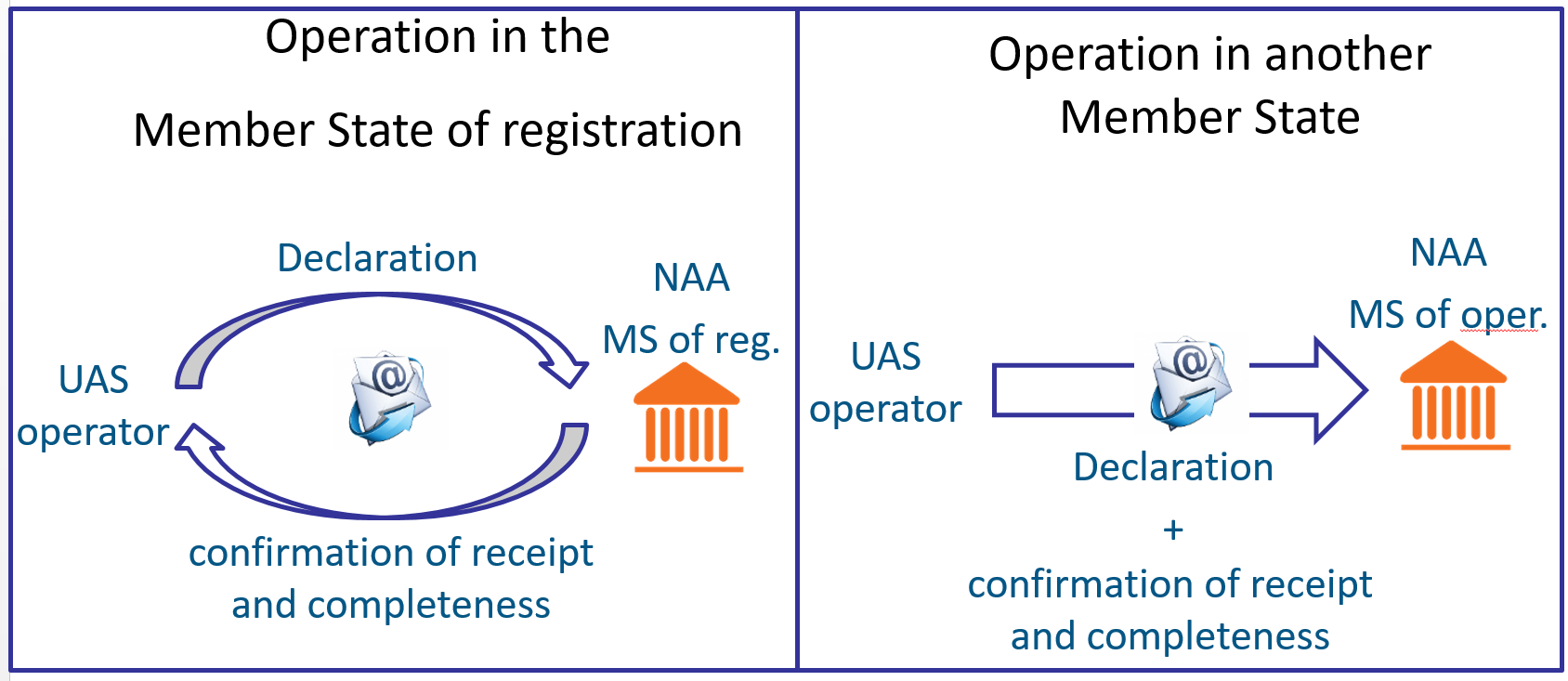 The UAS operator firstly submits the declaration to the competent authority of the Member State of registration, which, if the declaration complies with the UAS Regulation, issues a confirmation of receipt and completeness. The UAS operator will then provide the competent authority of the Member State of operations with a copy of the declaration and the confirmation of completeness received by the competent authority of the Member State of registration. There is no need for further verification.