Light
Dark
System
Log In
Loading...
Compare / EASA/
Incorporated Amendments
/
Compare & Highlight Differences
AMC1 ARA.FSTD.100(a)(3) Initial evaluation procedure
Available versions for ERULES-1963177438-10926
ED Decision 2012/006/R
found in: Aircrew (1178/2011) Part-FCL Part-MED Part-CC Part-ARA Part-ORA Part-DTO (Aug 2023)
From
Aircrew (1178/2011... (Nov 2025)
Aircrew (1178/2011... (Dec 2024)
Aircrew (1178/2011... (Aug 2023)
From section
To
Aircrew (1178/2011... (Nov 2025)
Aircrew (1178/2011... (Dec 2024)
Aircrew (1178/2011... (Aug 2023)
To section
No visible text changes
0 removals
0 additions
View
Rich
Plain
Sync scrolling
Share
From
Show details
Hide details
To
Show details
Hide details
Version
Show side by side
AMC1 ARA.FSTD.100(a)(3) Initial evaluation procedure ED Decision 2012/006/R FUNCTIONS AND SUBJECTIVE TESTS – SUGGESTED TEST ROUTINE (a) During initial and recurrent evaluations of an FSTD, the competent authority should conduct a series of functions and subjective tests that together with the objective tests complete the comparison of the FSTD with the aircraft, the class of aeroplane or type of helicopter. (b) Functions tests verify the acceptability of the simulated aircraft systems and their integration. Subjective tests verify the fitness of the FSTD in relation to training, checking and testing tasks. (c) The FSTD should provide adequate flexibility to permit the accomplishment of the desired and required tasks while maintaining an adequate perception by the flight crew that they are operating in a real aircraft environment. Additionally, the instructor operating station (IOS) should not present an unnecessary distraction from observing the activities of the flight crew whilst providing adequate facilities for the tasks. (d) It is important that both the competent authority and the organisation operating an FSTD understand what to expect from the routine of FSTD functions and subjective tests. Part of the subjective tests routine for an FSTD should involve an uninterrupted fly-out (except for FTD level 1) comparable with the duration of typical training sessions in addition to assessment of flight freeze and repositioning. An example of such a profile is to be found under points (f) and (g) (for BITD point (h)). (e) The competent authorities, and organisations operating FSTD, who are unfamiliar with the evaluation process should contact the Agency or the competent authority of another Member State with adequate expertise in this field. (f) Typical test profile for an FSTD aeroplane: 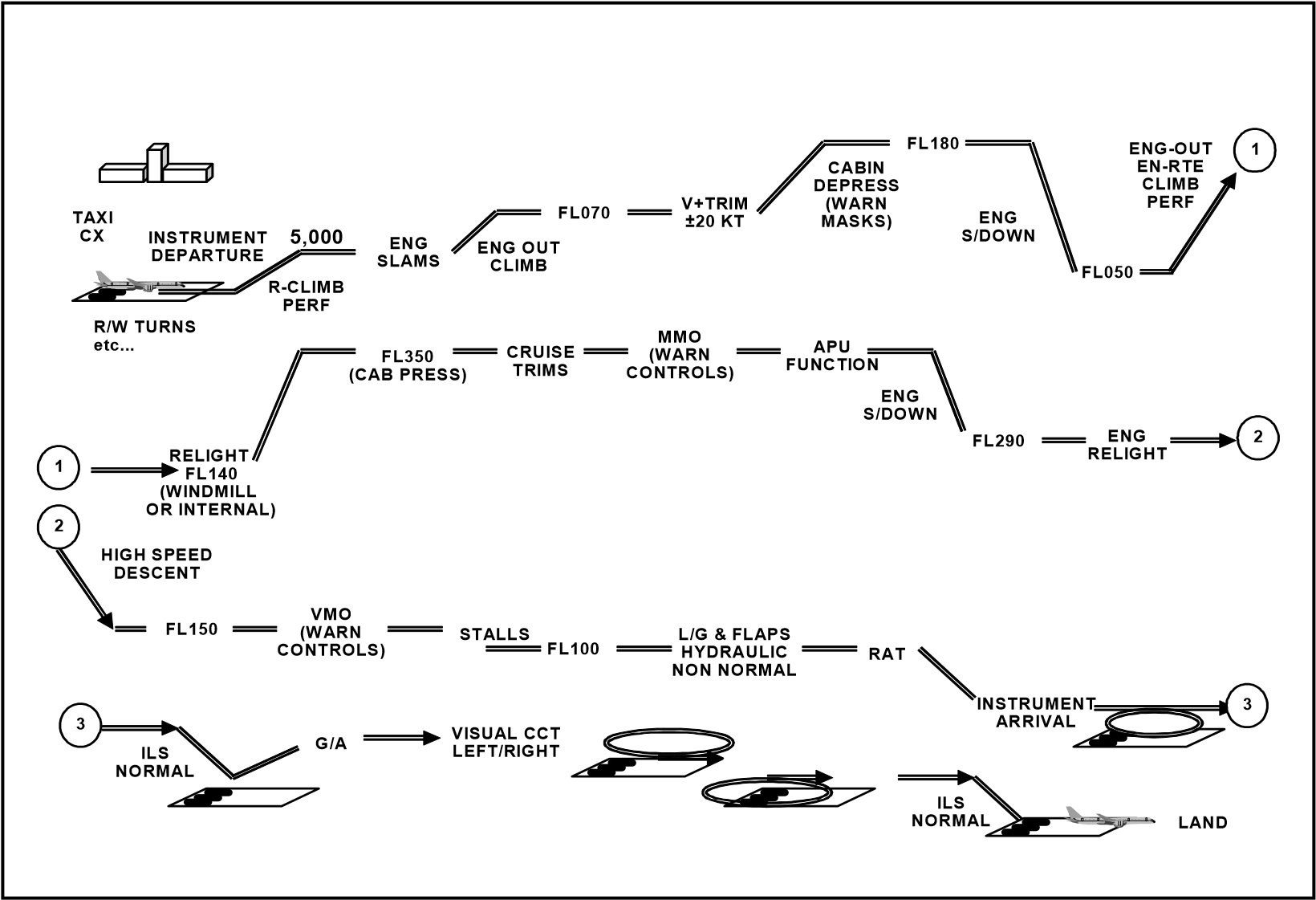 (g) Typical test profile for an FSTD helicopter:  (h) Typical subjective test profile for BITDs (approximately 2 hours) - items and altitudes, as applicable: (1) instrument departure, climb performance, (2) level-off at 4 000 ft, (3) fail engine (if applicable), (4) engine out climb to 6 000 ft (if applicable), (5) engine out cruise performance (if applicable), restart engine, (6) all engine cruise performance with different power settings, (7) descent to 2 000 ft, (8) all engine performance with different configurations, followed by instrument landing system (ILS) approach, (9) all engine go-around, (10) non-precision approach, (11) go-around with engine failure (if applicable), (12) engine out ILS approach (if applicable), (13) go-around engine out (if applicable), (14) non-precision approach engine out (if applicable), followed by go-around, (15) restart engine (if applicable), (16) climb to 4 000 ft, (17) manoeuvring, (18) normal turns left and right, (19) steep turns left and right, (20) acceleration and deceleration within operational range, (21) approaching to stall in different configurations, (22) recovery from spiral dive, (23) auto flight performance (if applicable), (24) system malfunctions, (25) approach.
AMC1 ARA.FSTD.100(a)(3) Initial evaluation procedure ED Decision 2012/006/R FUNCTIONS AND SUBJECTIVE TESTS – SUGGESTED TEST ROUTINE (a) During initial and recurrent evaluations of an FSTD, the competent authority should conduct a series of functions and subjective tests that together with the objective tests complete the comparison of the FSTD with the aircraft, the class of aeroplane or type of helicopter. (b) Functions tests verify the acceptability of the simulated aircraft systems and their integration. Subjective tests verify the fitness of the FSTD in relation to training, checking and testing tasks. (c) The FSTD should provide adequate flexibility to permit the accomplishment of the desired and required tasks while maintaining an adequate perception by the flight crew that they are operating in a real aircraft environment. Additionally, the instructor operating station (IOS) should not present an unnecessary distraction from observing the activities of the flight crew whilst providing adequate facilities for the tasks. (d) It is important that both the competent authority and the organisation operating an FSTD understand what to expect from the routine of FSTD functions and subjective tests. Part of the subjective tests routine for an FSTD should involve an uninterrupted fly-out (except for FTD level 1) comparable with the duration of typical training sessions in addition to assessment of flight freeze and repositioning. An example of such a profile is to be found under points (f) and (g) (for BITD point (h)). (e) The competent authorities, and organisations operating FSTD, who are unfamiliar with the evaluation process should contact the Agency or the competent authority of another Member State with adequate expertise in this field. (f) Typical test profile for an FSTD aeroplane: ![Aviation.Bot AI suggestion, not from EASA source: [Image caption skipped for debugging]](/static/files/file_9JKOJCH3CSC/image008.png) (g) Typical test profile for an FSTD helicopter: ![Aviation.Bot AI suggestion, not from EASA source: [Image caption skipped for debugging]](/static/files/file_9JKOJCH3CSC/image009.png) (h) Typical subjective test profile for BITDs (approximately 2 hours) - items and altitudes, as applicable: (1) instrument departure, climb performance, (2) level-off at 4 000 ft, (3) fail engine (if applicable), (4) engine out climb to 6 000 ft (if applicable), (5) engine out cruise performance (if applicable), restart engine, (6) all engine cruise performance with different power settings, (7) descent to 2 000 ft, (8) all engine performance with different configurations, followed by instrument landing system (ILS) approach, (9) all engine go-around, (10) non-precision approach, (11) go-around with engine failure (if applicable), (12) engine out ILS approach (if applicable), (13) go-around engine out (if applicable), (14) non-precision approach engine out (if applicable), followed by go-around, (15) restart engine (if applicable), (16) climb to 4 000 ft, (17) manoeuvring, (18) normal turns left and right, (19) steep turns left and right, (20) acceleration and deceleration within operational range, (21) approaching to stall in different configurations, (22) recovery from spiral dive, (23) auto flight performance (if applicable), (24) system malfunctions, (25) approach.
##### AMC1 ARA.FSTD.100(a)(3) Initial evaluation procedure *ED Decision 2012/006/R* **FUNCTIONS AND SUBJECTIVE TESTS – SUGGESTED TEST ROUTINE** (a) During initial and recurrent evaluations of an FSTD, the competent authority should conduct a series of functions and subjective tests that together with the objective tests complete the comparison of the FSTD with the aircraft, the class of aeroplane or type of helicopter. (b) Functions tests verify the acceptability of the simulated aircraft systems and their integration. Subjective tests verify the fitness of the FSTD in relation to training, checking and testing tasks. (c) The FSTD should provide adequate flexibility to permit the accomplishment of the desired and required tasks while maintaining an adequate perception by the flight crew that they are operating in a real aircraft environment. Additionally, the instructor operating station (IOS) should not present an unnecessary distraction from observing the activities of the flight crew whilst providing adequate facilities for the tasks. (d) It is important that both the competent authority and the organisation operating an FSTD understand what to expect from the routine of FSTD functions and subjective tests. Part of the subjective tests routine for an FSTD should involve an uninterrupted fly-out (except for FTD level 1) comparable with the duration of typical training sessions in addition to assessment of flight freeze and repositioning. An example of such a profile is to be found under points (f) and (g) (for BITD point (h)). (e) The competent authorities, and organisations operating FSTD, who are unfamiliar with the evaluation process should contact the Agency or the competent authority of another Member State with adequate expertise in this field. (f) Typical test profile for an FSTD aeroplane: 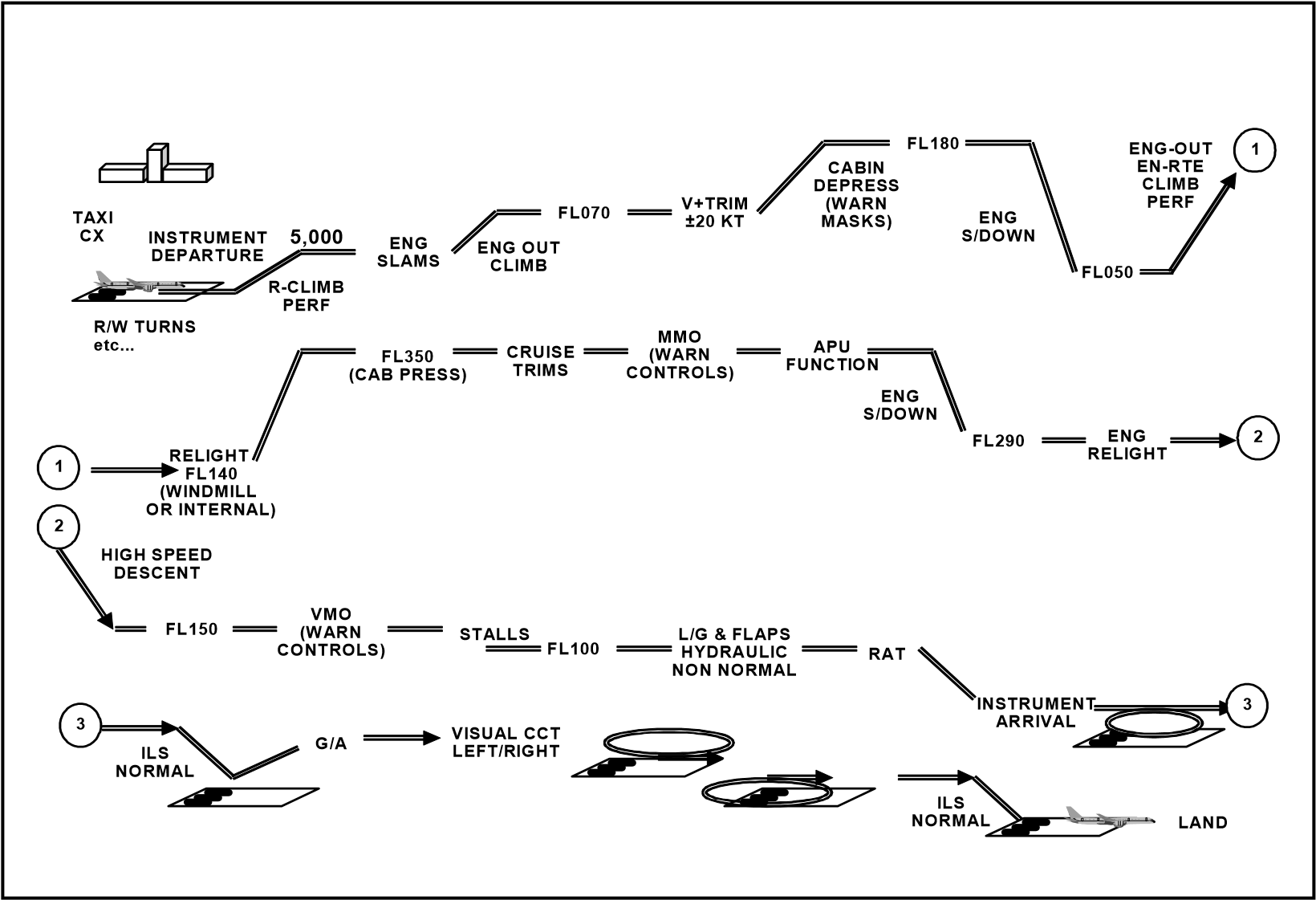 (g) Typical test profile for an FSTD helicopter:  (h) Typical subjective test profile for BITDs (approximately 2 hours) - items and altitudes, as applicable: (1) instrument departure, climb performance, (2) level-off at 4 000 ft, (3) fail engine (if applicable), (4) engine out climb to 6 000 ft (if applicable), (5) engine out cruise performance (if applicable), restart engine, (6) all engine cruise performance with different power settings, (7) descent to 2 000 ft, (8) all engine performance with different configurations, followed by instrument landing system (ILS) approach, (9) all engine go-around, (10) non-precision approach, (11) go-around with engine failure (if applicable), (12) engine out ILS approach (if applicable), (13) go-around engine out (if applicable), (14) non-precision approach engine out (if applicable), followed by go-around, (15) restart engine (if applicable), (16) climb to 4 000 ft, (17) manoeuvring, (18) normal turns left and right, (19) steep turns left and right, (20) acceleration and deceleration within operational range, (21) approaching to stall in different configurations, (22) recovery from spiral dive, (23) auto flight performance (if applicable), (24) system malfunctions, (25) approach.