MOC VTOL.2205 Interaction
of systems and structures
n/a
1. General
The following criteria should be used for compliance with VTOL.2205 for aircraft equipped with flight control systems, autopilots, stability augmentation systems, load alleviation systems, flutter control systems, fuel management systems and any other system the failure of which could affect the load condition or aeroelasticity characteristics of the aircraft. If this MOC is used for other systems, it may be necessary to adapt the criteria to the specific system.
(a) The criteria defined herein only address the direct structural consequences of the system responses and performances and cannot be considered in isolation but should be included in the overall safety evaluation of the aircraft. These criteria may in some instances duplicate standards already established for this evaluation. These criteria are applicable to any structure the loading of which may be modified by failure(s) of a system. Specific criteria that define acceptable limits on handling characteristics or stability requirements when operating in the system degraded or inoperative mode are not provided in this MOC.
(b) Depending upon the specific characteristics of the aircraft, additional studies may be required that go beyond the criteria provided in this appendix in order to demonstrate the capability of the aircraft to meet other realistic conditions such as alternative gust or manoeuvre descriptions for an aircraft equipped with a load alleviation system.
(c) The following definitions are applicable to this MOC.
(1) Structural performance: Capability of the aircraft to meet the structural requirements of SC-VTOL.
(2) Flight limitations: Limitations that can be applied to the aircraft flight conditions following an in-flight occurrence and that are included in the flight manual (e.g., speed limitations, avoidance of severe weather conditions, etc.).
(3) Operational limitations: Limitations, including flight limitations, that can be applied to the aircraft operating conditions before dispatch (e.g., fuel, payload and Master Minimum Equipment List limitations).
(4) Probabilistic terms: The probabilistic terms (probable, improbable, extremely improbable) used in this MOC are the same as those used in MOC VTOL.2510.
(5) Failure condition: The term failure condition is the same as that used in MOC VTOL.2510, however this MOC applies only to system failure conditions that affect the structural performance of the aircraft (e.g., system failure conditions that induce loads, change the response of the aircraft to inputs such as gusts or pilot actions, or lower flutter margins).
2. Effects of Systems on Structures
(a) General. The following criteria will be used in determining the influence of a system and its failure conditions on the aircraft structure. The analysis should be performed for each aircraft configuration or flight mode, as appropriate.
(b) System fully operative. With the system fully operative, the following apply:
(1) Limit loads should be derived in all normal operating configurations of the system from all the limit conditions specified in Subpart C, taking into account any special behaviour of such a system or associated functions or any effect on the structural performance of the aircraft that may occur up to the limit loads. In particular, any significant nonlinearity (rate of displacement of control surface, thresholds or any other system nonlinearities) should be accounted for in a realistic or conservative way when deriving limit loads from limit conditions.
(2) The aircraft should meet the strength requirements of SC-VTOL (Static strength, residual strength), using the specified factors to derive ultimate loads from the limit loads defined above. The effect of nonlinearities should be investigated beyond limit conditions to ensure the behaviour of the system presents no anomalies compared to the behaviour below limit conditions. However, conditions beyond limit conditions need not be considered when it can be shown that the aircraft has design features that will not allow it to exceed those limit conditions.
(3) The aircraft should meet the aeroelastic stability requirements of VTOL.2245
(c) System in the failure condition. For any system failure condition not shown to be extremely improbable, the following applies:
(1) At the time of occurrence. At the time of failure, the aircraft should be evaluated in 1-g level flight and also the most critical flight condition from the usage spectrum defined under MOC VTOL.2240(a)(b). Starting from these flight conditions, a realistic scenario, including pilot corrective actions, should be established to determine the loads occurring at the time of failure and immediately after failure.
Note: Failure scenarios may be excluded from the evaluation, if the probability of occurrence of the failure mode combined with the probability of being in the flight condition is shown to be extremely improbable.
(i) For static strength substantiation, these loads should be multiplied by an appropriate factor of safety that is related to the probability of occurrence of the failure in order to establish theultimate loads to be considered for design. The factor of safety (F.S.) is defined in Figure 1 where 10-X is equal to the probability associated to Extremely Improbable for the aircraft Category and number of passengers in accordance with MOC VTOL.2510.
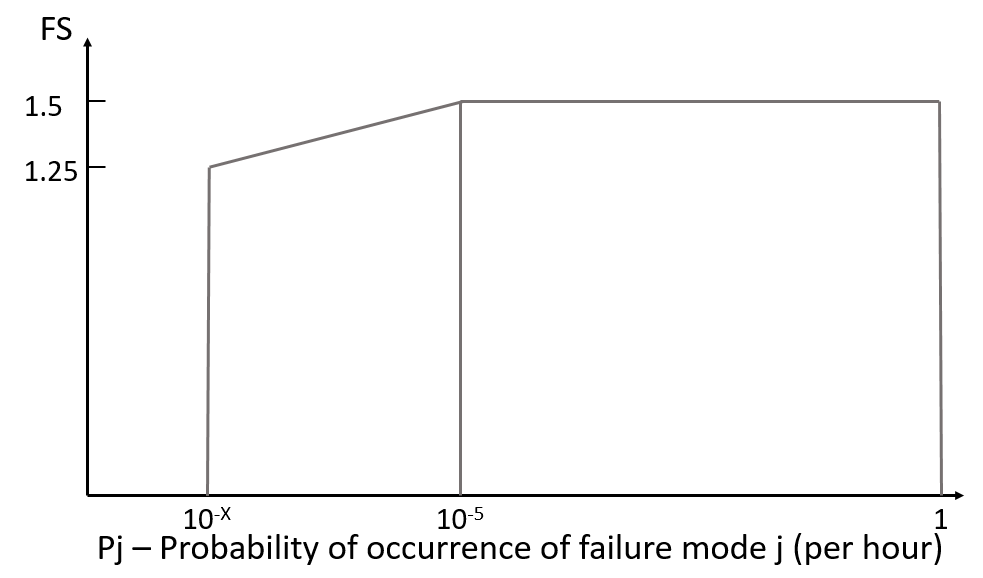
Figure 1: Factor of safety at the time of occurrence
(ii) For residual strength substantiation, the aircraft should be able to withstand two thirds of the ultimate loads defined in subparagraph (c)(1)(i).
(iii) Freedom from aeroelastic instability should be shown up to VD. The margins intended by MOC VTOL.2245 should be maintained.
(iv) For failure conditions that result in excursions beyond the never-exceed speed, VNE, freedom from aeroelastic instability should be shown to increased speeds, so that the margins intended by MOC VTOL.2245 are maintained. Similarly, any failure condition that results in excursions beyond other operating limitations, such as rpm ranges, freedom from aeroelastic instability should be shown considering these exceedances.
(v) Failures of the system that result in forced structural vibrations (oscillatory failures) should not produce loads that could result in detrimental deformation of primary structure.
(2) For the continuation of the flight. For the aircraft, in the system failed state and considering any appropriate reconfiguration and flight limitations, the following apply:
(i) The loads derived from the following conditions should be determined:
(A) The following limit flight manoeuvring conditions specified in MOC VTOL.2215 should be determined, at speeds up to VNE or the speed limitation prescribed for the remainder of the flight, unless otherwise stated:
(c) Symmetrical flight load conditions
(d) Symmetrical Pull-up and Recovery
(e) Symmetrical Pushover and Recovery
(f) Rolling Flight Conditions
(g) Yawing Conditions (or VH, whichever is lower)
(h) 50ft/sec gust cases (or VH, whichever is lower)
(B) The limit ground loads specified in MOC VTOL.2220
(ii) For static strength substantiation, each part of the structure should be able to withstand the loads in subparagraph (2)(i) of this paragraph multiplied by a factor of safety depending on the probability of being in this failure state. The factor of safety is defined in Figure 2 where 10-X is equal to the probability associated to Extremely Improbable for the aircraft Category and number of passengers in accordance with MOC VTOL.2510.
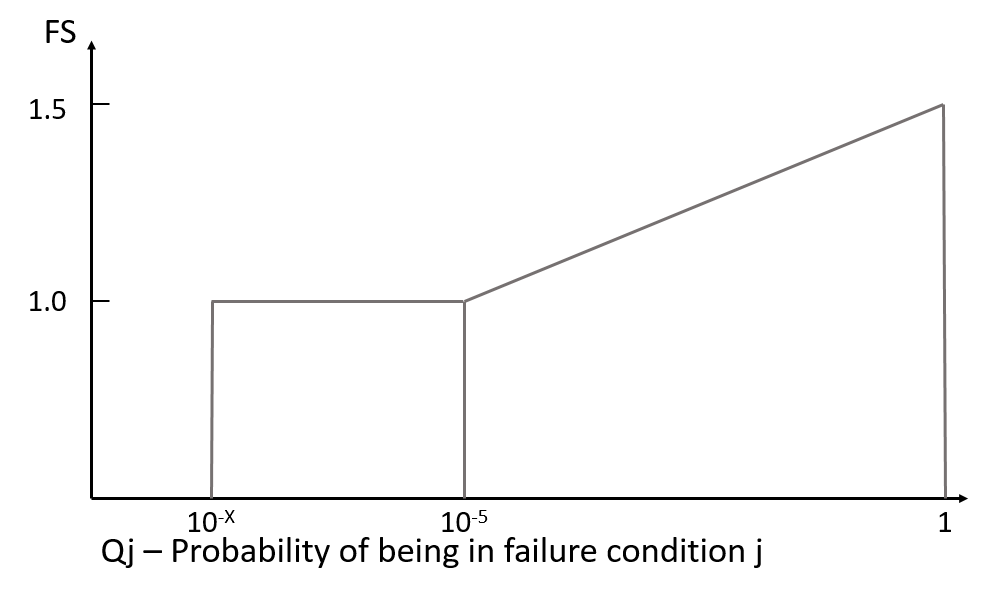
Figure 2: Factor of safety for continuation of flight
Qj = (Tj)(Pj) where:
Tj = Average time spent in failure condition j (in hours)
Pj = Probability of occurrence of failure mode j ( per hour)
Note: If Pj is greater than 10-3 per flight hour then a 1.5 factor of safety should be applied to all limit load conditions specified in Subpart C.
(iii) For residual strength substantiation, the aircraft should be able to withstand two thirds of the ultimate loads defined in subparagraph (c)(2)(ii).
(iv) If the loads induced by the failure condition have a significant effect on VTOL.2240(a) and (b) durability then their effects should be taken into account.
(v) Freedom from aeroelastic instability should be shown up to a speed determined from Figure 3. Flutter clearance speeds V' and V'' may be based on the speed limitation specified for the remainder of the flight using the margins defined by MOC VTOL.2245.
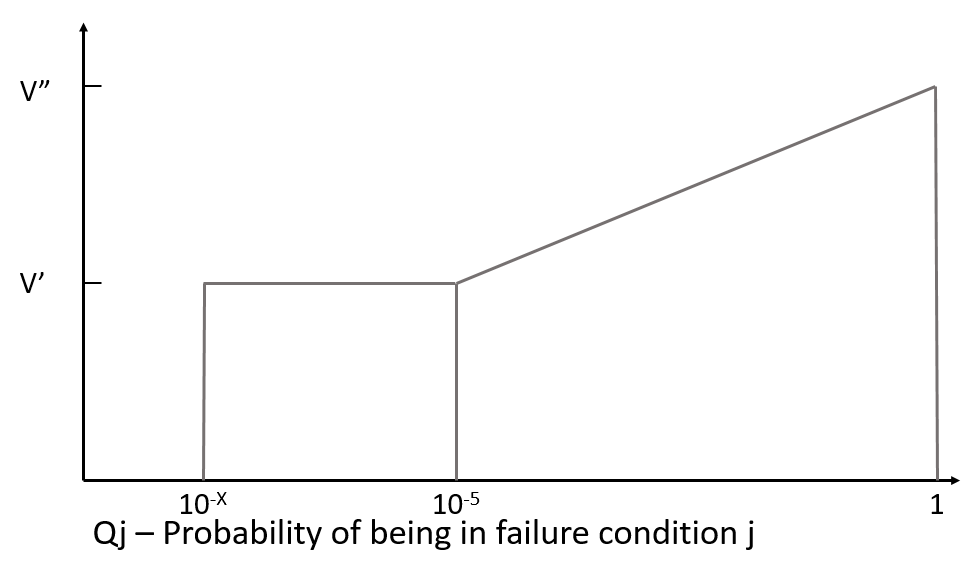
V' = Clearance speed as defined by maximum permissible speed (VNE) in the failed condition times 1.11
V''= An increase of 20% of V’
Qj = (Tj)(Pj) where:
Tj = Average time spent in failure condition j (in hours)
Pj = Probability of occurrence of failure mode j (per hour)
Note: If Pj is greater than 10-3
per flight hour, then the flutter clearance speed should not be less than V''.
(vi) Freedom from aeroelastic instability should also be shown up to V' in Figure 3 above, for any probable system failure condition combined with any damage required or selected for investigation by VTOL.2240
(3) Consideration of certain failure conditions may be required by other paragraphs of SC-VTOL regardless of calculated system reliability. Where the failure analysis shows the probability of these failure to be less than the probability associated to Extremely Improbable for the aircraft Category and number of passengers in accordance with MOC VTOL.2510, criteria other than those specified in MOC VTOL.2510 may be used for structural substantiation to show continued safe flight and landing (for Category Enhanced) or controlled emergency landing (for Category Basic)
(d) Failure indications. For system failure detection and indication, the following applies:
(1) The system should be checked for failure conditions, not extremely improbable, that degrade the structural capability below the level required by SC-VTOL or significantly reduce the reliability of the remaining system. As far as reasonably practicable, the flight crew should be made aware of these failures before flight. Certain elements of the control system, such as mechanical and hydraulic components, the use of special periodic inspections, and daily checks for electronic components maybe proposed , in lieu of detection and indication systems to achieve the objective of this requirement. These certification maintenance requirements should be limited to component failures that are not readily detectable by normal detection and indication systems and where service history shows that inspections will provide an adequate level of safety.
(2) The existence of any failure condition, that is not extremely improbable, during flight that could significantly affect the structural capability of the VTOL capable aircraft and for which the associated reduction in airworthiness can be minimised by suitable flight limitations, should be signalled to the flight crew. For example, failure conditions that result in a factor of safety between the aircraft strength and the loads of Subpart C below 1.25, or flutter margins below V", should be signalled to the flight crew during flight.
(e) Dispatch with known failure conditions. If the aircraft is to be dispatched in a known system failure condition that affects structural performance, or affects the reliability of the remaining system to maintain structural performance, then the provisions of VTOL.2205 should be met for the dispatched condition and for subsequent failures. Flight limitations and expected operational limitations may be taken into account in establishing Qj as the combined probability of being in the dispatched failure condition and the subsequent failure condition for the safety margins in Figures 2 and 3. These limitations should be such that the probability of being in this combined failure state and then subsequently encountering limit load conditions is extremely improbable. No reduction in these safety margins is allowed if the subsequent system failure rate is greater than 10-3 per hour.