n/a
This MOC does not cover the approach before the landing and starts from a point at which the decision to land, from an operational point of view, has been taken.
1. Landing procedures
(a) The landing can be of two main types: a Conventional Landing (ConvL) or a Vertical Landing (VL):
(1) A ConvL path starts at a Landing Decision Point (LDP, see below) and ends at the point where the aircraft reaches a stop at the FATO on the ground (after which it may taxi). The trajectory may have the most appropriate glide path foreseen by the applicant.
(2) A VL might be required to comply with obstacle separation when landing on a Vertiport in an Urban Air Mobility (UAM) environment. The applicant may choose to have, from a point along the approach after the LDP, a pure vertical trajectory.
(b) The landing procedures should be demonstrated to be consistently executable by flight crew of average skill, as required by VTOL.2105(c).
(c) The landing distance scatter and the maximum deviations from a nominal trajectory should be determined by the applicant.
2. Landing decision point (LDP)
(a) The characteristic point along the landing flight path is the Landing Decision Point (LDP), which is defined as the last point from which a balked landing can be performed. After LDP a balked landing is not assured.
(b) If the aircraft is required to show continued safe flight and landing, then a landing should be possible following a CFP before or after the LDP.
(c) LDP should be identified with a combination of height, vertical speed and airspeed and/or ground speed.
(d) LDP should be reached at a speed equal or lower to VREF.
3. Landing reference Speed (VREF)
The landing reference speed is the speed determined at the flight Glide Path Angle (GPA) for which certification is sought and with all lift/thrust systems operative that:
(a) allows for speed variations during a landing in expected turbulence and all reasonably expected environmental conditions; and
(b) provides enough manoeuvring capability; and
(c) is the initial speed that should be used to determine the area required to land and come to a stop.
4. Landing distance required (LDRV) and
touchdown and lift-off area (TLOF) required
(a) The landing distance required is the horizontal distance required to land and come to a stop from a point 15 m (50 ft) above the landing surface (Figure 1). The touchdown and lift-off area (TLOF) required is defined in MOC VTOL.2115 section (12).
(b) The landing distance required for VTOL capable aircraft (LDRV) that provides safe containment following a CFP being recognized at LDP should be established and published in metres, rounded up to the next tenth.
(a) The aircraft should be capable of a balked landing following a CFP event without requiring configuration changes commanded by the flight crew until regaining VTOSS. Reaching VTOSS could require continuing the descent, but the minimum height of 35 ft above the vertiport elevation or above h2, depending on the landing procedure, based on which the take-off distances are calculated, should be respected to ensure obstacle clearance.
(b) Once VTOSS has been regained, configuration changes are permitted, and the minimum climb gradients for the 1st and 2nd segment of the take-off path should be guaranteed (see MOC VTOL.2115).
(c) A representative time to perform a go-around from LDP back to LDP should be provided for the determination of the energy reserve.
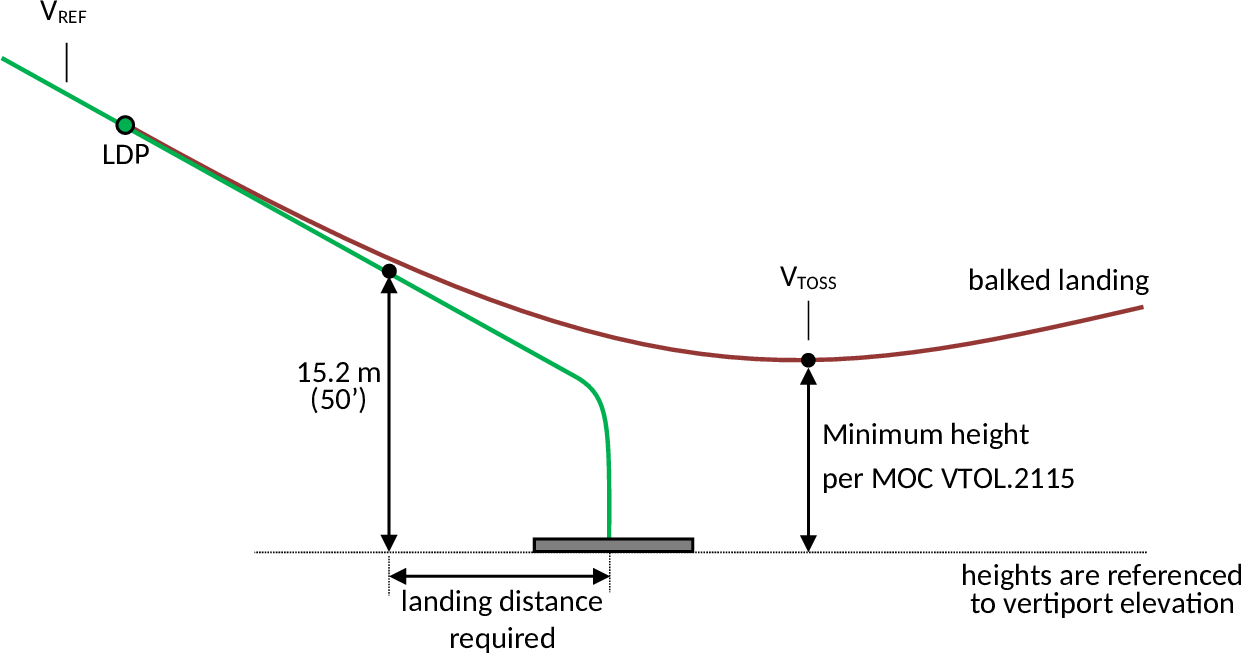
Figure 1: Landing path
6. Aircraft Flight Manual Data:
The AFM should include the following data, defined in the previous sections of this MOC:
(a) Landing procedures
(b) Landing decision point (LDP)
(c) Landing reference Speed (VREF)
(d) Landing distance required (LDRH)
(e) Balked landing procedure