AMC1 21.A.7(c) Completeness and timely availability of the ICA
COMPLETENESS AND TIMELY AVAILABILITY OF THE ICA FOR TYPE-CERTIFICATE (TC) AND RESTRICTED TYPE‑CERTIFICATE (RTC) APPLICANTS
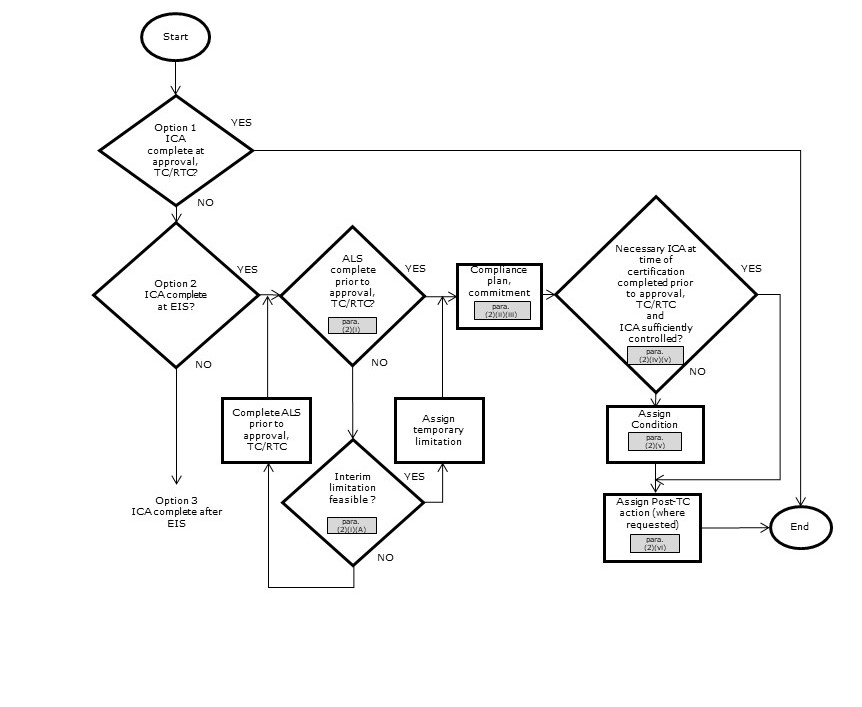
(a) An applicant may wish to choose among the three options described below. Once the certification programme starts, it may be necessary to modify the initially selected option to accommodate programme changes. All such changes should be coordinated with EASA.
(1) Option 1: Complete ICA are available at the time of the design approval (TC/RTC)
(i) The ICA will be made available at the time of the design approval. This option minimises the risk of incomplete ICA, especially for changes.
(ii) With all ICA available at the time of the design approval, they should also be furnished / made available to the aircraft operator / aircraft owner and made available to any other person required to comply with any of those instructions in accordance with points 21.A.21(c)(4), 21.A.44 and 21.A.7, without using the provision to delay certain parts of the ICA after the entry into service.
(iii) Frequently, there is only a short period of time between the design approval and the entry into service. Nevertheless, applicants/holders may still wish to apply Option 2 or 3 for a part of their ICA as stated below.
(2) Option 2: Complete ICA are available at entry into service (TC/RTC)
If an applicant plans to make part of the ICA available to EASA at entry into service, the following approach is acceptable:
(i) For the ALS, as part of the type design, notwithstanding the selection of Option 2: the applicant submits the ALS for approval prior to the design approval. Any ALS content that is incomplete, not yet demonstrated for compliance, or delayed beyond the design approval, requires to be compensated through an interim limitation to establish compliance within this limitation. The interim limitation is notified to the aircraft operator(s) concerned as a temporary operational limitation in a manner agreed with EASA.
In this context, ALS content is understood as the task method (e.g. a detailed inspection), including its reference, title and applicability, and the associated threshold / interval / life-limit. The accomplishment procedure itself, i.e. how to carry out the task, is usually described in other parts of the ICA (e.g. in the AMM or NDT manual). However, the feasibility study of the accomplishment procedure is required for compliance with specific requirements (e.g. CS 25.611).
(A) This may typically apply when the aircraft structural full-scale fatigue testing required for compliance with the fatigue- and damage-tolerance requirements, considering the expected operational life, will not be completed prior to the type certificate being issued. In this case, a temporary operational limitation is assigned and stated in the ALS, dependent on the aircraft full-scale fatigue testing progress. The ALS is effectively incomplete beyond this temporary operational limitation, as the required justification and the resulting ICA are not yet available to support the safe operation of the aircraft beyond this limitation.
(B) A TCDS notation is not necessary, since the product is provided with complete ALS content up to the established temporary operational limitation.
(ii) A compliance plan identifying those parts of the ICA that are only to be made available at entry into service is produced, submitted to EASA and agreed between the applicant and EASA prior to the design approval (refer also to (iv) for ICA considered to be necessary at the time of the design approval.
(iii) A commitment is provided to produce, verify and submit (when requested) to EASA the relevant ICA prior to entry into service. This commitment should be provided in a certification document (e.g. the compliance plan) and should also be addressed in a more general manner in a DOA procedure for EU holders/applicants in accordance with points 21.A.239 and 21.A.263. If the respective DOA holder has not previously exercised the practice of delaying the ICA beyond the design approval in order for the DOA to demonstrate this capability in its design assurance system (DAS), the required procedural changes need to be addressed via a significant change to the DAS in accordance with point 21.A.247.
(iv) ICA considered to be necessary at the time of design approval are provided or made available in a format that adequately defines the data. Furthermore, the way the data is presented at the time of the design approval offers the same understanding of the data as in the final published format.
The applicant should agree with the Agency, in a compliance plan, on all ICA necessary at the time of design approval. The Agency investigation may vary from no involvement or evaluating a limited sample of the ICA to performing a thorough review of specific parts of the ICA.
(v) In cases where the AgencyEASA has doubts as to whether the applicant/holder can fulfil the applicable requirements of point 21.A.44 to control and support delaying the ICA beyond the design approval, or TC/RTC, and until entry into service, EASA can decide to assign a condition for entry into service for non-ALS ICA.
As a condition for the entry into service, a note should be included in the type certificate data sheet (TCDS) as a result of these pending issues under the ICA paragraph as follows:
‘Note: The ICA are not complete. As per point 21.A.7 of Commission Regulation (EU) No 748/2012, they must be completed before the entry into service of the aircraft. Contact EASA for information on the status.’
The decision to assign a condition may be based on the applicant’s performance, e.g. if the applicant has already demonstrated in previous projects that it provided the complete set of ICA before the entry into service, if the applicant has already experienced difficulties in providing the ICA considered necessary at the time of the design approval, or has previously failed on a different project to meet its commitment to complete the ICA prior to entry into service, or if the applicant/holder has no previous experience with the practice of delaying the ICA beyond the design approval.
(vi) Post-TC action is established together with EASA (if EASA requests such a review) to review the ICA status at entry into service.
(vii) If all ICA are made available to EASA at the time of entry into service, they should also be furnished at this time to the aircraft operator / aircraft owner and made available to any other person(s) required to comply with any of those instructions in accordance with points 21.A.21(c)(4), 21.A.44 and 21.A.7, without using the provision to delay certain parts of the ICA beyond the entry into service. For an EU holder/applicant, this should be supported as part of the DOA/ADOA procedure.
Flow chart A — ‘Completeness of ICA’, Option 1 and 2
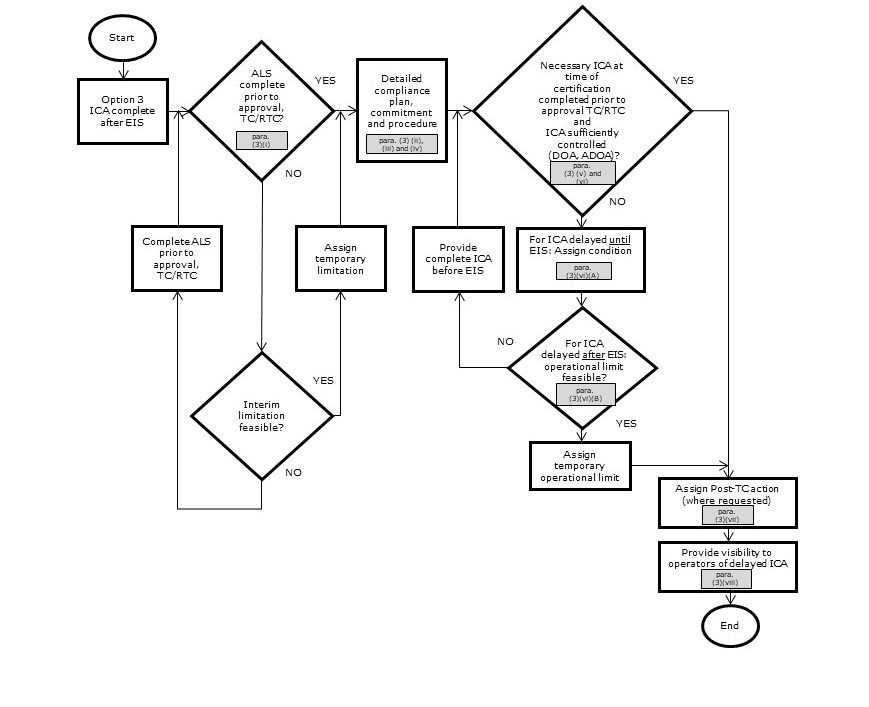
(3) Option 3: Complete ICA are available after the entry into service (TC/RTC)
As per point 21.A.7(c), certain ICA dealing with the ‘overhaul or other forms of heavy maintenance’ may be delayed until after the aircraft entry into service. Although there is no definition of what is meant by ‘overhaul or other forms of heavy maintenance’, the intention of the rule is to provide flexibility to applicants/holders for long-lead ICA of a scheduled nature.
If an applicant plans to make part of the ICA available only after the entry into service, the following is acceptable for the complete set of ICA:
(i) for the ALS, as it cannot be delayed until after the entry into service, point (i) of Option 2 applies;
(ii) for ICA considered to be necessary at the time of the design approval, point (iv) of Option 2 applies.
(iii) a detailed compliance plan identifying those parts of the ICA that are to be provided prior to and after the entry into service. For ICA made available after the entry into service, the plan should account for when the ICA are needed so that they can be complied with. This approach may only be used for scheduled maintenance accomplishment procedures, where threshold / interval / life-limit requirements of the related scheduled tasks are established. In that respect, the following aspects should be considered:
(A) The majority of the ICA are of an unscheduled nature; therefore, these items should be available at entry into service at the latest.
(B) Consideration should be given to the fact that a number of tasks are used for both scheduled and unscheduled maintenance (e.g. an operational check of a system is planned as a scheduled task at a certain point in time, but is also required as part of the installation procedure to determine the operational status of the system).
(C) For ICA to be made available after entry into service, the detailed plan should contain threshold(s) controlled by the applicant/holder, stating the maximum value in flight hours (FH) / flight cycles (FC) or calendar time (CT), or a combination of them as applicable, by which point in time the delayed ICA should be made available.
(D) This detailed plan should be available prior to the time of the design approval and should be either directly integrated or cross-referenced in a compliance plan.
(E) Information on the format in which the ICA delayed until after entry into service will be made available in time (e.g. regular revisions or temporary revisions (TRs) or service information (SBs, SIL, etc.).
(iv) A procedure/programme that ensures a detailed plan is produced and implemented in the applicant’s organisation in order to ensure the timely availability (to the aircraft operator / aircraft owner and to any other person required to comply with any of those instructions and to the Agency, if involved and when requested). For an EU holder/applicant, this should be part of the design organisation approval (DOA) procedure in accordance with points 21.A.239 and 21.A.263.
(v) A commitment is made to produce, verify and provide the relevant ICA in accordance with the detailed plan. This commitment should be provided in a certification document (e.g. a compliance plan) and should also be addressed in a more general manner in a DOA procedure for EU holders/applicants in accordance with points 21.A.239 and 21.A.263. If the respective DOA holder has not previously exercised the practice of delaying the ICA beyond the design approval in order for the DOA to demonstrate this capability in its design assurance system (DAS), the required procedural changes need to be addressed via a significant change to the DAS in accordance with point 21.A.247.
(vi) In order to ensure that the applicant/holder can meet their obligations as set out in point 21.A.44 to control and support delaying the ICA, EASA may decide:
(A) for ICA delayed until entry into service, to assign a condition/notation for the entry into service to be included in the TCDS as a result of these pending issues under the ICA paragraph, as per point (v) of Option 2;
(B) for ICA delayed until after entry into service, to assign an interim limitation to be published and included in the ALS as a temporary operational limitation, also for non-ALS ICA, to compensate for the delayed ICA; this approach may only be used for scheduled maintenance accomplishment procedures, where task and interval requirements are available.
The decision to assign a condition/limitation may be based on the applicant’s performance, e.g. if the applicant has already demonstrated in previous projects that it provided the complete set of ICA before the entry into service, if the applicant had already difficulties in providing the ICA considered necessary at the time of the design approval, or has failed before in a different project to control and support delaying the ICA, or if the applicant/holder has not previously exercised the practice of delaying the ICA beyond the design approval.
(vii) Post-TC action should be established with EASA to regularly review the ICA status, if EASA requests such a review, taking into account the DOA oversight activities.
(viii) An applicant/holder should provide visibility, regarding the ICA that are delayed beyond entry into service, to the aircraft operator / aircraft owner and to any other person(s) required to comply with any of those instructions. This can be achieved by providing this information, for example, on a website or in a document, such as an MPD or AMM, preferably in the principal ICA manual. This visibility information is then itself considered to be ICA information.
(ix) It is assumed that for those ICA that are made available to EASA at the time of entry into service, they are also at the same time furnished to the aircraft operator / aircraft owner and made available to any other person(s) required to comply with any of those instructions in accordance with points 21.A.21(c)(4), 21.A.44 and 21.A.7.
This is to satisfy EASA that such a delayed publication will not have an adverse effect on the continuing airworthiness of any individual aircraft.
To allow the timely review and incorporation of a delayed part of the ICA into continuing airworthiness activities and processes (e.g. amendment of the aircraft Maintenance Programme) by the person or organisation responsible for the aircraft continuing airworthiness or for performing maintenance, the Agency considers that the delayed ICA should typically be made available two years before the actual ICA has to be used, when using normal revisions as a format. However, shorter time margins may be acceptable, provided that the format used ensures the prompt notification of the availability of the delayed ICA or the ICA itself, but they should not be less than 1 year before the ICA has to be used.
Flow chart B — ‘Completeness of ICA’, Option 3
(b) Completeness and timely availability of changes to the ICA (TC/RTC)
Point 21.A.7(d) regulates the distribution of changes to the ICA required from the TC/RTC holder. Those changes to the ICA could result from the design change process (minor and major changes), in-service experience, corrections, and others.
For an EU TC/RTC holder/applicant, a programme showing how changes to the ICA are distributed is part of the respective procedures (e.g. design organisation procedures, or alternative procedures used to demonstrate capabilities). For changes to the ICA triggered by design changes, typically these procedures follow the same principles as those available for TC/RTC, Options 1 to 3, while taking into account the relevant privileges, e.g. that a DOA may approve minor changes in accordance with point 21.A.263(c)(2).