Appendix 2.5 to ETSO-C153a – Integrated Modular Avionics (IMA) Platform and Module Minimum Performance Standard (MPS
ED Decision 2020/011/R
This Appendix contains the Minimum Performance Standard (MPS) for the CLASS DS Intended Function: Data Storage.
These standards specify characteristics that should be useful to designers, manufacturers, installers and users of the IMA module.
1.2. Definitions
For ETSO-C153a CLASS DS, the IMA module provides shared resources in terms of data storage between hosted applications, modules and/or components.
Data Storage refers to the storage of data in a continuing and machine-readable mode. A Data Storage module that records data may access both the separate portable (removable) recording component and/or a permanent component to store and retrieve data.
The following definitions are used:
— Storage Unit: a set of physical components (hardware and/or software) in charge of supplying and managing recorded data resources (e.g. memory components and the associated interfaces, etc.)
— Data Storage Element: a completely defined set of data storage which is a primary form of recorded data and for which a level of isolation would be guaranteed by the IMA module.
In the context of DS class, the ‘concurrent item’ defined in Appendix 2.1, paragraph 1 means ‘Data Storage Element’.
For ETSO-C153a CLASS DS, the intended function is to provide the capability to share recorded data or data storage space supplied by one or several storage unit(s).
2. Requirements
2.1. Functional requirements for ETSO-C153a CLASS DS
DS.a) The IMA module shall provide to hosted applications, modules and/or components, a Data Storage Resource which has the capacity to record or to retrieve a set of data on/from a storage unit by performing data-retaining operations.
DS.b) The IMA module shall provide to hosted applications, modules and/or components, the capacity to use shared recorded data resources thanks to data storage elements accessible through (a) logical and/or physical interface(s).
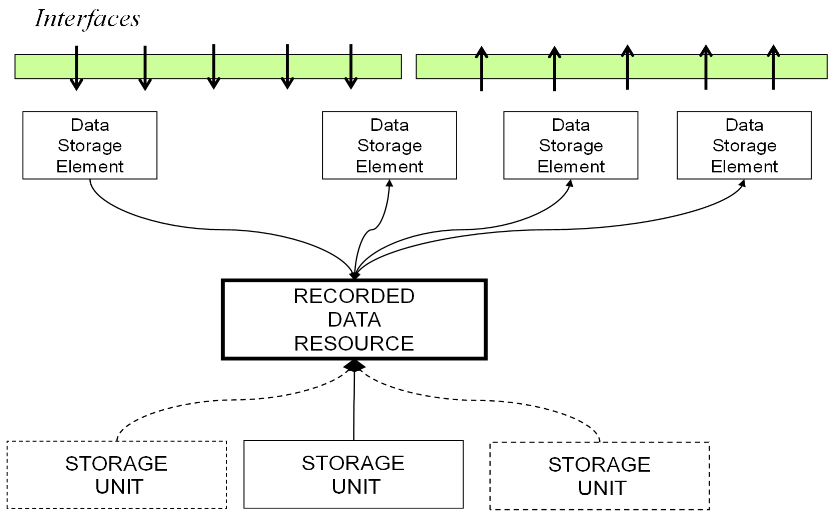
Figure 19: CLASS DS — the relationship between the data storage elements
2.2. Characterisation requirements
DS.c) All aspects of the Data Storage performance of the shared Storage Unit of the IMA module shall be characterised, including but not limited to the following:
1. performances of Memory Management functionality, including the cache and Memory Management Unit (e.g. storage capacity, cache performance, etc.);
2. performance of (a) User Interface Mechanism(s), Protocol(s) and Service(s) (e.g. access timings and throughputs, etc.); and
3. performance of a supported Data Storage Element Type (e.g. namespace, address scheme, arbitrary principles for multiple access, throughputs, timings, data space, etc.).
Note: These performance requirements are additional to those applicable in Appendix 2.1 — COMMON.
The following table gives the verification method for each MPS; nevertheless, an alternative method may be proposed to the certification authority:
-
Requirement identifier
Verification method
Test under normal conditions
Test under
environmental conditions
Comment
DS.a)
T
Y
Y
DS.b)
T
Y
Y
DS.c)
T(A*)
Y
Y(1)
Table 5: Verification Acceptance Criteria
(A*) means that verification by the Analysis method is possible for the item that cannot be tested.
Note (1): applicable for a functional subset cf. CO.gg).
[Amdt ETSO/10]
[Amdt ETSO/16]