Appendix 1 to ETSO-C44c A1 –
Minimum Performance Standard for
Fuel Flowmeters
ED Decision 2013/012/R
1. General Requirements.
The applicable standard is SAE AS407C, Fuel Flowmeters, dated July 1, 2001.
Paragraphs 3.1, 3.1.1, 3.1.2, 3.2.b, and 4.2.1 of the SAE AS407C do not apply to this ETSO.
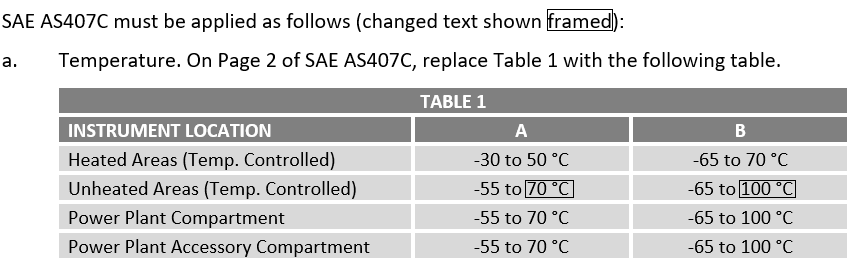
b. Altitude. In the first sentence of paragraph 3.3.4, Altitude, (page 3), replace ‘40.000 feet (12.192 m) standard altitude’ with ‘51.000 ft (15.545 m) standard altitude’.
c. Leak Test. In the second sentence of paragraph 6.3, Leak Test, (page 6), replace to ‘an air pressure of 40 psi (275.8 kPa)’ with ‘to an air pressure in accordance with the manufacturer's recommendations’.
2. Testing Your Fuel Flowmeter.
In addition to the qualification test requirements described in SAE AS407C, perform the following tests:
a. Thermal Shock Test. This test applies to any hermetically sealed components. Subject the components to four cycles of exposure to water 85 °C ± 2 °C and 5 C° ± 2 °C. There should be no evidence of moisture damage to coating or enclosure. During each cycle of the test, immerse the component in water at 85 °C ± 2 °C for 30 minutes. Within 5 seconds of removal from the bath, immerse the component for 30 minutes in the other bath maintained at 5 °C ± 2 °C. Repeat this cycle continuously, one cycle following the other until four cycles are completed. After this test, subject the component to the sealing test in paragraph 2b (2) of this appendix. The component must have no leakage resulting from the test.
b. Sealing Test. Apply this performance test to any hermetically
sealed components. Immerse the component in a suitable liquid such as
water. Then reduce the absolute pressure of the air above the liquid
to about 1 inch of mercury (Hg) (3.4 kPa) Maintain this absolute
pressure for 1 minute, or until the liquid stops giving off air
bubbles, whichever is longer. Increase the absolute pressure by 2½
inches Hg (8.5 kPa). If any bubbles come from the component case,
consider it Leakage and reject the component. Do not consider
bubbles, resulting from entrapped air in the exterior parts of the
case, as leakage. If other test methods provide evidence equal to the
immersion test, they can be used to test the integrity of the
instrument’s seals. If the component includes
non-hermetically
sealed appurtenances such as a case extension, these appurtenances
can be removed before the sealing test.
c. Other Tests. The following table lists where other tests and conditions can be found:
-
-
For:
Use the test conditions in:
Fire-resistant or fireproof test
SAE AS 1055, Rev. D, dated June 1997, Sections 4 and 5
The following sections of the environmental standards mentioned in paragraph 3.1.2 above.
Explosion proofness test
Section 9
Power input test
Section 16
Voltage spike test
Section 17
Audio frequency conducted susceptibility test
Section 18
Induced signal susceptibility test
Section 19
Radio frequency susceptibility test
Section 20
-
[Amdt ETSO/3]
[Amdt ETSO/8]