AMC1 ACNS.C.PBN.555 Vertical accuracy
when using barometric VNAV
ED Decision 2022/008/R
When supporting VNAV, the vertical total system error (TSEZ), taking into account all the errors in the aircraft processing chain of the vertical guidance, should be lower than or equal to the values specified in the table below.
|
Altitude
bands |
Level
flight segments & climb/descent intercept of clearance altitudes |
Flight
along specified vertical descent profile |
|
At or below 5 000 ft MSL |
150 ft |
160 ft |
|
Above 5 000 to 29 000 ft MSL |
200 ft |
210 ft |
|
Above 29 000 to 41 000 ft MSL |
200 ft |
260 ft |
Maximum vertical total
system error (TSEZ)
TSEZ should be calculated as the combination of the altimetry system error (ASE), the vertical path steering error (PSEZ), the vertical path definition error (PDEZ) and the horizontal coupling error (HCE) — see the figure below. Vertical navigation accuracy (TSEZ) is expected to be achieved for at least 99.7 % of the flight time. Assuming that these four errors are Gaussian and independent, the distribution of TSEz is also Gaussian with a standard deviation equal to the root sum square (RSS) of the standard deviations of the ASE, PSEZ, PDEZ, and HCE.

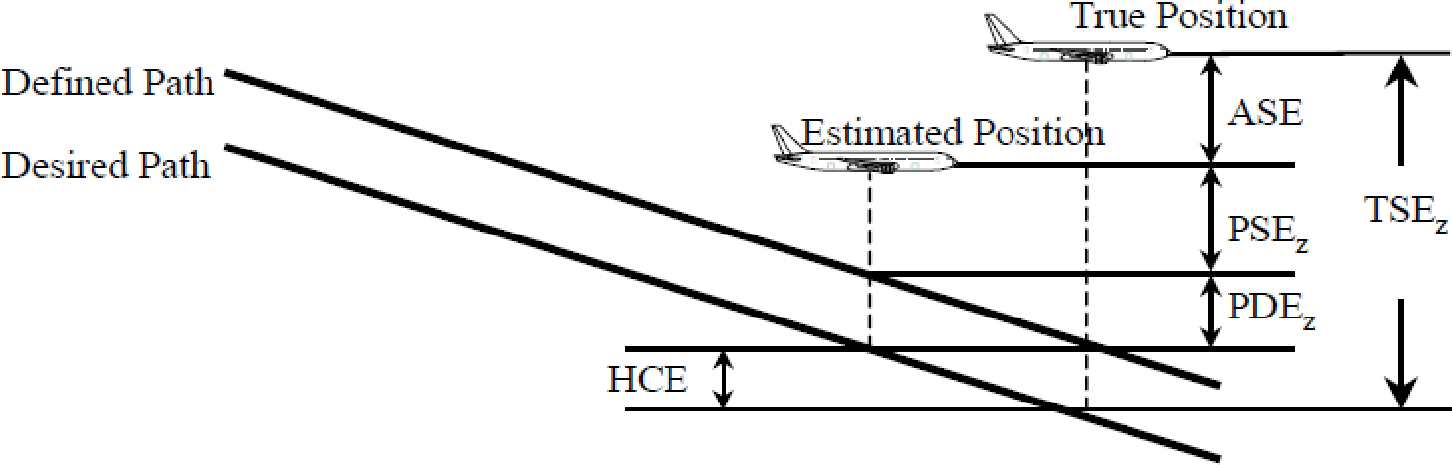
Vertical errors
(a) Altimetry system error (ASE)
Altimetry system performance is demonstrated separately from the VNAV certification through the static pressure system certification process (e.g. CS XX.1325). Altimetry systems that meet such a requirement satisfy the ASE requirements for VNAV operations. No further demonstration or compliance is necessary, and the following formula should be used to calculate the ASE (in ft) as a function of the aircraft altitude H (in ft), representing the maximum value which is expected to be achieved for at least 99.7 % of the flight time.

(b) Vertical path definition error (PDEZ)
VNAV path definition error is the error associated to the vertical path computation. It includes path definition error (PDE) and the approximation made by the VNAV equipment for the vertical path construction, if any. This is addressed through equipment approval (ETSO).
(c) Horizontal coupling error (HCE)
HCE (vertical error component of along-track positioning error) is a function of the horizontal NSE and is directly reflected in the along-track tolerance offset used in BARO-VNAV procedure design criteria. The HCE should only be taken into account in the final approach segment.
HCE is expected to be achieved for at least 99.7 % of the flight time and, in this context, may be assumed to be equal to 24 ft on a vertical path of 3 degrees°.
(d) Vertical path steering error (PSEZ)
The vertical path steering performance varies depending on how operations are conducted (manual, flight director or autopilot). The use of a flight director or autopilot may be required to support the PSEZ requirement in certain conditions. In this case, the required navigation performance (RNP) system coupling to the flight director and/or autopilot should be unambiguously displayed in the flight crew’s optimum field of view. This should also be documented in the AFM.
[Issue: CS-ACNS/2]
[Issue: CS-ACNS/4]