Appendix 2 — Test
specification rationale
ED Decision 2018/007/R
(a) Introduction
The overall risk of capsizing within the 5-minute exposure period
consists of two components: the probability of capsizing in a given wave
condition, and the probability of experiencing that wave condition in an
emergency landing on water.
If it is assumed that an emergency landing on water occurs at random
and is not linked with weather conditions, the overall risk of a capsizing can
be established by combining two pieces of information:
(1) The wave climate scatter table, which shows the probability of meeting any particular combination of Hs and Tz. An example scatter table is shown below in Figure 1 — Example of all-year wave scatter table. Each cell of the table contains the probability of experiencing a wave condition with Hs and Tz in the range provided. Thus, the total of all cells in the table adds up to unity.
(2) The
probability of a capsizing in a 5-minute exposure for each of these
height/period combinations. This probability of capsizing is different for
each helicopter design and for each wave height/period combination, and is to
be established through scale model testing using the method defined above.
In theory, a model test for the rotorcraft design should be performed
in the full range of wave height/period combinations covering all the cells in
the scatter table. Clearly, wave height/period combinations with zero or very
low probabilities of occurrence might be ignored. It might also be justifiably
assumed that the probability of capsizing at very high wave heights is unity,
and at very low wave heights, it is zero. However, there would still remain a
very large number of intermediate wave height/period combinations that would
need to be investigated in model tests, and it is considered that such a test
programme would be too lengthy and costly to be practicable.
The objective here is therefore to establish a justifiable method of estimating the overall 5-minute capsize probability using model test results for a single-wave condition. That is a single combination of Hs and Tz. Such a method can never be rigorously linked with the safety objective, but it is proposed that it may be regarded as a conservative approximation.
(b) Test
methodology
The proposed test methodology is as follows:
The rotorcraft designer selects a desired significant wave height limit
Hs(limit) for ditching or the emergency flotation certification of his
helicopter. Model tests are performed in the sea condition Hs(limit)
Tz(limit) (where Tz(limit) is the zero-crossing period most likely to accompany Hs(limit))
with the selected spectrum shape using the method specified above, and the
5-minute probability of capsizing (Pcapsize) established in this sea
condition.
The way in which Pcapsize varies for other values of Hs and Tz is not known
because it is not proposed to perform model tests in all the other possible
combinations. Furthermore, there is no theoretical method to translate a
probability of capsizing from one sea condition to another.
However, it is known that the probability of capsizing is related to
the exposure to breaking waves of sufficient height, and that this is in turn
linked with wave steepness. Hence:
(1) the
probability of capsizing is likely to be higher for wave heights just less
than Hs(limit) but with wave
periods shorter than Tz(limit); and
(2) the
probability of capsizing will be lower for the larger population of wave
conditions with wave heights less than Hs(limit) and with wave
periods longer than Tz(limit).
So, a reasonable and conservative assumption is that on average, the
same Pcapsize holds good for all wave conditions with heights less
than or equal to Hs(limit).
A further conservative assumption is that Pcapsize is unity
for all wave heights greater than Hs(limit).
Using these assumptions, a comparison of the measured Pcapsize
in Hs(limit) Tz(limit) against the target probability of
capsizing (Pcapsize(target)) can be performed.
In jurisdictions where flying is not permitted when the wave height is
above Hs(limit), the rotorcraft will have passed the certification
criteria provided that Pcapsize ≤ Pcapsize(target).
In jurisdictions where flying over waves greater than Hs(limit) is permitted, the rotorcraft will have passed the certification criteria provided that: Pcapsize ≤ Pcapsize(target) – Pe, where Pe is the probability of exceedance of Hs(limit). Clearly, in this case, it can be seen that it would not be permissible for the rotorcraft designer to select an Hs(limit) which has a probability of exceedance greater than Pcapsize(target).
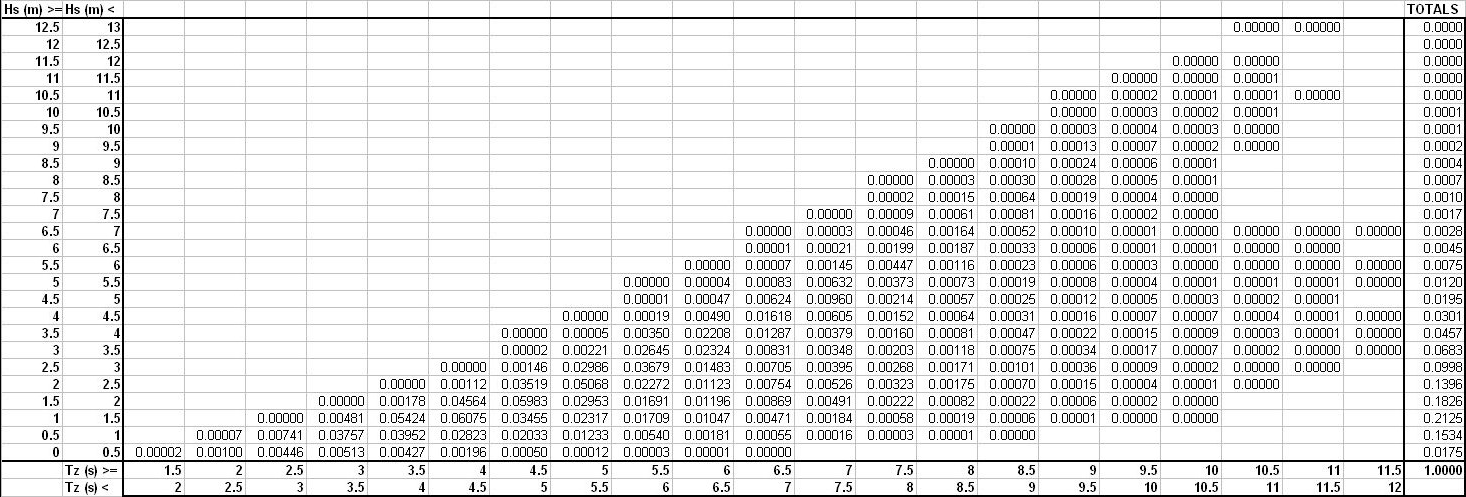
Figure 1 —
Example of all-year wave scatter table
[Amdt No: 27/5]