The diagram below describes the full process that may be followed, the various stakeholders involved, and the modification loops that may be applied to the validation data roadmap (VDR).
This full process applies to the VDR that is delivered by a data provider and to the first flight simulation training device (FSTD) qualification that is based on this VDR.
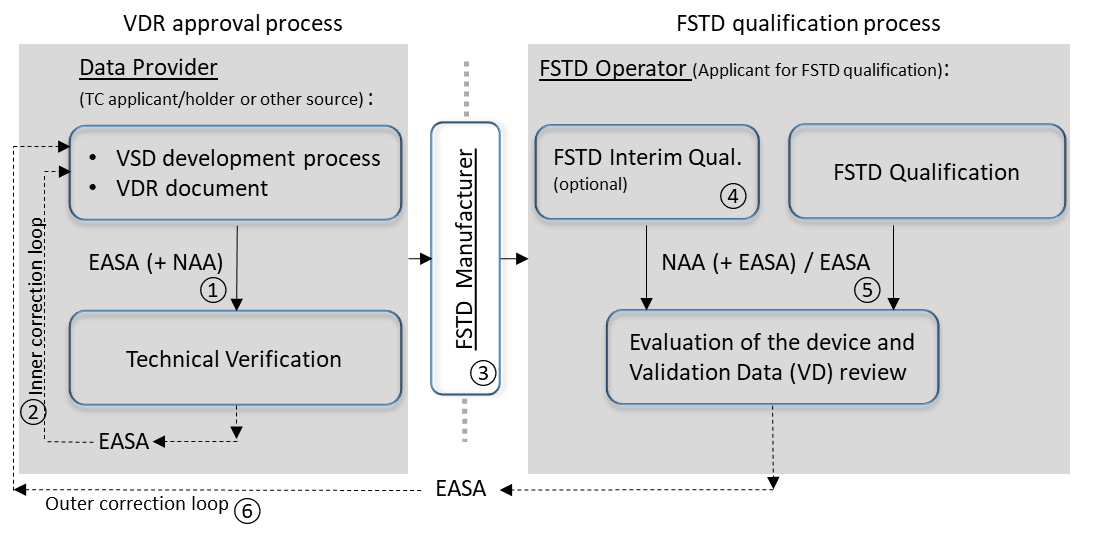
Point ①: EASA is
responsible for the technical verification of compliance against CS-SIMD. If a
national aviation authority (NAA) is the competent authority for the
evaluation of the FSTD, that NAA may support EASA in the technical
verification. This technical
verification may be done at the data provider’s location.
Point ②: the VDR and
the validation source data (VSD) may be modified as a result of the technical
verification (e.g. inner correction loop, which is managed by EASA).
Point ③: the FSTD
manufacturer should comply with CS-FSTD(A) or (H) and, if applicable, with the
additional tests as specified in GM1 SIMD.100.
Point ④: for the
definition of ‘Interim FSTD qualification’, see ARA.FSTD.115, AMC1 ARA.FSTD.115, and GM1 ARA.FSTD.115 of Regulation (EU) No 1178/2011 (the
‘Aircrew Regulation’).
Point ⑤: if an NAA
is the competent authority for the evaluation of the FSTD, EASA is present
during the evaluation to witness the correct implementation of the VDR and to
evaluate whether corrections to the VDR are needed, for example to:
—
validate
the usability of the proposed scope of the VSD for the evaluation of an FSTD
in accordance with the CS-FSTD(A) or (H) requirements or special conditions
that are established based on ORA.FSTD.210 ‘Qualification basis’ of the
Aircrew Regulation;
—
validate
the completeness of the proposed validation data (VD) against the operational
suitability data (OSD) requirements for simulator data (SIMD);
—
validate
the effectiveness of the applicant’s OSD SIMD process;
—
ensure
that the data used to objectively assess that the first FSTD corresponds to
that proposed by the data provider as part of the OSD requirements for SIMD;
and
—
identify
any amendments to existing rationales or the need for additional rationales
that are required to use the proposed data.
If EASA is the
competent authority for the evaluation of the FSTD, EASA performs the
evaluation.
Example
If the manufacturer of the first FSTD for a new aircraft type considers that the parameters of a flight test are not correctly processed/calculated and decides to recalculate them, then the rationale behind the required correction and the correction itself (not the result) should be mentioned in the VDR. This should happen in cooperation and agreement with the aircraft manufacturer/data provider, who should then amend and redistribute the VDR to avoid readdressing the same issue. This does not preclude an FSTD manufacturer from also mentioning rationales in the master qualification test guide (MQTG).
Point ⑥: the VDR and
the VSD may be modified as a result of the first evaluation of the first FSTD
(e.g. outer correction loop, which is managed by EASA). When the correction
process is triggered by such a result, this process should be considered
within a timeframe that is agreed with the competent authority, to ensure that
the corrected VDR and VSD are used for further FSTDs to be qualified. During
the process of data correction that leads to the correction of the first FSTD,
that FSTD may be restricted in its use.
Additional feedback loops to the data provider may exist (e.g. from the training device manufacturer (TDM)) and should be considered by the data provider, as they may contribute to the improvement of the VDR.
After successful completion of the technical verification and the inner correction loop (point ②, if required), the process for generating the VSD and the completeness of the VDR are considered suitable, and the VDR becomes the basis for the qualification of the first FSTD.
During the qualification of the first FSTD, the VDR may require corrections by the data provider in some areas. In that case, the outer loop (point ⑥) applies, the amended version of the VDR becomes the reference in the type certificate data sheet (TCDS), and that should be the qualification basis for subsequent FSTDs for that aircraft type.
The approval of the amended version of the VDR is based on the data provider’s processes, which are verified by the competent authority.
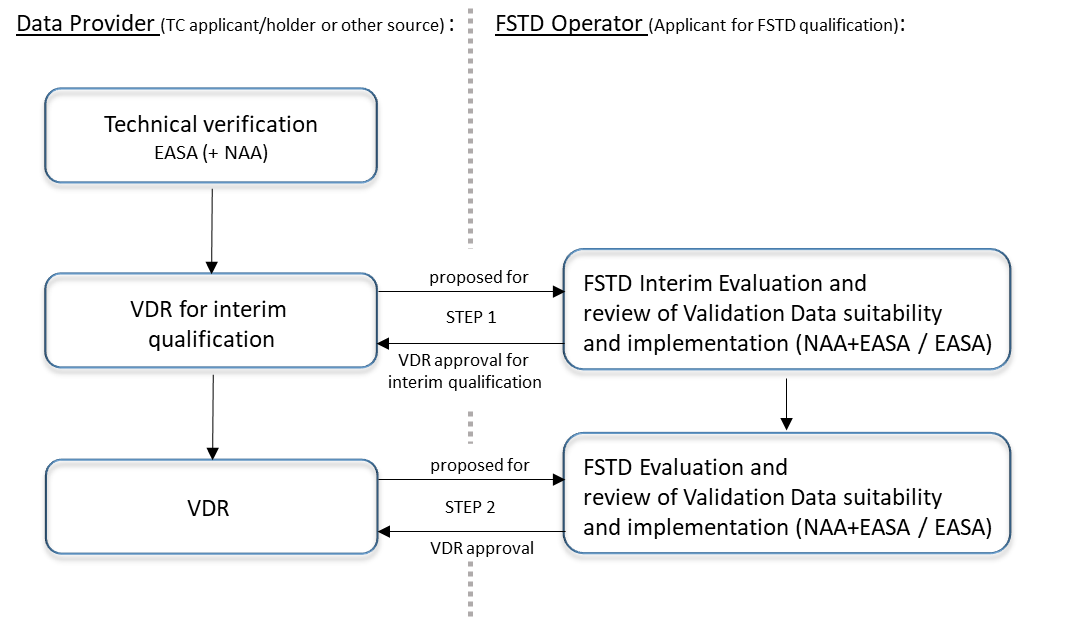
The diagram below describes the various steps that the VDR may take. If no interim qualification is sought, then Step 1 does not apply.
[Issue No: SIMD/2]