Appendix IV to ANNEX VI (Part-ARA) – Flight simulation training device qualification certificate
Regulation (EU) 2026/781
Introduction
EASA Form 145 shall be used for the FSTD qualification certificate. This document shall contain the FSTD Specification including any limitation(s) and special authorisation(s) or approval(s) as appropriate to the FSTD concerned. The qualification certificate shall be printed in English and in any other language(s) determined by the competent authority.
Convertible FSTDs shall have a separate qualification certificate for each aircraft type. Different engine and equipment fit on one FSTD shall not require separate qualification certificates. All qualification certificates shall carry a serial number prefixed by a code in letters, which shall be specific to that FSTD. The letter code shall be specific to the competent authority of issue.
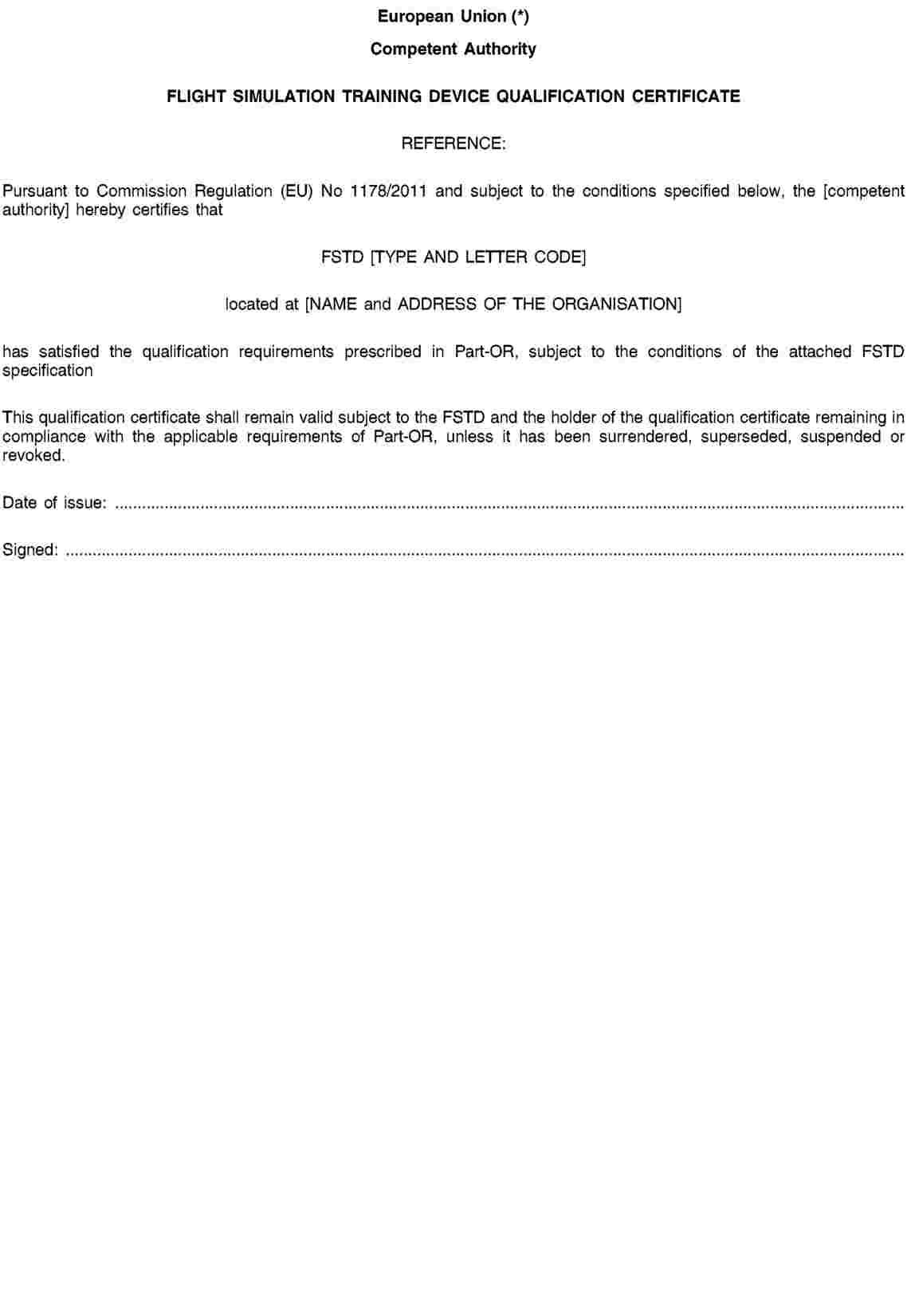

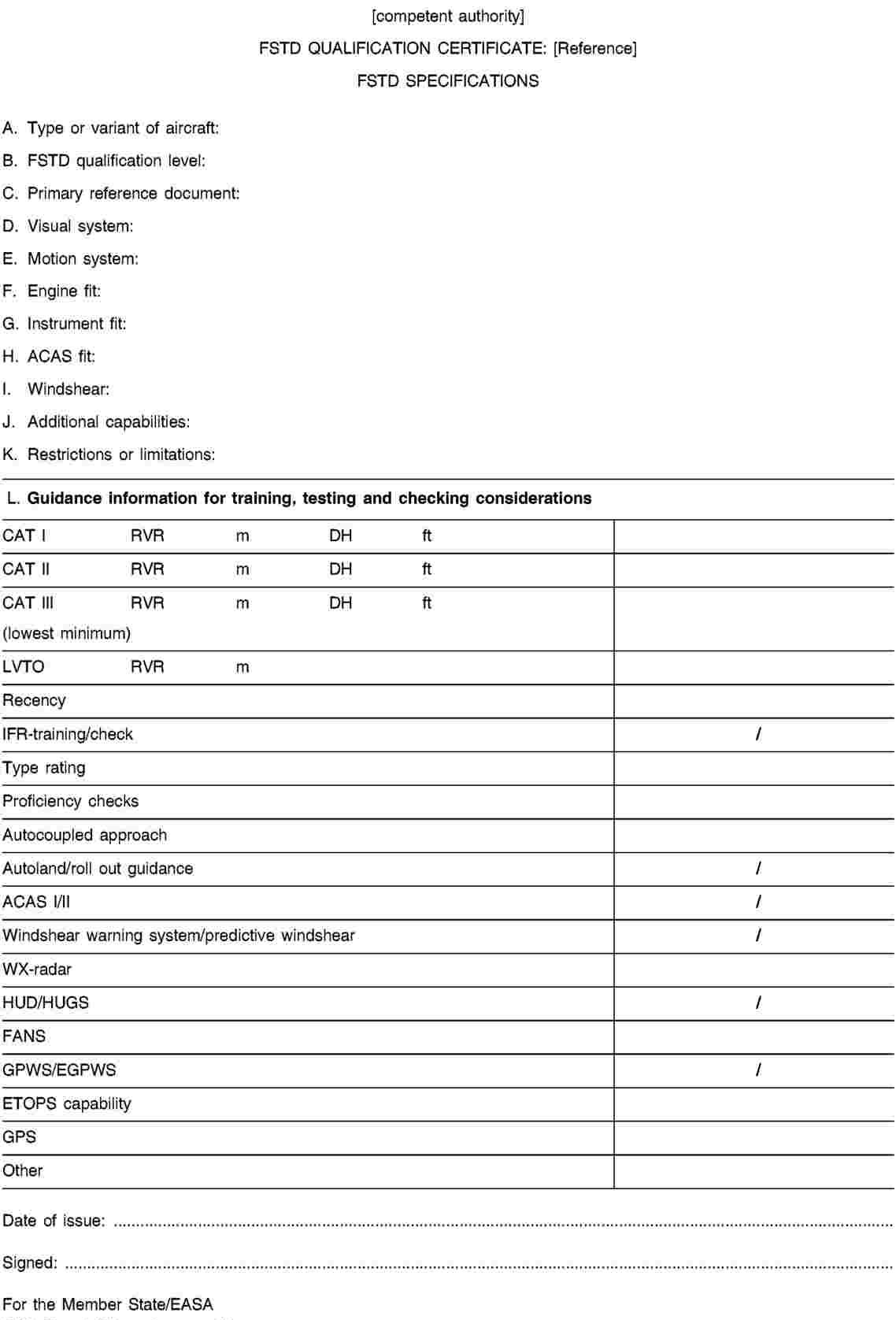

[applicable until 29 April 2028 — Regulation (EU) 2024/2076]
European Union [35]
[Competent authority]
FLIGHT SIMULATION TRAINING DEVICE (FSTD) QUALIFICATION CERTIFICATE
Pursuant to Commission Regulation (EU) No 1178/2011 and subject to the conditions specified below, the [competent authority] hereby certifies that
FSTD [IDENTIFICATION]
[FSTD MANUFACTURER AND SERIAL NUMBER]
located at
[LOCATION OF THE DEVICE]
operated by
[HOLDER OF THE QUALIFICATION CERTIFICATE]
has satisfied the qualification requirements in accordance with the applicable primary reference document of the device and Annex VII (Part-ORA) to Regulation (EU) No 1178/2011, subject to the conditions of the attached FSTD specifications.
This qualification certificate shall remain valid subject to the FSTD’s compliance with the applicable requirements of the qualification basis and the holder of the qualification certificate remaining in compliance with the applicable requirements of Part-ORA, unless it has been surrendered, superseded, suspended or revoked.
Date of initial issue:
Revision:
Date of revision:
For the [competent authority]
Signature:
EASA Form 145, Issue 3 – page 1/2
FSTD QUALIFICATION CERTIFICATE: [Reference]
FSTD SPECIFICATION
A. |
Primary reference document (PRD) |
|
B. |
(For legacy FSTDs only) FSTD type and level Group of aircraft/type/type and variant |
|
C. |
Additional capabilities: |
|
D. |
Limitations: |
|
E. |
Remarks: |
|
FSTD CAPABILITY SIGNATURE (FCS)
F. |
FSTD FEATURE |
|
FIDELITY LEVEL |
SIMULATED AIRCRAFT |
1. |
Flight deck layout and structure (FDK) |
|
|
|
2. |
Flight control forces and hardware (CLH) |
|
|
|
3. |
Flight control systems operation (CLO) |
|
|
|
4. |
Aircraft systems (SYS) |
|
|
|
5. |
Performance and handling on ground (GND) |
|
|
|
6. |
Performance and handling in-ground effect (IGE) |
|
|
|
7. |
Performance and handling out-of-ground effect (OGE) |
|
|
|
8. |
Sound cueing (SND) |
|
|
|
9. |
Vibration cueing (VIB) |
|
|
|
10. |
Motion cueing (MTN) |
|
|
|
11. |
Visual cueing (VIS) |
|
|
|
12. |
Navigation (NAV) |
|
|
|
13. |
Atmosphere and weather (ATM) |
|
|
|
14. |
Operating sites and terrain (OST) |
|
|
|
EASA Form 145, Issue 3 – page 2/2
Instructions for the issue of the FSTD qualification certificate
(a) EASA Form 145 shall be used for the FSTD qualification certificate.
This document shall contain the FSTD specification and the FCS or assigned FCS, where applicable, including any limitation(s) as appropriate to the FSTD concerned.
(b) The qualification certificate shall be printed in English and in any other language(s) determined by the competent authority.
(c) Separate qualification certificates shall be issued for:
(1) each FCS or assigned FCS;
(2) each combination of flight deck and platform in the case of major interchangeable assemblies;
(3) each flight deck to be used as an FSTD in the case of major interchangeable assemblies.
The FSTD qualification certificate shall specify the serial number of the flight deck.
(d) The identification of each flight deck and platform shall be established by using serial number placards and each flight deck and platform combination shall have a qualification certificate with a single FSTD serial number that contains the identification/serial number of the flight deck and platform.
(e) Different engine fits and alternate thrust ratings on one FSTD shall not require separate qualification certificates as long as the FCS or assigned FCS is not changed.
(f) Different equipment, such as avionics fits, included in one FSTD shall not require separate qualification certificates. However, major differences in avionics may result in aircraft variants, which may require separate software loads. In such cases, separate FSTD qualification certificates shall be issued.
(g) The FSTD indicated on the qualification certificate shall carry a serial number prefixed by a code in letters. The letter code shall be specific to the issuing competent authority.
(h) In the table ‘FSTD specification’, the FSTD shall be defined by the PRD, which is defined in the MQTG and indicates any limitations of the FSTD, if applicable. In the case of a legacy FSTD, the FSTD specification table shall specify all of the following:
(1) the FSTD type and level;
(2) the simulated aircraft type or type and variant or group of aircraft (e.g. aircraft category, engine configuration, wake turbulence category, as applicable).
(i) The competent authority shall specify in the table ‘FSTD specification’ under ‘Additional capabilities’ that an FSTD with an FCS or assigned FCS is qualified for MCC where both following conditions are met:
(1) the FSTD meets the requirements for MCC as specified in the applicable PRD;
(2) the FSTD has an FCS or assigned FCS that is equal to or higher than those in the following table:
|
1. Flight deck layout and structure |
2. Flight control forces and hardware |
3. Flight control systems operation |
4. Aircraft systems |
5.
Performance and handling |
6.
Performance and handling |
7. Performance and handling out-of-ground effect |
8. Sound cueing |
9. Vibration cueing |
10. Motion cueing |
11. Visual cueing |
12. Navigation |
13. Atmosphere and weather |
14. Operating sites and terrain |
Aeroplane FSTD |
G |
G |
G |
G |
G |
G |
G |
G |
N |
N |
G |
R |
G |
G |
Helicopter FSTD |
R |
G |
R |
G |
G |
G |
G |
G |
N |
N |
R |
R |
G |
G |
(j) The competent authority shall specify, in the table ‘FSTD specification’ under ‘additional capabilities’ that an aeroplane FSTD is qualified for UPRT and indicate whether it is ‘approach to stall’ or ‘full stall’.
(k) In the table ‘FSTD capability signature (FCS)’, the FSTD shall be defined by its FCS, unless it is a legacy FSTD. In the case of an FSTD that falls under Article 10b(2), point (a)(i)(1), and Article 10b(2), point (a)(ii)(1), the table ‘FSTD capability signature (FCS)’ shall be filled in with the assigned FCS in accordance with Appendix IX to Annex VI (Part-ARA).
(l) Completion of the qualification certificate for FSTDs with FCSs.
(1) When the FSTD qualification process validates the FCS declared in the application, the relevant FSTD feature fidelity levels (N, G, R or S) shall be entered on the FSTD qualification certificate in the ‘fidelity level’ column of the ‘FSTD capability signature (FCS)’ table for each feature in turn. The fidelity levels are defined as follows:
(i) specific (S) is the highest level of fidelity for a given FSTD feature;
(ii) representative (R) is the intermediate level of fidelity for a given FSTD feature;
(iii) generic (G) is the lowest level of fidelity for a given FSTD feature;
(iv) none (N) means either of the following:
(a) the FSTD feature is not installed, functional or available for use in training;
(b) a feature is installed but is not required and, in that case, it shall not be distracting or detracting from the other features for the intended use of the device.
(2) Where an FCS feature is either not applicable or not available for the FSTD being qualified, the fidelity level ‘N’ shall be entered in the ‘fidelity level’ column.
(3) Where the FSTD feature ‘aircraft systems’ reflects different aircraft systems that are at different fidelity levels, the highest fidelity level shall be entered and marked with an asterisk (*). The simulated aircraft systems and the related fidelity level shall be specified on the ESL. In that case, the following statement shall be made in the ‘remarks’ column: ‘Not all aircraft systems are simulated and/or at the same fidelity level. Please refer to the ESL.’.
(4) Where the FSTD feature ‘flight control forces and hardware’ reflects flight controls that are at different fidelity levels, the highest fidelity level shall be entered and marked with an asterisk (*). The simulated flight control forces and hardware and the related fidelity level shall be specified on the ESL. In that case, the following statement shall be made in the ‘remarks’ column: ‘Not all flight control forces and hardware are simulated and/or at the same fidelity level. Please refer to the ESL.’.
(5) In the case of an interim qualification in accordance with point ARA.FSTD.115, the qualification certificate shall indicate the fidelity level and include ‘interim’ in the column ‘fidelity level’ for the applicable features in the table ‘FSTD capability signature (FCS)’.
(m) Completion of the qualification certificate for FSTDs with FCSs and with assigned FCS.
For the aircraft simulation features (1–7) and/or the cueing features (8–9), the simulated aircraft shall be entered on the FSTD qualification certificate in the ‘simulated aircraft’ column of the table ‘FSTD capability signature (FCS)’. For each feature, the simulated aircraft shall be specified as follows:
(i) if the fidelity level is ‘S’, an aircraft type and variant (make, model and series);
(ii) if the fidelity level is ‘R’, an aircraft type (make and model);
(iii) if the fidelity level is ‘G’, a group of aircraft by indicating all of the following:
(a) the aircraft category;
(b) the engine configuration;
(c) the wake turbulence category for the features, where it is applicable.
[applicable from 30 April 2028 — Regulation (EU) 2026/781]
[35] ‘European Union’ to be deleted for non-EU Member States or EASA.