GM1 MED.B.010(b) Cardiovascular system
ED Decision 2025/002/R
(a) Cardiovascular risk factor assessment
A risk calculator is constructed as an equation with regression coefficients for each included risk factor, based on a statistical analysis of data from a population of a certain region to provide a crude risk estimate. A risk calculator to be used for screening of CAT pilots should be relevant for the ethnicity of the pilots being screened and should predict the 5–10-year risk for non-fatal events such as acute coronary syndromes or stroke, as well as fatal cardiac events, as both may lead to total in-flight incapacitation.
It is recommended to use a risk estimation tool that is based on populations similar to your most common target population. No risk calculator is perfect, and an assessment of advantages and disadvantages should be made when deciding on which tools should be used. For example, the most common tools that are based on European population are: SCORE 2, PROCAM, AGLA and QRISK 3.
In the risk assessment AMEs should give proper consideration to the latest published guidance of the European Society of Cardiology. At the time of the drafting, the most recent guidelines are ‘2021 ESC Guidelines on cardiovascular disease prevention in clinical practice’.
(b) Cardiovascular assessment
It is recommended that for applicants involved in single-pilot HEMS operations who have reached the age of 60, the cardiovascular assessment considers the risk level when deciding on enhanced screening investigations.
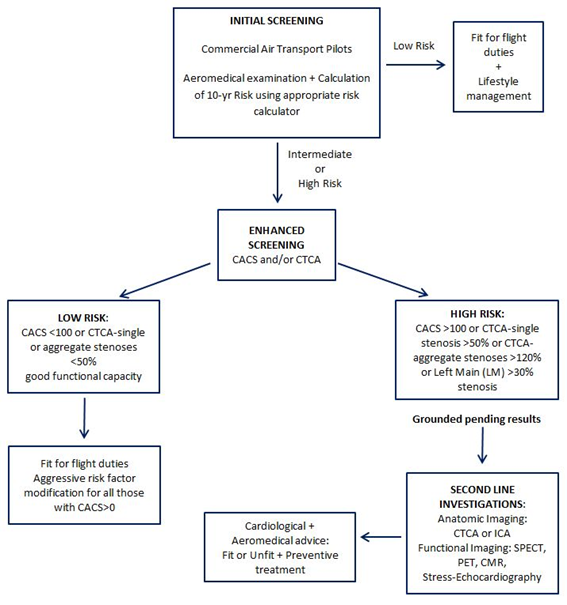
In this regard the following flow chart algorithm adapted by Simons et al. (2019) from Gray et al.(2019) is aimed at supporting AMEs and medical assessors. The classification of low, intermediate or high risk is given by the cardiovascular score being used. The enhanced screening investigations are in the realm of the consultant cardiologist.
Abbreviations used in the flowchart: CACS=Coronary Artery Calcium Score; CTCA=Computed Tomography Coronary Angiography; SPECT=Single-Positron Emission Tomography; PET=Positron Emission Tomography; CMR=Cardiac Magnetic Resonance; ICA= Invasive Coronary Angiography. [Simons et al. (2019]