GM1 to Appendix 5 Integrated MPL
training course
ED
Decision 2019/005/R
GENERAL
(a) In broad terms, the MPL holder is expected
to be able to complete the airline operators’ conversion course with a high
probability of success and within the time frame normally allowed for this
phase. The standard is equivalent to what is currently expected from graduates
of the ATP(A) integrated course who have completed type rating training.
(b) The general approach is to use the
existing ATP(A) integrated training course as a reference and to implement
progressively the MPL integrated training course and specifically the transfer
from actual flight to simulated flight.
(c) This transfer should be organised in a
way that is similar to the approach used for ETOPS. Successive evolutions of
the training syllabus introduce progressively a higher level of simulated
flight and a reduction of actual flight. Change from one version to the next
should only take place after enough experience has been gained and once its
results, including those of airline operator conversion courses, have been
analysed and taken into account.
MPL
TRAINING SCHEME
(d) The specific arrangement, pursuant to
ORA.GEN.205, between an approved training organisation (ATO) and an operator
for the multi-pilot licence (MPL) training should cover at least the following
points:
(1) pre-entry requirements (including
screening and selection);
(2) provision of the relevant documentation
(operations manuals (OMs) and training manuals);
(3) design of the training programme;
(4) content of the operator conversion course;
(5) training effectiveness (e.g. continuous
monitoring system, progress checks, etc.);
(6) provision of base training;
(7) graduate performance data feedback from
the operator to the ATO;
(8) course evaluation and improvement; and
(9) alignment of the grading and assessment
criteria.
The ATO and
operator may use their OMs and training manuals to identify additional areas
to be covered by the specific arrangement.
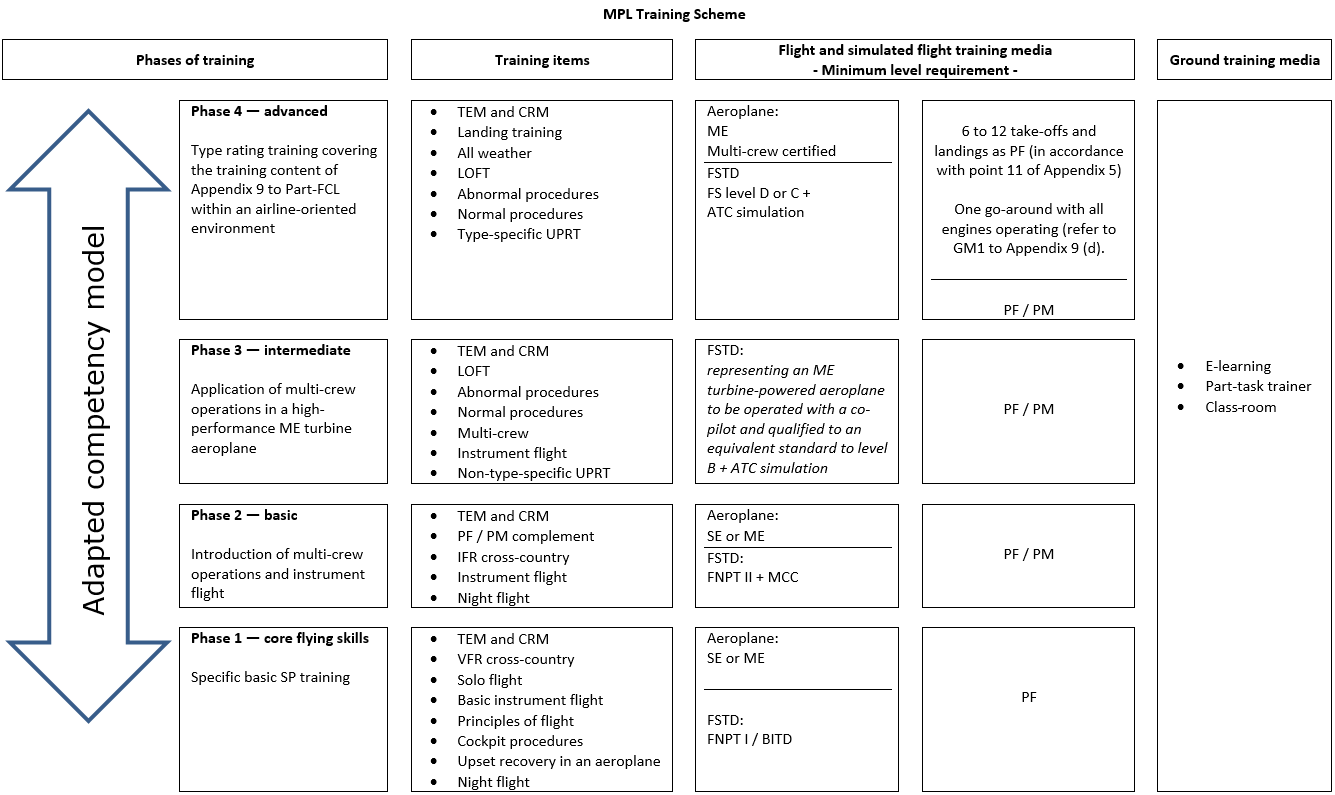
The following
scheme should be applied:
THEORETICAL
KNOWLEDGE INSTRUCTION
(e) The 750 hours of instruction, which also
cover the Area 100 KSA, may include in suitable proportions:
(1) classroom work;
(2) lessons;
(3) tutorials;
(4) demonstrations, including those supported
by demonstration equipment;
(5) exercises carried out as groups or
individuals and based on pre-flight and en-route planning, communications,
presentations and projects;
(6) exercises that use demonstration equipment
or training devices;
(7) directed study including workbook
exercises or assignments;
(8) aerodrome or aviation industry field
trips;
(9) computer-based training and e-learning
elements;
(10) progress tests, Area 100 KSA assessments
and mental maths test(s); and
(11) other training methods, media and tools
approved by the competent authority.
COMPETENCY
UNITS, COMPETENCY ELEMENTS AND PERFORMANCE CRITERIA
(f) Apply human performance principles,
including principles of threat and error management:
(1) cooperation;
(2) leadership and managerial skills;
(3) situation awareness;
(4) decision making.
These
behaviour categories are intended to help in the effective utilisation of all
available resources to achieve safe and efficient operations.
These
behaviour categories may be adapted and extended to incorporate issues like
communication and use of automation if it is considered to be relevant to the
development of the curriculum.
(g) Perform Aircraft Ground and Pre-Flight
Operations
List of
competency elements and performance criteria:
(1) demonstrate attitudes and behaviours appropriate
to the safe conduct of flight, including recognising and managing potential
threats and errors;
Duty
Observation and assessment
Satisfactory
(S)
Unsatisfactory
(U)
(2) perform dispatch duties: (S)
or (U)
(i) verifies technical condition of the a/c,
including adequate use of MEL; PF/PNF
(ii) checks technical bulletins and notices; PF/PNF
(iii) determines operational environment and
pertinent weather; PF/PNF
(iv) determines impact of weather on aircraft
performance; PF/PNF
(v) applies flight planning and load procedures; PF/PNF
(vi) determines fuel requirement; PF/PNF
(vii) files an ATS flight plan (if required) PF/PNF
(3) provide flight crew and cabin crew briefings; (S)
or (U)
(i) briefed flight crew in all relevant matters; PF
(ii) briefed cabin crew in all relevant matters. PF
(4) perform pre-flight checks and cockpit
preparation: (S)
or (U)
(i) ensures the airworthiness of the aircraft; PF
(ii) performs the cockpit preparation and
briefings; PF/PNF
(iii) performs FMS initialisation, data insertion
and confirmation; PF/PNF
(iv) optimises and checks take-off performance
and take-off data calculation. PF/PNF
(5) perform engine start: (S)
or (U)
(i) asks for, receives acknowledges and
checks ATC clearance; PNF
(ii) performs engine start procedure; PF/PNF
(iii) uses standard communication procedures
with ground crew and ATC. PF/PNF
(6) perform taxi out: (S)
or (U)
(i) receives, checks and adheres to taxi clearance;
PNF
(ii) taxis the aircraft, including use of exterior
lighting; PF
(iii) complies to taxi clearance; PF/PNF
(iv) maintains look-out for conflicting traffic
and obstacles; PF/PNF
(v) operates thrust, brakes and steering; PF
(vi) conducts relevant briefings; PF
(vii) uses standard communication procedures with
crew and ATC; PNF
(viii) completes standard operating procedures and
checklists; PF/PNF
(ix) updates and confirms FMS data; PF/PNF
(x) manages changes in performance and departure
route; PF/PNF
(xi) completes de or anti-ice procedures. PF/PNF
(7) manage abnormal and emergency situations: (S)
or (U)
(i) identifies the abnormal condition; PF/PNF
(ii) interprets the abnormal condition; PF/PNF
(iii) performs the procedure for the abnormal
condition. PF/PNF
(8) communicate with cabin crew, passengers
and company: (S)
or (U)
(i) communicates relevant information with
cabin crew; PF
(ii) communicates relevant information with
company; PF/PNF
(iii) makes passenger announcements when
appropriate. PF/PNF
(h) Perform take-off
List of
competency elements and performance criteria:
(1) demonstrate attitudes and behaviours
appropriate to the safe conduct of including recognising flight, and managing
potential
(2) perform pre threats and errors. -take-off
and predeparture preparation: (S) or
(U)
(i) checks and acknowledges line up clearance; PF/PNF
(ii) checks correct runway selection; PF/PNF
(iii) confirms validity of performance data; PF/PNF
(iv) checks approach sector and runway are
clear; PF/PNF
(v) confirms all checklists and take-off preparations
completed; PF/PNF
(vi) lines up the aircraft on centreline without
losing distance; PF
(vii) checks weather on departure sector; PF/PNF
(viii) checks runway status and wind. PF/PNF
(3) perform take-off roll: (S)
or (U)
(i) applies take-off thrust; PF
(ii) checks engine parameters; PNF
(iii) checks air speed indicators; PF/PNF
(iv) stays on runway centreline. PF
(4) perform transition to instrument flight rules: (S)
or (U)
(i) applies v1 procedures; PF/PNF
(ii) rotates at vr to initial pitch attitude; PF
(iii) establishes initial wings level attitude; PF
(iv) retracts landing gear; PNF
(v) maintains climb out speed. PF
(5) perform initial climb to flap retraction altitude: (S)
or (U)
(i) sets climb power; PF
(ii) adjusts attitude for acceleration; PF
(iii) selects flaps according flap speed schedule; PF/PNF
(iv) observes speed restrictions; PF
(v) completes relevant checklists. PF/PNF
(6) perform rejected take-off: (S)
or (U)
(i) recognises the requirement to abort the
take-off; PF
(ii) applies the rejected take-off procedure; PF
(iii) assesses the need to evacuate the aircraft. PF/PNF
(7) perform navigation: (S)
or (U)
(i) complies to departure clearance; PF
(ii) complies with published departure procedures,
for example speeds; PF
(iii) monitors navigation accuracy; PF/PNF
(iv) communicates and coordinates with ATC. PNF
(8) manage abnormal and emergency situations: (S)
or (U)
(i) identifies the abnormal condition; PF/PNF
(ii) interprets the abnormal condition; PF/PNF
(iii) performs the procedure for the abnormal
condition. PF/PNF
(i) Perform climb
List of
competency elements and performance criteria:
(1) demonstrate attitudes and behaviours appropriate
to the safe conduct of flight, including recognising and managing potential
threats and errors;
(2) perform SID or en-route navigation: (S)
or (U)
(i) complies with departure clearance and
procedures; PF
(ii) demonstrates terrain awareness; PF/PNF
(iii) monitors navigation accuracy; PF/PNF
(iv) adjusts flight to weather and traffic conditions; PF
(v) communicates and coordinates with ATC; PNF
(vi) observes minimum altitudes; PF/PNF
(vii) selects appropriate level of automation; PF
(viii) complies with altimeter setting procedures. PF/PNF
(3) complete climb procedures and checklists: (S)
or (U)
(i) performs the after take-off items; PF/PNF
(ii) confirms and checks according checklists. PF/PNF
(4) modify climb speeds, rate of climb and cruise
altitude: (S)
or (U)
(i) recognises the need to change speed, Rate
of climb or cruise altitude; PF
(ii) selects and maintains the appropriate climb
speed or rate of climb; PF
(iii) selects optimum cruise flight level. PF/PNF
(5) perform systems operations and procedures: (S)
or (U)
(i) monitors operation of all systems; PF/PNF
(ii) operates systems as required. PF/PNF
6) manage abnormal and emergency situations: (S)
or (U)
(i) identifies the abnormal condition; PF/PNF
(ii) interprets the abnormal condition; PF/PNF
(iii) performs the procedure for the abnormal
condition. PF/PNF
(7) communicate with cabin crew, passengers
and company: (S)
or (U)
(i) communicates relevant information with
cabin crew; PF
(ii) communicates relevant information with
company; PF/PNF
(iii) makes passenger announcements when
appropriate. PF
(j) Perform
cruise
List of
competency elements and performance criteria.
(1) demonstrate attitudes and behaviours
appropriate to the safe conduct of flight, including recognising and managing
potential threats and errors;
(2) monitor navigation accuracy: (S)
or (U)
(i) demonstrates adequate area knowledge; PF/PNF
(ii) demonstrates adequate route knowledge; PF/PNF
(iii) navigates according to flight plan and clearance;
PF
(iv) adjusts flight to weather and traffic conditions; PF
(v) communicates and coordinates with ATC; PNF
(vi) observes minimum altitudes; PF/PNF
(vii) uses all means of automation. PF
(3) monitor flight progress: (S)
or (U)
(i) selects optimum speed; PF
(ii) selects optimum cruise flight level; PF
(iii) monitors and controls fuel status; PF/PNF
(iv) recognises the need for a possible diversion; PF/PNF
(v) creates a diversion contingency plan if required. PF/PNF
(4) perform descent and approach planning: (S)
or (U)
(i) checks weather of destination and alternate
airport; PF/PNF
(ii) checks runway in use and approach procedure; PF/PNF
(iii) sets the FMS accordingly; PNF
(iv) checks landing weight and landing distance
required; PNF
(v) checks MEA, MGA and MSA; PF/PNF
(vi) identifies top of descent point. PF
(5) perform systems operations and procedures: (S)
or (U)
(i) monitors operation of all systems; PF/PNF
(ii) operates systems as required. PNF
(6) manage abnormal and emergency situations: (S)
or (U)
(i) identifies the abnormal condition; PF/PNF
(ii) interprets the abnormal condition; PF/PNF
(iii) performs the procedure for the abnormal condition. PF/PNF
(7) communicate with cabin crew, passengers
and company: (S)
or (U)
(i) communicates relevant information with
cabin crew; PF
(ii) communicates relevant information with
company; PF/PNF
(iii) makes passenger announcements when
appropriate. PF
(k) Perform descent
List of
competency elements and performance criteria:
(1) Demonstrate attitudes and behaviours
appropriate to the safe conduct of flight, including recognising and managing
potential threats and errors;
(2) initiate and manage descent: (S)
or (U)
(i) starts descent according to ATC clearance
or optimum descent point; PF
(ii) selects optimum speed and descent rate; PF
(iii) adjusts speed to existing environmental
conditions; PF
(iv) recognises the need to adjust the descent
path; PF
(v) adjusts the flight path as required; PF
(vi) utilises all means of FMS descent information. PF
(3) monitor and perform en route and descent
navigation: (S)
or (U)
(i) complies with arrival clearance and procedures; PF
(ii) demonstrates terrain awareness; PF/PNF
(iii) monitors navigation accuracy; PF/PNF
(iv) adjusts flight to weather and traffic conditions; PF
(v) communicates and coordinates with ATC; PNF
(vi) observes minimum altitudes; PF/PNF
(vii) selects appropriate level or mode of automation; PF
(viii) complies with altimeter setting procedures. PF/PNF
(4) re-planning and update of approach briefing: (S)
or (U)
(i) re-checks destination weather and runway
in use; PNF
(ii) briefs or re-briefs about instrument approach
and landing as required; PF
(iii) reprograms the FMS as required; PNF
(iv) re-checks fuel status. PF/PNF
(5) perform holding: (S)
or (U)
(i) identifies holding requirement; PF/PNF
(ii) programs FMS for holding pattern; PNF
(iii) enters and monitors holding pattern; PF
(iv) assesses fuel requirements and determines
max holding time; PF/PNF
(v) reviews the need for a diversion; PF/PNF
(vi) initiates diversion. PF
(6) perform systems operations and procedures: (S)
or (U)
(i) monitors operation of all systems; PF/PNF
(ii) operates systems as required. PF/PNF
(7) manage abnormal and emergency situations:
(i) identifies the abnormal condition; PF/PNF
(ii) interprets the abnormal condition; PF/PNF
(iii) performs the procedure for the abnormal
condition. PF/PNF
(8) communicate with cabin crew, passengers
and company: (S)
or (U)
(i) communicates relevant information with
cabin crew; PF
(ii) communicates relevant information with
company; PF/PNF
(iii) makes passenger announcements when
appropriate; PF
(l) Perform approach
List of
competency elements and performance criteria:
(1) demonstrate attitudes and behaviours appropriate
to the safe conduct of flight, including recognising and managing potential
threats and errors;
(2) perform approach in general: (S)
or (U)
(i) executes approach according to procedures
and situation; PF
(ii) selects appropriate level or mode of automation; PF
(iii) selects optimum approach path; PF
(iv) operates controls smooth and coordinated; PF
(v) performs speed reduction and flap extension; PF/PNF
(vi) performs relevant checklists; PF/PNF
(vii) initiates final descent; PF
(viii) achieves stabilised approach criteria; PF
(ix) ensures adherence to minima; PF/PNF
(x) initiates go-around if required; PF
(xi) masters transition to visual segment. PF
(3) perform precision approach: (S)
or (U)
(i) performs ILS approach; PF
(ii) performs MLS approach. PF
(4) perform non-precision approach: (S)
or (U)
(i) performs VOR approach; PF
(ii) performs NDB approach; PF
(iii) performs SRE approach; PF
(iv) performs GNSS approach; PF
(v) performs ILS loc approach; PF
(vi) performs ILS back beam approach. PF
(5) perform approach with visual reference to
ground: (S)
or (U)
(i) performs standard visual approach; PF
(ii) performs circling approach. PF
(6) monitor the flight progress: (S)
or (U)
(i) insures navigation accuracy; PF/PNF
(ii) communicates with ATC and crew members; PNF
(iii) monitors fuel status. PF/PNF
(7) perform systems operations and procedures:
(i) monitors operation of all systems; PF
(ii) operates systems as required. PF
(8) manage abnormal and emergency situations: (S)
or (U)
(i) identifies the abnormal condition; PF/PNF
(ii) interprets the abnormal condition; PF/PNF
(iii) performs the procedure for the abnormal
condition. PF/PNF
(9) perform missed approach and goaround: (S)
or (U)
(i) initiates go-around procedure; PF
(ii) navigates according to missed approach
procedure; PF
(iii) completes the relevant checklists; PF/PNF
(iv) initiates approach or diversion after the
go-around; PF
(v) communicates with ATC and crew members. PNF
(10) communicate with cabin crew, passengers and
company: (S)
or (U)
(i) communicates relevant information with
cabin crew; PF
(ii) communicates relevant information with
company; PF/PNF
(iii) makes passenger announcements when
appropriate; PF
(iv) initiates go-around procedure. PF
(m) Perform landing
List of
competency elements and performance criteria:
(1) demonstrate attitudes and behaviours
appropriate to the safe conduct of flight, including recognising and managing
potential threats and errors;
(2) land the aircraft; (S)
or (U)
(i) maintains a stabilised approach path during
visual segment; PF
(ii) recognises and acts on changing conditions
for windshift or wind shear segment; PF
(iii) initiates flare; PF
(iv) controls thrust; PF
(v) achieves touchdown in touchdown zone on centreline; PF
(vi) lowers nose wheel; PF
(vii) maintains centreline; PF
(viii) performs after-touchdown procedures; PF
(ix) makes use of appropriate braking and reverse
thrust; PF
(x) vacates runway with taxi speed. PF
(3) perform systems operations and procedures:
(S)
or (U)
(i) monitors operation of all systems; PF
(ii) operates systems as required. PF
(4) manage abnormal and emergency situations: (S)
or (U)
(i) identifies the abnormal condition; PF/PNF
(ii) interprets the abnormal condition; PF/PNF
(iii) performs the procedure for the abnormal
condition. PF/PNF
(n) Perform after landing and post flight
operations
List of
competency elements and performance criteria:
(1) demonstrate attitudes and behaviours
appropriate to the safe conduct of flight, including recognising and managing
potential threats and errors;
(2) perform taxiing and parking: (S)
or (U)
(i) receives, checks and adheres to taxi clearance; PNF
(ii) taxies the aircraft including use of exterior
lighting; PF
(iii) controls taxi speed; PF/PNF
(iv) maintains centreline; PF
(v) maintains look-out for conflicting traffic
and obstacles; PF
(vi) identifies parking position; PF/PNF
(vii) complies with marshalling or stand guidance;
PF/PNF
(viii) applies parking and engine shut down procedures; PF
(ix) completes with relevant checklists. PF/PNF
(3) perform aircraft post-flight operations: (S)
or (U)
(i) communicates to ground personnel and
crew; PF
(ii) completes all required flight documentation; PF/PNF
(iii) ensures securing of the aircraft; PF
(iv) conducts the debriefings. PF
(4) perform systems operations and procedures: (S)
or (U)
(i) monitors operation of all systems; PF/PNF
(ii) operates systems as required. PF/PNF
(5) manage abnormal and emergency situations: (S)
or (U)
(i) identifies the abnormal condition; PF/PNF
(ii) interprets the abnormal condition; PF/PNF
(iii) performs the procedure for the abnormal condition. PF/PNF
(6) communicate with cabin crew, passengers
and company: (S)
or (U)
(i) communicates relevant information with
cabin crew; PF
(ii) communicates relevant information with
company; PF/PNF
(iii) makes passenger announcements when
appropriate. PF
PRINCIPLES
OF THREAT AND ERROR MANAGEMENT
(o) One model that explains the principles of
threat and error management is the TEM model.
(1) The components of the TEM model:
There are
three basic components in the TEM model, from the perspective of flight crews:
threats, errors and undesired aircraft states. The model proposes that threats
and errors are part of everyday aviation operations that must be managed by
flight crews, since both threats and errors carry the potential to generate
undesired aircraft states. Flight crews must also manage undesired aircraft
states, since they carry the potential for unsafe outcomes. Undesired state
management is an essential component of the TEM model, as important as threat
and error management. Undesired aircraft state management largely represents
the last opportunity to avoid an unsafe outcome and thus maintain safety
margins in flight operations.
(2) Threats:
(i) Threats are defined as events or errors
that occur beyond the influence of the flight crew, increase operational
complexity, and which must be managed to maintain the margins of safety.
During typical flight operations, flight crews have to manage various
contextual complexities. Such complexities would include, for example, dealing
with adverse meteorological conditions, airports surrounded by high mountains,
congested airspace, aircraft malfunctions, errors committed by other people
outside of the cockpit, such as air traffic controllers, flight attendants or
maintenance workers, and so forth. The TEM model considers these complexities
as threats because they all have the potential to negatively affect flight
operations by reducing margins of safety;
(ii) Some threats can be anticipated, since
they are expected or known to the flight crew. For example, flight crews can
anticipate the consequences of a thunderstorm by briefing their response in
advance, or prepare for a congested airport by making sure they keep a
watchful eye on other aircraft as they execute the approach;
(iii) Some threats can occur unexpectedly, such
as an in-flight aircraft malfunction that happens suddenly and without
warning. In this case, flight crews must apply skills and knowledge acquired
through training and operational experience;
(iv) Lastly, some threats may not be directly
obvious to, or observable by, flight crews immersed in the operational
context, and may need to be uncovered by safety analysis. These are considered
latent threats. Examples of latent threats include equipment design issues,
optical illusions, or shortened turnaround schedules;
(v) Regardless of whether threats are
expected, unexpected, or latent, one measure of the effectiveness of a flight
crew’s ability to manage threats is whether threats are detected with the
necessary anticipation to enable the flight crew to respond to them through
deployment of appropriate countermeasures;
(vi) Threat management is a building block to
error management and undesired aircraft state management. Although the
threat-error linkage is not necessarily straightforward, and although it may
not be always possible to establish a linear relationship, or one-to-one
mapping between threats, errors and undesired states, archival data
demonstrates that mismanaged threats are normally linked to flight crew
errors, which in turn are often linked to undesired aircraft states. Threat
management provides the most proactive option to maintain margins of safety in
flight operations, by voiding safety-compromising situations at their roots.
As threat managers, flight crews are the last line of defence to keep threats
from impacting flight operations;
(vii) Table 1 presents examples of threats,
grouped under two basic categories derived from the TEM Model. Environmental
threats occur due to the environment in which flight operations take place.
Some environmental threats can be planned for and some will arise
spontaneously, but they all have to be managed by flight crews in real time.
Organisational threats, on the other hand, can be controlled (for example
removed or, at least, minimised) at source by aviation organisations.
Organisational threats are usually latent in nature. Flight crews still remain
the last line of defence, but there are earlier opportunities for these
threats to be mitigated by aviation organisations themselves.
|
Environmental threats |
Organisational threats |
|
(A) weather: thunderstorms, turbulence,
icing, wind shear, cross or tailwind, very low or high temperatures; (B) ATC: traffic congestion, ACAS RA/TA,
ATC command, ATC error, ATC language difficulty, ATC non-standard
phraseology, ATC runway change, ATIS communication or units of measurement
(QFE/meters); (C) airport: contaminated or short runway;
contaminated taxiway, lack of, confusing, faded signage, markings, birds,
aids unserviceable, complex surface navigation procedures or airport
constructions; (D) terrain: high ground, slope, lack of
references or ‘black hole’; (E) other:
similar call-signs. |
(A) operational pressure: delays, late
arrivals or equipment changes; (B) aircraft: aircraft malfunction,
automation event or anomaly, MEL/CDL; (C) cabin: flight attendant error, cabin
event distraction, interruption, cabin door security; (D) maintenance: maintenance event or
error; (E) ground: ground-handling event,
de-icing or ground crew error; (F) dispatch: dispatch paperwork event or
error; (G) documentation: manual error or chart
error; (H) other: crew scheduling event. |
Table 1. Examples of threats (list is not exhaustive)
(3) Errors:
(i) Errors are defined actions or inactions
by the flight crew that lead to deviations from organisational or flight crew
intentions or expectations. Unmanaged or mismanaged errors frequently lead to
undesired aircraft states. Errors in the operational context thus tend to
reduce the margins of safety and increase the probability of adverse
events;
(ii) Errors can be spontaneous (for example
without direct linkage to specific, obvious threats), linked to threats, or
part of an error chain. Examples of errors would include the inability to
maintain stabilised approach parameters, executing a wrong automation mode,
failing to give a required callout, or misinterpreting an ATC clearance;
(iii) Regardless of the type of error, an
error’s effect on safety depends on whether the flight crew detects and
responds to the error before it leads to an undesired aircraft state and to a
potential unsafe outcome. This is why one of the objectives of TEM is to
understand error management (for example detection and response), rather than
to solely focus on error causality (for example causation and commission).
From the safety perspective, operational errors that are timely detected and
promptly responded to (for example properly managed), errors that do not lead
to undesired aircraft states, do not reduce margins of safety in flight
operations, and thus become operationally inconsequential. In addition to its
safety value, proper error management represents an example of successful
human performance, presenting both learning and training value;
(iv) Capturing how errors are managed is then
as important, if not more, as capturing the prevalence of different types of
error. It is of interest to capture if and when errors are detected and by
whom, the response(s) upon detecting errors, and the outcome of errors. Some
errors are quickly detected and resolved, thus becoming operationally
inconsequential, while others go undetected or are mismanaged. A mismanaged
error is defined as an error that is linked to or induces an additional error
or undesired aircraft state;
(v) Table 2 presents examples of errors,
grouped under three basic categories derived from the TEM model. In the TEM
concept, errors have to be ‘observable’ and therefore, the TEM model uses the
‘primary interaction’ as the point of reference for defining the error
categories;
(vi) The TEM model classifies errors based upon
the primary interaction of the pilot or flight crew at the moment the error is
committed. Thus, in order to be classified as aircraft handling error, the
pilot or flight crew must be interacting with the aircraft (for example
through its controls, automation or systems). In order to be classified as
procedural error, the pilot or flight crew must be interacting with a
procedure (for example checklists; SOPs; etc.). In order to be classified as
communication error, the pilot or flight crew must be interacting with people
(ATC, ground crew, other crewmembers, etc.);
(vii) Aircraft handling errors, procedural errors
and communication errors may be unintentional or involve intentional
non-compliance. Similarly, proficiency considerations (for example skill or
knowledge deficiencies, training system deficiencies) may underlie all three
categories of error. In order to keep the approach simple and avoid confusion,
the TEM model does not consider intentional noncompliance and proficiency as
separate categories of error, but rather as sub-sets of the three major
categories of error.
|
Aircraft handling errors |
(A) manual handling, flight controls:
vertical, lateral or speed deviations, incorrect flaps or speed brakes,
thrust reverser or power settings; (B) automation: incorrect altitude, speed,
heading, auto throttle settings, incorrect mode executed or incorrect
entries; (C) systems, radio, instruments: incorrect
packs, incorrect anti-icing, incorrect altimeter, incorrect fuel switches
settings, incorrect speed bug or incorrect radio frequency dialled; (D) ground navigation: attempting to turn
down wrong taxiway or runway, taxi too fast, failure to hold short or missed
taxiway or runway. |
|
Procedural errors |
(A) SOPs: failure to cross-verify
automation inputs; (B) checklists: wrong challenge and
response; items missed, checklist performed late or at the wrong time; (C) callouts: omitted or incorrect
callouts; (D) briefings: omitted briefings; items
missed; (E) documentation: wrong weight and
balance, fuel information, ATIS, or clearance information recorded,
misinterpreted items on paperwork; incorrect logbook entries or incorrect
application of MEL procedures. |
|
Communication errors |
(A) crew to external: missed calls,
misinterpretations of instructions, incorrect read-back, wrong clearance,
taxiway, gate or runway communicated; (B) pilot to pilot: within crew
miscommunication or mis-interpretation. |
Table 2. Examples of errors (list is not exhaustive)
(4) Undesired aircraft states:
(i) Undesired aircraft states are flight
crew-induced aircraft position or speed deviations, misapplication of flight
controls, or incorrect systems configuration, associated with a reduction in
margins of safety. Undesired aircraft states that result from ineffective
threat or error management may lead to compromising situations and reduce
margins of safety in flight operations. Often considered at the cusp of
becoming an incident or accident, undesired aircraft states must be managed by
flight crews;
(ii) Examples of undesired aircraft states
would include lining up for the incorrect runway during approach to landing,
exceeding ATC speed restrictions during an approach, or landing long on a
short runway requiring maximum braking. Events such as equipment malfunctions
or ATC controller errors can also reduce margins of safety in flight
operations, but these would be considered threats;
(iii) Undesired states can be managed
effectively, restoring margins of safety, or flight crew response(s) can
induce an additional error, incident, or accident;
(iv) Table 3 presents examples of undesired
aircraft states, grouped under three basic categories derived from the TEM
model;
|
Aircraft handling |
(A) aircraft
control (attitude); (B) vertical,
lateral or speed deviations; (C) unnecessary
weather penetration; (D) unauthorised
airspace penetration; (E) operation
outside aircraft limitations; (F) unstable
approach; (G) continued
landing after unstable approach; (H) long,
floated, firm or off-centreline landing. |
|
Ground navigation |
(A) proceeding
towards wrong taxiway or runway; (B) Wrong
taxiway, ramp, gate or hold spot. |
|
Incorrect aircraft configurations |
(A) incorrect
systems configuration; (B) incorrect
flight controls configuration; (C) incorrect
automation configuration; (D) incorrect
engine configuration; (E) incorrect
weight and balance configuration. |
Table 3. Examples of undesired
aircraft states (list is not exhaustive)
(v) An important learning and training point
for flight crews is the timely switching from error management to undesired
aircraft state management. An example would be as follows: a flight crew
selects a wrong approach in the FMC. The flight crew subsequently identifies
the error during a cross-check prior to the FAF. However, instead of using a
basic mode (for example heading) or manually flying the desired track, both
flight crew members become involved in attempting to reprogram the correct
approach prior to reaching the FAF. As a result, the aircraft ‘stitches’
through the localiser, descends late, and goes into an unstable approach. This
would be an example of the flight crew getting ‘locked in’ to error
management, rather than switching to undesired aircraft state management. The
use of the TEM model assists in educating flight crews that, when the aircraft
is in an undesired state, the basic task of the flight crew is undesired
aircraft state management instead of error management. It also illustrates how
easy it is to get locked in to the error management phase;
(vi) Also from a learning and training
perspective, it is important to establish a clear differentiation between
undesired aircraft states and outcomes. Undesired aircraft states are
transitional states between a normal operational state (for example a stabilised
approach) and an outcome. Outcomes, on the other hand, are end states, most
notably, reportable occurrences (for example incidents and accidents). An
example would be as follows: a stabilised approach (normal operational state)
turns into an unstabilised approach (undesired aircraft state) that results in
a runway excursion (outcome);
(vii) The training and remedial implications of
this differentiation are of significance. While at the undesired aircraft
state stage, the flight crew has the possibility, through appropriate TEM, of
recovering the situation, returning to a normal operational state, thus
restoring margins of safety. Once the undesired aircraft state becomes an
outcome, recovery of the situation, return to a normal operational state, and
restoration of margins of safety is not possible.
(5) Countermeasures:
(i) Flight crews must, as part of the normal
discharge of their operational duties, employ countermeasures to keep threats,
errors and undesired aircraft states from reducing margins of safety in flight
operations. Examples of countermeasures would include checklists, briefings,
call-outs and SOPs, as well as personal strategies and tactics. Flight crews
dedicate significant amounts of time and energies to the application of
countermeasures to ensure margins of safety during flight operations.
Empirical observations during training and checking suggest that as much as 70
% of flight crew activities may be countermeasures-related activities.
(ii) All countermeasures are necessarily
flight crew actions. However, some countermeasures to threats, errors and
undesired aircraft states that flight crews employ build upon ‘hard’ resources
provided by the aviation system. These resources are already in place in the
system before flight crews report for duty, and are therefore considered as
systemic-based countermeasures. The following would be examples of ‘hard’
resources that flight crews employ as systemic-based countermeasures:
(A) ACAS;
(B) TAWS;
(C) SOPs;
(D) checklists;
(E) briefings;
(F) training;
(G) etc.
(iii) Other countermeasures are more directly
related to the human contribution to the safety of flight operations. These
are personal strategies and tactics, individual and team countermeasures that
typically include canvassed skills, knowledge and attitudes developed by human
performance training, most notably, by CRM training. There are basically three
categories of individual and team countermeasures:
(A) planning countermeasures: essential for
managing anticipated and unexpected threats;
(B) execution countermeasures: essential for
error detection and error response;
(C) review countermeasures: essential for
managing the changing conditions of a flight.
(iv) Enhanced TEM is the product of the
combined use of systemic based and individual and team countermeasures. Table
4 presents detailed examples of individual and team countermeasures. Further
guidance on countermeasures can be found in the sample assessment guides for
terminal training objectives (PANS-TRG, Chapter 3, Attachment B) as well as in
the ICAO manual, Line Operations Safety Audit (LOSA) (Doc 9803).
|
Planning
countermeasures |
||
|
SOP briefing |
The required briefing was interactive and
operationally thorough |
(A) Concise,
not rushed, and met SOP requirements; (B) Bottom
lines were established |
|
Plans stated |
Operational plans and decisions were communicated
and acknowledged |
Shared understanding about plans: ‘Everybody on the
same page’ |
|
Workload assignment |
Roles and responsibilities were defined for normal
and non-normal situations |
Workload assignments were communicated and
acknowledged |
|
Contingency management |
Crew members developed effective strategies to
manage threats to safety |
(A) Threats
and their consequences were anticipated; (B) Used
all available resources to manage threats |
|
Execution countermeasures |
||
|
Monitor and cross-check |
Crew members actively monitored and cross-checked
systems and other crew members |
Aircraft position, settings, and crew actions were
verified |
|
Workload management |
Operational tasks were prioritised and properly
managed to handle primary flight duties |
(A) Avoided
task fixation; (B) Did
not allow work overload |
|
Automation management |
Automation was properly managed to balance
situational and workload requirements |
(A) Automation
setup was briefed to other members (B) Effective
recovery techniques from automation anomalies |
|
Review countermeasures |
||
|
Evaluation and modification of plans |
Existing plans were reviewed and modified when
necessary |
Crew decisions and actions were openly analysed to
make sure the existing plan was the best plan |
|
Inquiry |
Crew members asked questions to investigate and/or
clarify current plans of action |
Crew members not afraid to express a lack of
knowledge: ‘Nothing taken for granted’ attitude |
|
Assertiveness |
Crew members stated critical information or
solutions with appropriate persistence |
Crew members spoke up without hesitation |
Table 4. Examples of individual and team
countermeasures