GM1
HPT-DSN.E.410 Approach surface
ED Decision 2019/012/R
(a) Consultations with helicopter operators
could assist the aerodrome operator in determining the appropriate slope
category to apply according to the heliport environment and the most critical
helicopter type for which the heliport is intended.
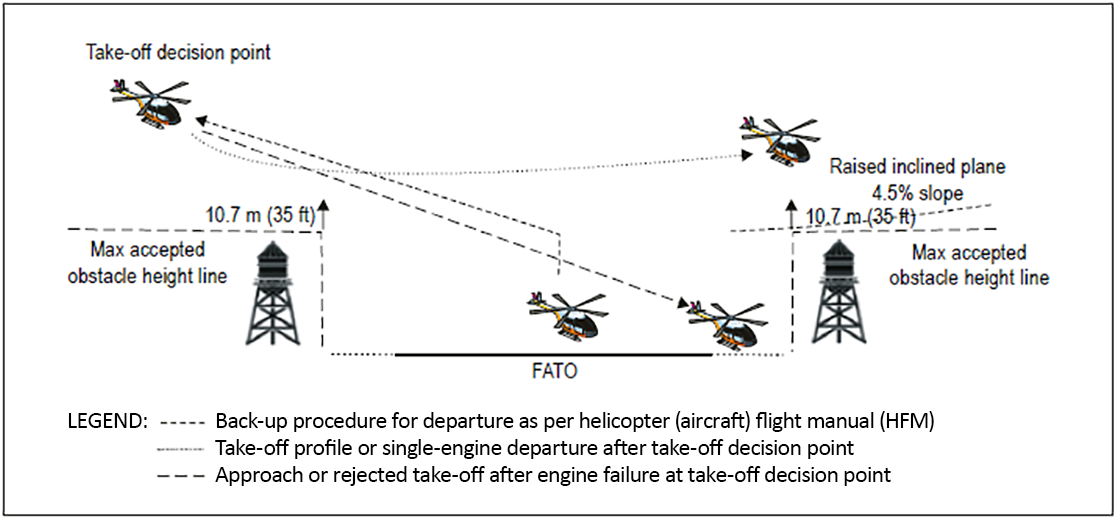
Figure GM1-E-1. Example of raised inclined plane
during operations in performance class 1
(b) The example shown in Figure GM1-E-1 does
not represent any specific profile, technique or helicopter type and is
intended to show a generic example. An approach profile and a back-up
procedure for departure profile are depicted. Specific manufacturers operations
in performance class 1 may be represented differently in the specific
helicopter (aircraft) flight manual (HFM).
(c) The approach/landing profile may not be
the reverse of the take-off profile.
(d) Additional safety assessment for obstacles
might be required in the area that a back-up procedure is intended. Helicopter
performance and the HFM limitations would determine the extent of the
assessment required.
(e) For heliports intended to be used by
helicopters operated in performance class 2 and 3, it is good practice for the
approach paths to be selected so as to permit safe forced landing or
one-engine-inoperative landings such that, as a minimum requirement, injury to
persons on the ground or water or damage to property are minimised. The most
critical helicopter type for which the heliport is intended and the ambient
conditions may be factors in determining the suitability of such areas.
(f) The approach and take-off surfaces should
be offset from each other ideally by an angle of not less than 135 degrees.