CS
HPT-DSN.F.520 Heliport identification marking
ED Decision 2019/012/R
(a) Applicability: Heliport identification
markings should be provided at a heliport.
(b) Location:
(1) For runway-type FATOs:
A heliport
identification marking should be located in the FATO and when used in
conjunction with FATO designation markings, should be displayed at each end of
the FATO (see Figure F-2).
(2) For all FATOs except runway-type FATOs:
(i) A heliport identification marking should
be located at or near the centre of the FATO (see Figure F-1).
(ii) On a FATO which contains a TLOF, a
heliport identification marking should be located in the FATO so that the
position of it coincides with the centre of the TLOF.
(c) Characteristics:
(1) A heliport identification marking should
consist of a letter ‘H’, white in colour. The dimensions of the ‘H’ marking
should be no less than those shown in Figure F-3.
(2) Where the ‘H’ marking is used for a
runway-type FATO, its dimensions should be increased by a factor of 3 (see
Figures F-2 and F-3).
(3) A heliport identification marking should
be oriented with the cross arm of the ‘H’ at right angles to the preferred
final approach direction.
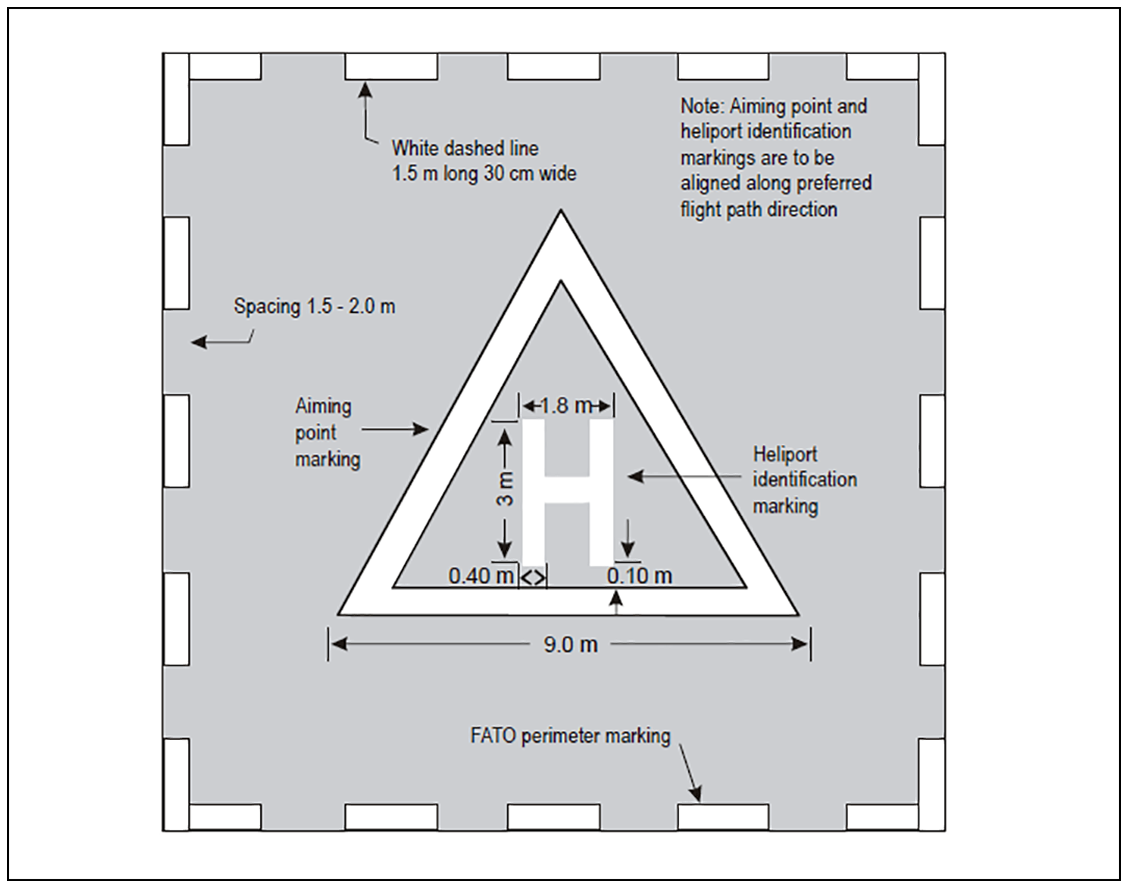
Note: The
aiming point, heliport identification and FATO perimeter markings are white
and may be edged with a 10 cm black border to improve contrast
Figure F-1. Combined heliport
identification, aiming point and FATO perimeter marking
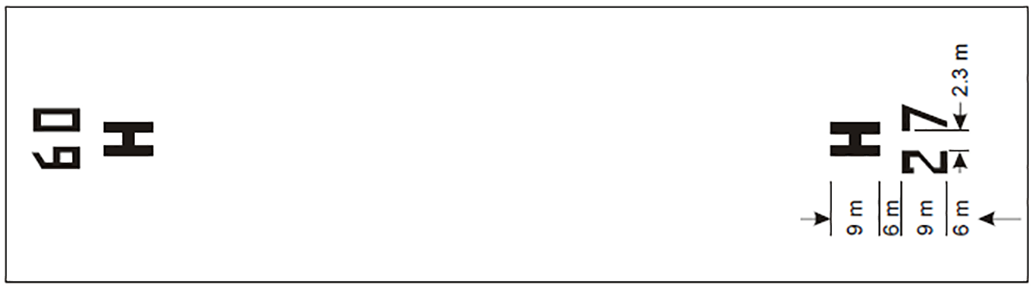
Figure F-2.
FATO designation marking and heliport identification marking for a runway-type
FATO
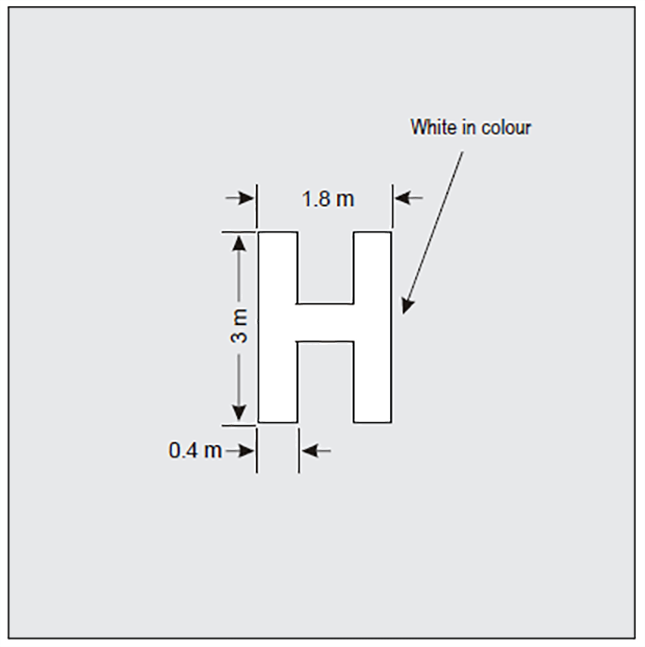
Figure F-3. Heliport identification marking