CS HPT-DSN.D.300 Helicopter
stands
ED
Decision 2019/012/R
(a) Characteristics:
(1) When a TLOF is collocated with a
helicopter stand, the protection area of the stand should not overlap the
protection area of any other helicopter stand or associated taxi route.
(2) A helicopter stand should provide rapid
drainage.
(3) The slope of a helicopter stand in any
direction should not exceed 2 per cent.
(4) When used by helicopters turning in a
hover, a helicopter stand should be of sufficient size to contain a circle of
diameter of at least 1.2 D of the largest helicopter the stand is intended to
serve (see Figure D-1).
(5) Where a helicopter stand is intended to be
used for taxi-through and where the helicopter using the stand is not required
to turn, the minimum width of the stand and associated protection area should
be that of the taxi-route.
(6) Where a helicopter stand is intended to be
used for turning, the minimum overall dimension of the stand and protection
area should not be less than 2 D.
(7) Where a helicopter stand is intended to be used for turning, the helicopter stand should be surrounded by a protection area which extends for a distance of 0.4 D from the edge of the helicopter stand.
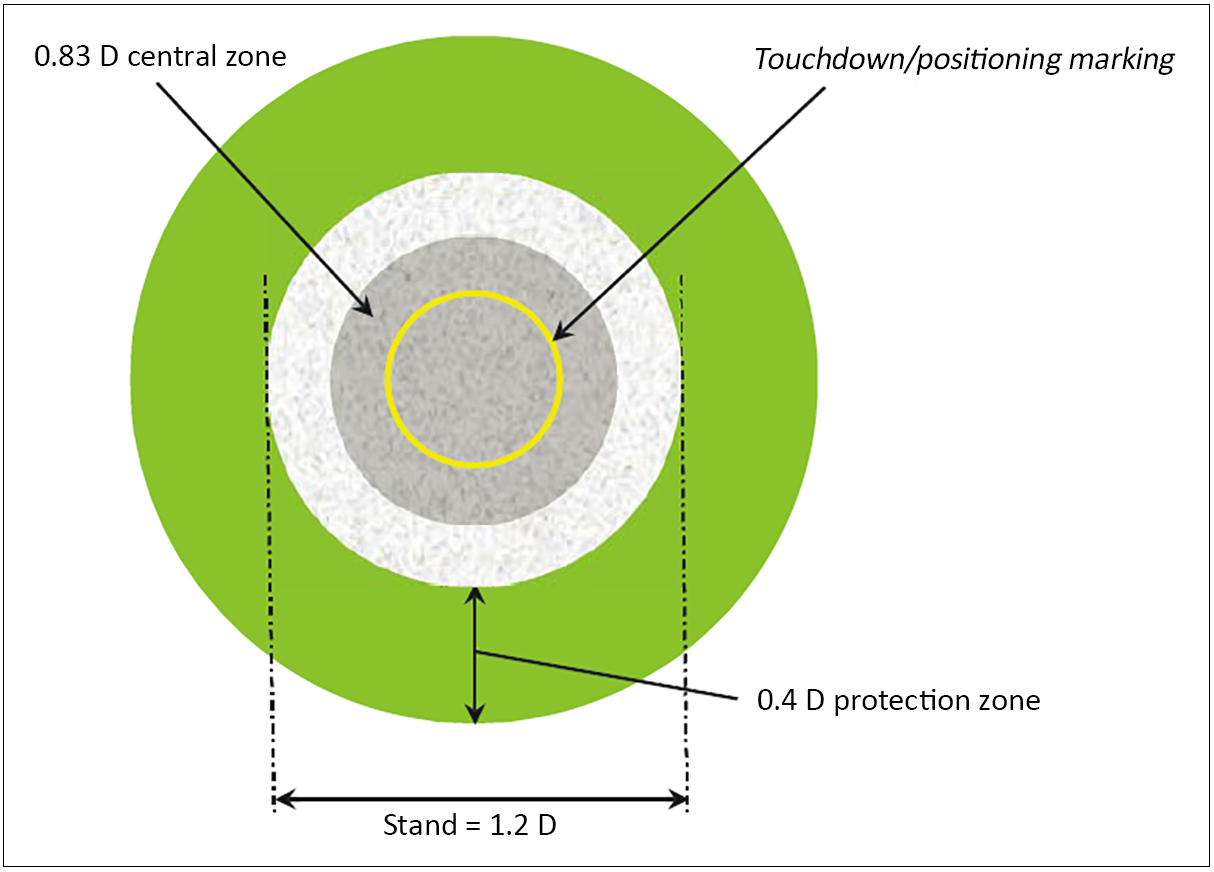
Figure D-1. Helicopter stand and
associated protection area permitting the helicopter to turn in a hover when
operating
(8) For simultaneous operations, the
protection areas of helicopter stands and their associatedtaxi-routes should
not overlap (see Figure D-2).
(9) A helicopter stand and the associated
protection area intended to be used for air taxiing should provide ground
effect.
(10) No fixed object should be permitted above
the surface of the ground on a helicopter stand, except for tie-down points
with a height of less than 5 cm, which can be accommodated if needed.
(11) No fixed object should be permitted above
the surface of the ground in the protection area around a helicopter stand
except for frangible objects which, because of their function, must be located
there.
(12) No mobile object should be permitted on a
helicopter stand and the associated protection area during helicopter
movements.
(13) Objects whose function requires them to be
located in the protection area at a distance of less than 0.75 D from the
centre of the helicopter stand, should not exceed 5 cm in height.
(14) Objects whose function requires them to be
located in the protection area should not:
(i) if located at a distance of less than
0.75 D from the centre of the helicopter stand, penetrate a plane at a height
of 5 cm above the plane of the central zone; and
(ii) if located at a distance of 0.75 D or more
from the centre of the helicopter stand, penetrate a plane at a height of 25
cm above the plane of the central zone and sloping upwards and outwards at a
gradient of 5 per cent.
(15) The central zone of a helicopter stand
should be capable of withstanding the traffic of helicopters it is intended to
serve and have a static load-bearing area:
(i) of diameter not less than 0.83 D of the
largest helicopter it is intended to serve; or
(ii) for a helicopter stand intended to be used for taxi-through, and where the helicopter using the stand is not required to turn, the same width as the helicopter ground taxiway.
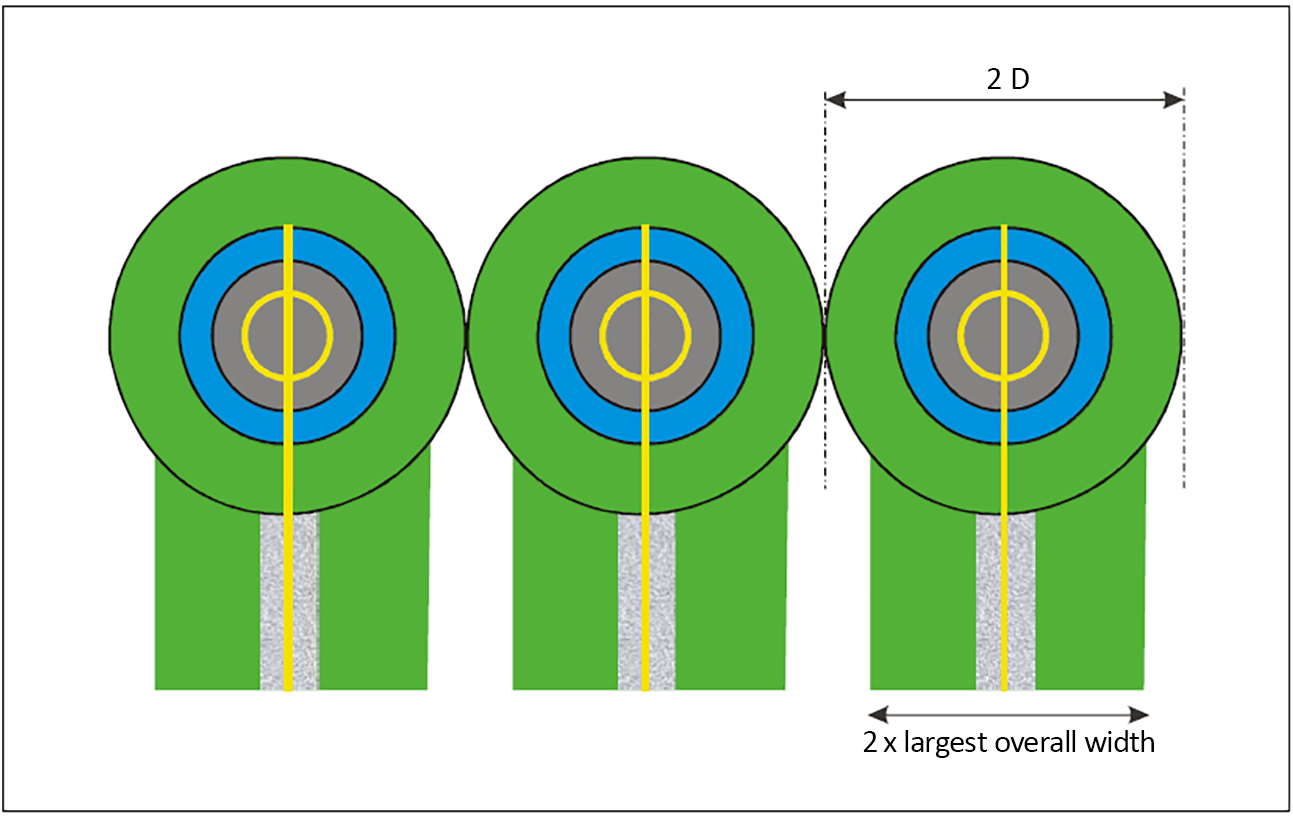
Figure
D-2. Helicopter stands designed for hover turns with air taxi-routes/taxiways
— simultaneous operations