GM1
ATS.OR.210(a) Safety
criteria
ED
Decision 2017/001/R
SAFETY
CRITERIA IN TERMS OF PROXIES FOR SAFETY RISKS
(a) In the safety assessment of functional
systems, it may not always be possible or desirable to specify safety criteria
in terms of quantitative values of risk. Instead, safety criteria may be
defined in terms of other measures that are related to risk. These measures
are called proxies and they need to meet the requirements for a proxy as
stated in AMC2 ATS.OR.210(a). For
examples of their use, see GM1 to
AMC1 ATS.OR.205(b)(4).
(b) A proxy is some measurable property that
can be used to represent the value of something else. In the safety assessment
of functional systems, the value of a proxy may be used as a substitute for a
value of risk, providing it meets the requirements for a proxy as stated in AMC2 ATS.OR.210(a). Examples of proxies are the
frequency of airspace infringements, runway incursions, false alert rate,
head-down time, limited sight, level of situation awareness, fraction of read
back errors, reduced vigilance, amount of turbulence, distraction of controller’s
attention, inappropriate pilot behaviour, system availability, information
integrity and service continuity.
An
example of the concept of using a different but specific quantity to assess an
actually relevant quantity is the transposition/measure of an aircraft’s
altitude which is in terms of barometric pressure or the transposition/measure
of an aircraft’s airspeed which is in terms of dynamic pressure.
(c) A proxy is a measure of a certain
property along the causal trajectory between the hazard/event and the harmful
effects of the hazard/event in question (see Figure 5). The causal
relationship between the proxy and the accident must be justified in the safety
case, i.e. it must satisfy AMC2 ATS.OR.210(a).
This means that the accident trajectory must be modelled and analysed such
that the causal relationship can be assured but without the need to evaluate
the quantitative nature of this relationship. It is assumed that since the
proxy lies between the hazard/event and the accident, then there is a
quantitative causal relationship between the rate of the hazard/event’s
occurrence and the rate of the proxy’s occurrence. As a consequence, the variation of values of the
proxy correlates with values of the hazards/events rate of occurrence and the
value of the rate at which the harmful effects occur, i.e. the accident rate,
and this relationship is a monotonically increasing one. This means that when
the proxy value, e.g. Proxy1, increases/decreases, the associated
risk value of the related accident, e.g. Accident1,
increases/decreases accordingly.
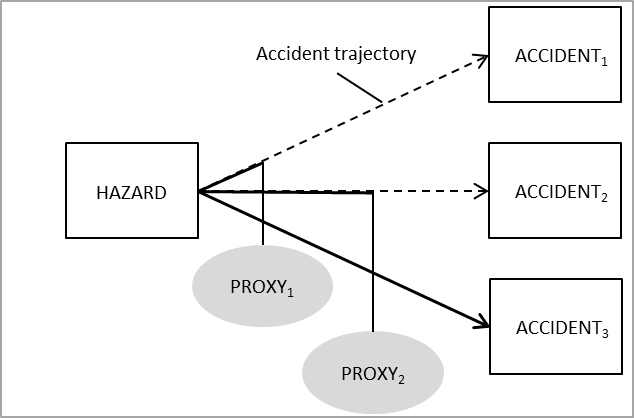
Figure
5: Use of proxies along accident trajectories
(d) Proxies might be preferred where the extra
effort needed to identify, describe and analyse a complete set of sequences of
events from the occurrence of a hazard to the occurrence of an accident or
incident has no added value in the safety assessment. The intrinsic reasons
for the amount of the extra effort are the number of significantly different
event sequences, the complexity of some accident scenarios, the existence of
many barriers preventing the occurrence of a hazard developing into an
accident and the lack of evidence on the probability of some events or the
frequency of occurrence of some external circumstances and factors. The usage
of proxies might then make the safety assessment more tractable and
comprehensible and increase the quality of the risk analysis.
(e) The main advantages of proxies are the
easy recognition of safety issues by operational staff involved in the safety
assessment, and the direct focus on the analysis and mitigation of the
identified hazards and safety issues introduced or affected by the change.
(f) The main disadvantage of using proxies is
that it is not possible to express risk by a uniform measure. However, the
value of the proxy should be measurable.
(g) For further details on the use of proxies,
please refer to GM1
to AMC1 ATS.OR.205(b)(4), which contains two examples to assist in
the selection and use of proxies in safety analysis.