GM2
CAT.POL.MAB.100(e) Mass and Balance, Loading
STATISTICAL EVALUATION OF PASSENGERS AND BAGGAGE DATA
(a) Sample size
(1) For calculating the required sample size, it is necessary to make an estimate of the standard deviation on the basis of standard deviations calculated for similar populations or for preliminary surveys. The precision of a sample estimate is calculated for 95 % reliability or ‘significance’, i.e. there is a 95 % probability that the true value falls within the specified confidence interval around the estimated value. This standard deviation value is also used for calculating the standard passenger mass.
(2) As a consequence, for the parameters of mass distribution, i.e. mean and standard deviation, three cases have to be distinguished:
(i) μ, σ = the true values of the average passenger mass and standard deviation, which are unknown and which are to be estimated by weighing passenger samples.
(ii) μ’, σ’ = the ‘a priori’ estimates of the average passenger mass and the standard deviation, i.e. values resulting from an earlier survey, which are needed to determine the current sample size.
(iii) 
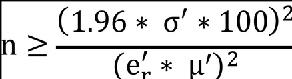
The sample size can then be calculated using the following formula:
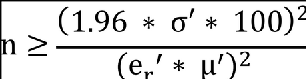
where:
n = number of passengers to be weighed (sample size)
e’r = allowed relative confidence range (accuracy)
for the estimate of µ by 
1.96 = value from the Gaussian distribution for 95 % significance level of the resulting confidence interval.
(b) Calculation
of average mass and standard deviation. If the sample of passengers weighed is
drawn at random, then the arithmetic mean of the sample (
(1) Arithmetic mean of sample where:
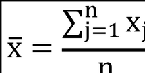
xj = mass values of individual passengers (sampling units).
(2) Standard deviation where:
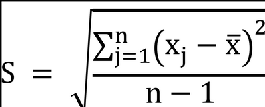
xj – 
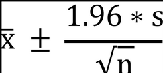
(c) Checking the accuracy of the sample mean. The accuracy (confidence range) which can be ascribed to the sample mean as an indicator of the true mean is a function of the standard deviation of the sample which has to be checked after the sample has been evaluated. This is done using the formula:
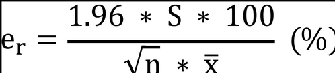
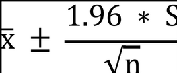
whereby er should not exceed 1 % for an all adult average mass and 2 % for an average male and/or female mass. The result of this calculation gives the relative accuracy of the estimate of µ at the 95 % significance level. This means that with 95 % probability, the true average mass µ lies within the interval:
(d) Example of determination of the required sample size and average passenger mass
(1) Introduction. Standard passenger mass values for mass and balance purposes require passenger weighing programs to be carried out. The following example shows the various steps required for establishing the sample size and evaluating the sample data. It is provided primarily for those who are not well versed in statistical computations. All mass figures used throughout the example are entirely fictitious.
(2) Determination of required sample size. For calculating the required sample size, estimates of the standard (average) passenger mass and the standard deviation are needed. The ‘a priori’ estimates from an earlier survey may be used for this purpose. If such estimates are not available, a small representative sample of about 100 passengers should be weighed so that the required values can be calculated. The latter has been assumed for the example.
Step 1: Estimated average passenger mass.
|
n |
xj (kg) |
|
1 |
79.9 |
|
2 |
68.1 |
|
3 |
77.9 |
|
4 |
74.5 |
|
5 |
54.1 |
|
6 |
62.2 |
|
7 |
89.3 |
|
8 |
108.7 |
|
. |
. |
|
85 |
63.2 |
|
86 |
75.4 |
|
|
6 071.6 |

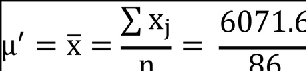
= 70.6 kg
Step 2: Estimated standard deviation.
|
n |
xj |
(xj
– |
(xj
– |
|
1 |
79.9 |
+9.3 |
86.49 |
|
2 |
68.1 |
–2.5 |
6.25 |
|
3 |
77.9 |
+7.3 |
53.29 |
|
4 |
74.5 |
+3.9 |
15.21 |
|
5 |
54.1 |
–16.5 |
272.25 |
|
6 |
62.2 |
–8.4 |
70.56 |
|
7 |
89.3 |
+18.7 |
349.69 |
|
8 |
108.7 |
+38.1 |
1 451.61 |
|
. |
. |
. |
. |
|
85 |
63.2 |
–7.4 |
54.76 |
|
86 |
75.4 |
–4.8 |
23.04 |
|
|
6 071.6 |
|
34 683.40 |


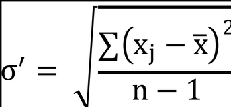
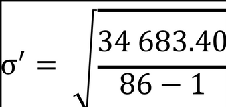
σ' = 20.20 kg
Step 3: Required sample size.
The required number of passengers to be weighed should be such that the confidence range, e'r does not exceed 1 %, as specified in (c).
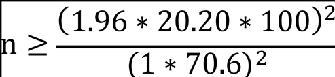
n ≥ 3145
The result shows that at least 3 145 passengers should be weighed to achieve the required accuracy. If e’r is chosen as 2 % the result would be n ≥786.
Step 4: After having established the required sample size, a plan for weighing the passengers is to be worked out.
(3) Determination of the passenger average mass
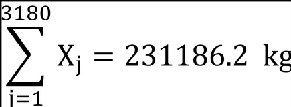
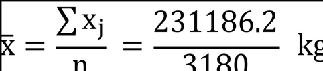
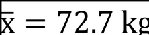
Step 1: Having collected the required number of passenger mass values, the average passenger mass can be calculated. For the purpose of this example, it has been assumed that 3 180 passengers were weighed. The sum of the individual masses amounts to 231 186.2 kg.
n = 3 180
Step 2: Calculation of the standard deviation
For calculating the standard deviation, the method shown in paragraph (2) step 2 should be applied.

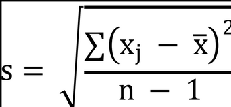
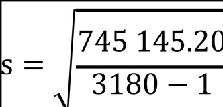
s = 15.31 kg
Step 3: Calculation of the accuracy of the sample mean
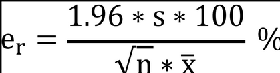
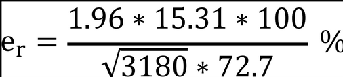
er = 0.73 %
Step 4: Calculation of the confidence range of the sample mean
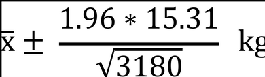
72.7 ± 0.5 kg
The result of this calculation shows that there is a 95 % probability of the actual mean for all passengers lying within the range 72.2 kg to 73.2 kg.