<?xml version="1.0" encoding="utf-8"?>
<feed xmlns="http://www.w3.org/2005/Atom">
    <id>https://aviation.bot/blog/</id>
    <title>Aviation.Bot Blog</title>
    <updated>2026-05-06T00:00:00.000Z</updated>
    <generator>https://github.com/jpmonette/feed</generator>
    <link rel="alternate" href="https://aviation.bot/blog/"/>
    <subtitle>Aviation.Bot Blog</subtitle>
    <icon>https://aviation.bot/img/favicon.svg</icon>
    <entry>
        <title type="html"><![CDATA[EASA Part-IS Readiness: Finding Cybersecurity Gaps Across Aviation Manuals, Suppliers, Risk Registers, and Training Records]]></title>
        <id>https://aviation.bot/blog/easa-part-is-readiness-cybersecurity-evidence/</id>
        <link href="https://aviation.bot/blog/easa-part-is-readiness-cybersecurity-evidence/"/>
        <updated>2026-05-06T00:00:00.000Z</updated>
        <summary type="html"><![CDATA[A practical AI document workflow for aviation teams that need to map EASA Part-IS information-security material across manuals, supplier evidence, risk registers, incident procedures, training records, and audit evidence.]]></summary>
        <content type="html"><![CDATA[<p>EASA Part-IS work is not one cybersecurity policy. It is a cross-functional evidence problem: information-security manuals, safety-impact procedures, supplier files, cyber risk registers, incident response, EFB administration, OCC continuity, training records, and compliance monitoring all need to line up.</p>
<p>Aviation.Bot is useful here because it treats Part-IS readiness as a document workspace, not as a one-off question over one PDF.</p>
<p><img decoding="async" loading="lazy" src="https://cdn.document.bot/marketing/easa-part-is-cybersecurity-evidence-readiness/05-impact-review.png" alt="Aviation.Bot Part-IS impact review screenshot" class="img_tDZ2"></p>
<p>This article walks through a fictional but realistic example: Asteria Regional Airways, a European commercial air operator preparing a Part-IS evidence-readiness review.</p>
<p>The demo uses public EASA source material, synthetic company files, and a real agent run. The workspace did not contain the final report upfront. Aviation.Bot inspected the sources and company files during the recorded run, then created the impact and evidence review.</p>
<p>This is preparation support, not regulatory advice. A qualified compliance, safety, cybersecurity, and accountable management review remains required before any real Part-IS submission, audit response, or operational change.</p>
<video controls="" preload="metadata" width="100%" src="https://cdn.document.bot/marketing/easa-part-is-cybersecurity-evidence-readiness/easa-part-is-cybersecurity-evidence-readiness.mp4" title="Aviation.Bot EASA Part-IS cybersecurity evidence readiness demo"></video>
<h2 class="anchor anchorTargetStickyNavbar_ugxl" id="why-this-becomes-a-workspace-problem">Why This Becomes A Workspace Problem<a href="https://aviation.bot/blog/easa-part-is-readiness-cybersecurity-evidence/#why-this-becomes-a-workspace-problem" class="hash-link" aria-label="Direct link to Why This Becomes A Workspace Problem" title="Direct link to Why This Becomes A Workspace Problem" translate="no">​</a></h2>
<p>Part-IS asks aviation organisations to manage information-security risks with a potential impact on aviation safety. That quickly becomes bigger than an IT policy review.</p>
<p>A useful readiness review needs to connect:</p>
<ul>
<li class="">official EASA Part-IS source material and AMC/GM</li>
<li class="">the organisation's information-security management manual</li>
<li class="">procedures for aviation safety impact assessment</li>
<li class="">cyber incident response and reporting</li>
<li class="">OCC, dispatch, EFB, maintenance, CAMO, and technical-publications interfaces</li>
<li class="">flight-planning, EFB, maintenance, and other safety-relevant suppliers</li>
<li class="">access control, privileged accounts, patching, vulnerability handling, and continuity procedures</li>
<li class="">training records and role-based awareness material</li>
<li class="">compliance matrices, risk registers, supplier assurance registers, and evidence trackers</li>
</ul>
<p>The hard part is not reading one document. The hard part is finding where cybersecurity language is generic, where aviation safety impact is missing, and where audit evidence does not yet exist.</p>
<p><img decoding="async" loading="lazy" src="https://cdn.document.bot/marketing/easa-part-is-cybersecurity-evidence-readiness/01-part-is-source.png" alt="Aviation.Bot Part-IS source screenshot" class="img_tDZ2"></p>
<h2 class="anchor anchorTargetStickyNavbar_ugxl" id="what-goes-into-the-workspace">What Goes Into The Workspace<a href="https://aviation.bot/blog/easa-part-is-readiness-cybersecurity-evidence/#what-goes-into-the-workspace" class="hash-link" aria-label="Direct link to What Goes Into The Workspace" title="Direct link to What Goes Into The Workspace" translate="no">​</a></h2>
<p>For a real review, start from official sources and keep provenance outside the visible working folder: canonical URL, access date, file version, direct download URL when applicable, file size, and checksum.</p>
<p>Useful public EASA starting points include:</p>
<ul>
<li class=""><a href="https://www.easa.europa.eu/en/document-library/easy-access-rules/easy-access-rules-information-security-regulations-eu-2023203" target="_blank" rel="noopener noreferrer" class="">Easy Access Rules for Information Security</a>, which consolidate Regulations (EU) 2023/203 and 2022/1645 with related AMC/GM</li>
<li class=""><a href="https://www.easa.europa.eu/en/regulations/information-security" target="_blank" rel="noopener noreferrer" class="">EASA Information Security regulations</a></li>
<li class=""><a href="https://www.easa.europa.eu/en/the-agency/faqs/information-security-part" target="_blank" rel="noopener noreferrer" class="">EASA Information Security Part-IS FAQs</a></li>
</ul>
<p>The demo uses those public-source categories and then adds synthetic company files, including an information-security management manual, incident response SOP, EFB administration procedure, supplier security template, compliance matrix, cyber risk register, supplier assurance register, incident log, and training matrix.</p>
<p><img decoding="async" loading="lazy" src="https://cdn.document.bot/marketing/easa-part-is-cybersecurity-evidence-readiness/02-isms-manual.png" alt="Aviation.Bot information-security manual screenshot" class="img_tDZ2"></p>
<h2 class="anchor anchorTargetStickyNavbar_ugxl" id="the-prompt-pattern">The Prompt Pattern<a href="https://aviation.bot/blog/easa-part-is-readiness-cybersecurity-evidence/#the-prompt-pattern" class="hash-link" aria-label="Direct link to The Prompt Pattern" title="Direct link to The Prompt Pattern" translate="no">​</a></h2>
<p>The visible demo prompt is bounded. It asks Aviation.Bot to separate official Part-IS material from context, inspect the company workspace, and create a review artifact.</p>
<div class="language-text codeBlockContainer_UFuS theme-code-block" style="--prism-color:#393A34;--prism-background-color:#f6f8fa"><div class="codeBlockContent__cCW"><pre tabindex="0" class="prism-code language-text codeBlock_zOJW thin-scrollbar" style="color:#393A34;background-color:#f6f8fa"><code class="codeBlockLines_mm5G"><div class="token-line" style="color:#393A34"><span class="token plain">Review the Part-IS information-security source material and the company workspace. Identify affected manuals, SOPs, supplier documents, training records, and registers. Draft reviewable updates where company wording is incomplete or stale, and save an audit-oriented impact and evidence review in outputs as part-is-impact-and-evidence-review.md.</span><br></div></code></pre></div></div>
<p>The important pattern is:</p>
<ol>
<li class="">name the official source material and company files in scope</li>
<li class="">ask for affected documents and missing evidence</li>
<li class="">ask for reviewable updates, not approved manual text</li>
<li class="">keep the output bounded as evidence-readiness support</li>
</ol>
<h2 class="anchor anchorTargetStickyNavbar_ugxl" id="what-the-agent-did-in-the-demo">What The Agent Did In The Demo<a href="https://aviation.bot/blog/easa-part-is-readiness-cybersecurity-evidence/#what-the-agent-did-in-the-demo" class="hash-link" aria-label="Direct link to What The Agent Did In The Demo" title="Direct link to What The Agent Did In The Demo" translate="no">​</a></h2>
<p>The recorded run used a real model, not a scripted final answer. During the run, Aviation.Bot indexed the workspace, opened the EASA source material, inspected the company information-security manual, checked supplier and risk registers, reviewed training and incident evidence, and then wrote the final Part-IS impact and evidence review.</p>
<p><img decoding="async" loading="lazy" src="https://cdn.document.bot/marketing/easa-part-is-cybersecurity-evidence-readiness/03-supplier-register.png" alt="Aviation.Bot supplier cyber assurance register screenshot" class="img_tDZ2"></p>
<p>The final output is an evidence-readiness review. It is not a finding of compliance.</p>
<p>The report identified practical issues such as:</p>
<ul>
<li class="">an ISMS manual that looked ISO-style but did not clearly classify aviation safety impact</li>
<li class="">incident response language without a strong safety-effect triage path</li>
<li class="">supplier assurance records that needed better coverage for safety-relevant systems</li>
<li class="">EFB and operational technology procedures that needed stronger data-integrity and escalation controls</li>
<li class="">compliance monitoring records that needed clearer evidence, owners, due dates, and corrective-action status</li>
<li class="">training material that needed to distinguish flight operations, OCC, maintenance, EFB, supplier, and compliance responsibilities</li>
</ul>
<p><img decoding="async" loading="lazy" src="https://cdn.document.bot/marketing/easa-part-is-cybersecurity-evidence-readiness/04-compliance-matrix.png" alt="Aviation.Bot Part-IS compliance matrix screenshot" class="img_tDZ2"></p>
<h2 class="anchor anchorTargetStickyNavbar_ugxl" id="why-this-is-better-than-a-one-off-chat-upload">Why This Is Better Than A One-Off Chat Upload<a href="https://aviation.bot/blog/easa-part-is-readiness-cybersecurity-evidence/#why-this-is-better-than-a-one-off-chat-upload" class="hash-link" aria-label="Direct link to Why This Is Better Than A One-Off Chat Upload" title="Direct link to Why This Is Better Than A One-Off Chat Upload" translate="no">​</a></h2>
<p>Uploading a single PDF to a chat tool can help with reading. It does not solve the Part-IS evidence problem.</p>
<p>For Part-IS readiness, the useful workflow is:</p>
<ol>
<li class="">keep official sources and company evidence in one working folder</li>
<li class="">index PDFs, Word files, spreadsheets, and notes together</li>
<li class="">let the agent inspect original source files and target documents</li>
<li class="">map each finding to a document, owner, evidence request, and review status</li>
<li class="">create a reviewable output in the same workspace</li>
<li class="">let accountable humans verify and approve each next step</li>
</ol>
<p>Aviation.Bot is designed around that loop. The generated review is just another workspace file, and the user can continue from it instead of copy-pasting between a PDF viewer, spreadsheet, file browser, and chat session.</p>
<h2 class="anchor anchorTargetStickyNavbar_ugxl" id="what-to-ask-the-ai-to-produce">What To Ask The AI To Produce<a href="https://aviation.bot/blog/easa-part-is-readiness-cybersecurity-evidence/#what-to-ask-the-ai-to-produce" class="hash-link" aria-label="Direct link to What To Ask The AI To Produce" title="Direct link to What To Ask The AI To Produce" translate="no">​</a></h2>
<p>For a serious readiness review, ask for a report with sections like:</p>
<ul>
<li class="">scope and assumptions</li>
<li class="">source hierarchy and source status</li>
<li class="">applicability caveats</li>
<li class="">affected company documents</li>
<li class="">direct terminology hits</li>
<li class="">indirect safety-impact and supplier-interface gaps</li>
<li class="">draft controlled-document update proposals</li>
<li class="">evidence requests for audit readiness</li>
<li class="">training and role impacts</li>
<li class="">register updates</li>
<li class="">open human-review questions</li>
<li class="">recommended next actions</li>
</ul>
<p>The most useful output is not a broad cybersecurity summary. It is a traceable worklist that a compliance manager, safety manager, cybersecurity owner, supplier manager, training owner, and accountable manager can review.</p>
<p><img decoding="async" loading="lazy" src="https://cdn.document.bot/marketing/easa-part-is-cybersecurity-evidence-readiness/06-impact-review-bottom.png" alt="Aviation.Bot generated Part-IS review bottom screenshot" class="img_tDZ2"></p>
<h2 class="anchor anchorTargetStickyNavbar_ugxl" id="what-to-avoid">What To Avoid<a href="https://aviation.bot/blog/easa-part-is-readiness-cybersecurity-evidence/#what-to-avoid" class="hash-link" aria-label="Direct link to What To Avoid" title="Direct link to What To Avoid" translate="no">​</a></h2>
<p>Do not ask any AI tool to certify Part-IS compliance. Do not treat generic ISO 27001 language as automatically sufficient for aviation safety impact. Do not let supplier cyber evidence stop at "IT vendor" when flight planning, EFB, maintenance records, OCC communications, crew planning, and technical-publications systems may affect operations.</p>
<p>Also avoid flattening all sources into one pool. Current EASA material, AMC/GM, FAQs, company policies, supplier documents, and contextual cybersecurity material do not have the same authority or use.</p>
<p>The useful promise is narrower and more practical: reduce the search tax, make the evidence gap visible, and create reviewable updates for accountable humans.</p>
<h2 class="anchor anchorTargetStickyNavbar_ugxl" id="how-aviationbot-can-help">How Aviation.Bot Can Help<a href="https://aviation.bot/blog/easa-part-is-readiness-cybersecurity-evidence/#how-aviationbot-can-help" class="hash-link" aria-label="Direct link to How Aviation.Bot Can Help" title="Direct link to How Aviation.Bot Can Help" translate="no">​</a></h2>
<p>For Part-IS work, Aviation.Bot helps turn a scattered evidence set into a reviewable folder: official EASA source PDFs, information-security manuals, incident procedures, supplier files, risk registers, training matrices, audit checklists, and generated evidence reviews can all stay together.</p>
<p>You can choose the AI model or provider that fits your data boundary. Use a capable cloud model when policy allows it, or use a local/offline model when cybersecurity records, supplier files, company policy, or EU GDPR concerns require tighter control. Aviation.Bot then adds the document workflow: indexing, source inspection, file-aware chat, generated reports, reviewable output files, and human approval before the result is used.</p>
<p>Learn more at <a href="https://aviation.bot/" target="_blank" rel="noopener noreferrer" class="">aviation.bot</a>.</p>]]></content>
        <category label="aviation" term="aviation"/>
        <category label="EASA" term="EASA"/>
        <category label="Part-IS" term="Part-IS"/>
        <category label="cybersecurity" term="cybersecurity"/>
        <category label="compliance" term="compliance"/>
        <category label="document ai" term="document ai"/>
    </entry>
    <entry>
        <title type="html"><![CDATA[How to Find Gaps in an EASA SORA Application Before Submission]]></title>
        <id>https://aviation.bot/blog/find-gaps-in-easa-sora-application-before-submission/</id>
        <link href="https://aviation.bot/blog/find-gaps-in-easa-sora-application-before-submission/"/>
        <updated>2026-05-04T00:00:00.000Z</updated>
        <summary type="html"><![CDATA[A practical AI document workflow for commercial drone operators who need to find missing evidence, inconsistent claims, and open actions before submitting an EASA SORA application.]]></summary>
        <content type="html"><![CDATA[<p>Preparing a SORA-based operational authorisation package is not just filling in one form. It is a document-control problem: the official EASA material, the application draft, CONOPS, operations manual, UAS evidence, risk tables, compliance matrices, mitigation records, pilot records, and national-authority notes all need to stay consistent.</p>
<p>Aviation.Bot is useful here because it treats the application as a workspace, not as a single uploaded PDF.</p>
<p><img decoding="async" loading="lazy" src="https://cdn.document.bot/marketing/easa-sora-application/05-gap-review.png" alt="Aviation.Bot SORA application gap review screenshot" class="img_tDZ2"></p>
<p>This article walks through a fictional but realistic example: NorthSea Aero Logistics, a commercial drone operator preparing a specific-category SORA application package for BVLOS infrastructure work in the Netherlands.</p>
<p>The demo uses public EASA and Dutch ILT source material, synthetic company files, and a real agent run. The workspace did not contain the final report upfront. Aviation.Bot created the pre-submission gap review during the recorded run.</p>
<p>This is preparation support, not regulatory advice. A qualified compliance lead and the relevant competent-authority process remain required before any real submission.</p>
<video controls="" width="100%" src="https://cdn.document.bot/marketing/easa-sora-application/easa-sora-application.webm" title="Aviation.Bot EASA SORA application workspace demo"></video>
<h2 class="anchor anchorTargetStickyNavbar_ugxl" id="why-this-becomes-a-workspace-problem">Why This Becomes A Workspace Problem<a href="https://aviation.bot/blog/find-gaps-in-easa-sora-application-before-submission/#why-this-becomes-a-workspace-problem" class="hash-link" aria-label="Direct link to Why This Becomes A Workspace Problem" title="Direct link to Why This Becomes A Workspace Problem" translate="no">​</a></h2>
<p>A SORA package has many moving parts:</p>
<ul>
<li class="">the current SORA methodology and related AMC/GM material</li>
<li class="">the operational authorisation application form and current draft</li>
<li class="">the operator's concept of operations</li>
<li class="">UAS system, C2 link, containment, maintenance, and emergency-response evidence</li>
<li class="">risk registers and mitigation evidence matrices</li>
<li class="">remote pilot competence records</li>
<li class="">operations manual sections that must match the application</li>
<li class="">national or local authority constraints for the state of operation</li>
</ul>
<p>The hard part is consistency. A single mismatch such as altitude, operating area, mitigation owner, evidence ID, or document revision can create review work later.</p>
<p>In the recorded demo, the generated gap review found exactly that kind of issue: the application draft used one altitude assumption, while the CONOPS and operational-volume evidence used another.</p>
<p><img decoding="async" loading="lazy" src="https://cdn.document.bot/marketing/easa-sora-application/03-risk-register.png" alt="Aviation.Bot SORA risk register screenshot" class="img_tDZ2"></p>
<h2 class="anchor anchorTargetStickyNavbar_ugxl" id="what-goes-into-the-workspace">What Goes Into The Workspace<a href="https://aviation.bot/blog/find-gaps-in-easa-sora-application-before-submission/#what-goes-into-the-workspace" class="hash-link" aria-label="Direct link to What Goes Into The Workspace" title="Direct link to What Goes Into The Workspace" translate="no">​</a></h2>
<p>For a real review, start from official sources and keep provenance outside the visible working folder: canonical URL, access date, direct download URL when applicable, file size, and checksum. In the demo pipeline, that source manifest is kept as a sidecar artifact rather than cluttering the user's workspace.</p>
<p>Useful EASA starting points include:</p>
<ul>
<li class=""><a href="https://www.easa.europa.eu/en/domains/drones-air-mobility/operating-drone/specific-category-civil-drones/specific-operations-risk-assessment-sora" target="_blank" rel="noopener noreferrer" class="">EASA SORA overview</a></li>
<li class=""><a href="https://www.easa.europa.eu/en/document-library/agency-decisions/ed-decision-2025018r" target="_blank" rel="noopener noreferrer" class="">ED Decision 2025/018/R</a>, including the SORA 2.5 annex, explanatory note, and corrigendum</li>
<li class=""><a href="https://www.easa.europa.eu/en/document-library/easy-access-rules/easy-access-rules-unmanned-aircraft-systems-regulations-eu" target="_blank" rel="noopener noreferrer" class="">Easy Access Rules for Unmanned Aircraft Systems</a></li>
<li class=""><a href="https://www.easa.europa.eu/en/domains/drones-air-mobility/operating-drone/specific-category-civil-drones/application-forms" target="_blank" rel="noopener noreferrer" class="">Specific-category application forms</a></li>
<li class=""><a href="https://www.easa.europa.eu/en/document-library/general-publications/drones/easa-operations-manual-example-uas-operations-sail-ii" target="_blank" rel="noopener noreferrer" class="">EASA operations manual example for SAIL II UAS operations</a></li>
<li class=""><a href="https://www.easa.europa.eu/en/domains/drones-air-mobility/operating-drone/critical-area-assessment-tool-caat" target="_blank" rel="noopener noreferrer" class="">Critical Area Assessment Tool guidance</a></li>
</ul>
<p>Because the fictional operator is based in the Netherlands, the demo also includes Dutch ILT pages captured as PDFs. This matters because local conditions can change what evidence is needed for BVLOS operations.</p>
<p><img decoding="async" loading="lazy" src="https://cdn.document.bot/marketing/easa-sora-application/01-application-form.png" alt="Aviation.Bot EASA application draft screenshot" class="img_tDZ2"></p>
<h2 class="anchor anchorTargetStickyNavbar_ugxl" id="company-files-to-add">Company Files To Add<a href="https://aviation.bot/blog/find-gaps-in-easa-sora-application-before-submission/#company-files-to-add" class="hash-link" aria-label="Direct link to Company Files To Add" title="Direct link to Company Files To Add" translate="no">​</a></h2>
<p>After the official sources, add the operator files. A useful SORA review workspace normally includes:</p>
<ul>
<li class="">current application form draft</li>
<li class="">CONOPS or equivalent operation description</li>
<li class="">UAS system description</li>
<li class="">draft operations manual</li>
<li class="">operational volume and ground risk buffer evidence</li>
<li class="">risk register</li>
<li class="">compliance matrix</li>
<li class="">mitigation evidence matrix</li>
<li class="">remote pilot competence matrix</li>
<li class="">maintenance, C2 link, containment, and emergency-response procedures</li>
<li class="">national or local-condition evidence where applicable</li>
</ul>
<p>The demo uses synthetic DOCX, XLSX, and PDF files instead of Markdown because real SORA work normally happens across office documents and formal PDFs.</p>
<h2 class="anchor anchorTargetStickyNavbar_ugxl" id="the-prompt-pattern">The Prompt Pattern<a href="https://aviation.bot/blog/find-gaps-in-easa-sora-application-before-submission/#the-prompt-pattern" class="hash-link" aria-label="Direct link to The Prompt Pattern" title="Direct link to The Prompt Pattern" translate="no">​</a></h2>
<p>The visible demo prompt is deliberately bounded. It asks Aviation.Bot to compare a named document set and create a review artifact, not to "approve" an application.</p>
<div class="language-text codeBlockContainer_UFuS theme-code-block" style="--prism-color:#393A34;--prism-background-color:#f6f8fa"><div class="codeBlockContent__cCW"><pre tabindex="0" class="prism-code language-text codeBlock_zOJW thin-scrollbar" style="color:#393A34;background-color:#f6f8fa"><code class="codeBlockLines_mm5G"><div class="token-line" style="color:#393A34"><span class="token plain">Review this SORA application workspace. Start with the application draft, compare it with the SORA 2.5 annex, the form guidance, the CONOPS, risk register, compliance matrix, and supporting evidence. Identify missing evidence, inconsistent mitigations, national or local-condition gaps, and the highest-priority actions. Save the gap review in outputs as sora-application-gap-review.md.</span><br></div></code></pre></div></div>
<p>The exact wording can change. The important pattern is:</p>
<ol>
<li class="">name the official sources and company files in scope</li>
<li class="">ask for missing evidence and inconsistencies</li>
<li class="">ask for a concrete review artifact</li>
<li class="">keep the output bounded as preparation support</li>
</ol>
<h2 class="anchor anchorTargetStickyNavbar_ugxl" id="what-the-agent-did-in-the-demo">What The Agent Did In The Demo<a href="https://aviation.bot/blog/find-gaps-in-easa-sora-application-before-submission/#what-the-agent-did-in-the-demo" class="hash-link" aria-label="Direct link to What The Agent Did In The Demo" title="Direct link to What The Agent Did In The Demo" translate="no">​</a></h2>
<p>The recorded run used a real model, not a scripted final answer. During the run, Aviation.Bot indexed the workspace, opened the application draft, inspected the official source PDFs, read the SORA annex and Form 208 material, checked the Dutch ILT captures, inspected Word documents and spreadsheets, searched for missing evidence files, and then wrote the gap review.</p>
<p><img decoding="async" loading="lazy" src="https://cdn.document.bot/marketing/easa-sora-application/02-sora-source.png" alt="Aviation.Bot SORA source document screenshot" class="img_tDZ2"></p>
<p>The final output is a pre-submission gap review. It is not an approval opinion. It gives the operator a practical list of items to review with a compliance owner.</p>
<p>The report flagged issues such as:</p>
<ul>
<li class="">inconsistent altitude and operational-volume assumptions</li>
<li class="">missing KML/KMZ or equivalent location package evidence</li>
<li class="">missing adjacent-area population-density support</li>
<li class="">containment evidence ID mismatch and missing flight-test evidence</li>
<li class="">incomplete emergency-response revision and role alignment</li>
<li class="">operations manual maturity gaps</li>
<li class="">weak compliance-matrix traceability</li>
<li class="">missing insurance evidence for the ILT application context</li>
</ul>
<p><img decoding="async" loading="lazy" src="https://cdn.document.bot/marketing/easa-sora-application/04-compliance-matrix.png" alt="Aviation.Bot SORA compliance matrix screenshot" class="img_tDZ2"></p>
<h2 class="anchor anchorTargetStickyNavbar_ugxl" id="why-this-is-better-than-a-one-off-chat-upload">Why This Is Better Than A One-Off Chat Upload<a href="https://aviation.bot/blog/find-gaps-in-easa-sora-application-before-submission/#why-this-is-better-than-a-one-off-chat-upload" class="hash-link" aria-label="Direct link to Why This Is Better Than A One-Off Chat Upload" title="Direct link to Why This Is Better Than A One-Off Chat Upload" translate="no">​</a></h2>
<p>Uploading a single PDF to a chat tool can help with reading. It does not solve the workspace problem.</p>
<p>For a SORA package, the useful workflow is:</p>
<ol>
<li class="">keep official sources and operator evidence in one folder</li>
<li class="">index PDFs, Word files, spreadsheets, and notes together</li>
<li class="">let the agent search and inspect the original source files</li>
<li class="">create a reviewable output in the same workspace</li>
<li class="">let a human owner verify each finding against the cited documents</li>
</ol>
<p>Aviation.Bot is designed around that loop. The source documents remain visible, the generated report is just another workspace file, and the user can continue reviewing instead of copy/pasting between a PDF viewer, spreadsheet, file browser, and chat session.</p>
<h2 class="anchor anchorTargetStickyNavbar_ugxl" id="how-to-build-this-workspace-yourself">How To Build This Workspace Yourself<a href="https://aviation.bot/blog/find-gaps-in-easa-sora-application-before-submission/#how-to-build-this-workspace-yourself" class="hash-link" aria-label="Direct link to How To Build This Workspace Yourself" title="Direct link to How To Build This Workspace Yourself" translate="no">​</a></h2>
<ol>
<li class="">Install Aviation.Bot and create a new workspace folder for the application package.</li>
<li class="">Download the relevant official EASA sources listed above and store them under a <code>sources/easa/</code> folder.</li>
<li class="">Add national or local authority material under a folder such as <code>sources/naa/</code> when your operation depends on state-specific conditions.</li>
<li class="">Add your own operator files under folders such as <code>company/</code>, <code>risk/</code>, and <code>evidence/</code>.</li>
<li class="">Include the application draft, CONOPS, operations manual, risk register, compliance matrix, mitigation evidence, pilot competence records, UAS system description, and emergency-response material.</li>
<li class="">Ask Aviation.Bot to compare the official sources with your company files and produce a gap review.</li>
<li class="">Inspect every cited source and assign a human owner for each open action.</li>
</ol>
<p>Do not stop at the AI output. Treat it as a review accelerant: a way to find inconsistencies, missing evidence, and draft action lists faster.</p>
<img alt="Aviation.Bot generated SORA gap review caveat screenshot" src="https://cdn.document.bot/marketing/easa-sora-application/06-gap-review-bottom.png">
<h2 class="anchor anchorTargetStickyNavbar_ugxl" id="what-to-avoid">What To Avoid<a href="https://aviation.bot/blog/find-gaps-in-easa-sora-application-before-submission/#what-to-avoid" class="hash-link" aria-label="Direct link to What To Avoid" title="Direct link to What To Avoid" translate="no">​</a></h2>
<p>Do not ask any AI tool to approve a SORA application. Do not rely on a generated answer without checking source documents. Do not use a workspace like this as a substitute for national requirements, privacy and data-protection review, insurance, liability, security, environmental constraints, or competent-authority guidance.</p>
<p>The useful promise is narrower and more practical: reduce the search tax, keep official sources and operator evidence together, and make the pre-submission review easier to inspect.</p>
<h2 class="anchor anchorTargetStickyNavbar_ugxl" id="how-aviationbot-can-help">How Aviation.Bot Can Help<a href="https://aviation.bot/blog/find-gaps-in-easa-sora-application-before-submission/#how-aviationbot-can-help" class="hash-link" aria-label="Direct link to How Aviation.Bot Can Help" title="Direct link to How Aviation.Bot Can Help" translate="no">​</a></h2>
<p>For SORA work, Aviation.Bot helps turn a scattered application package into a reviewable folder: EASA source PDFs, national-authority material, the application draft, CONOPS, operations manual sections, risk registers, evidence matrices, and generated gap reviews can all stay together.</p>
<p>You can choose the AI model or provider that fits your data boundary. Use a cloud model for maximum capability when policy allows it, or use a local/offline model when operational details, customer constraints, company policy, or EU GDPR concerns require tighter control. Aviation.Bot then adds the document workflow: indexing, source inspection, file-aware chat, generated reports, reviewable output files, and human approval before the result is used.</p>
<p>Learn more at <a href="https://aviation.bot/" target="_blank" rel="noopener noreferrer" class="">aviation.bot</a>.</p>]]></content>
        <category label="aviation" term="aviation"/>
        <category label="drones" term="drones"/>
        <category label="EASA" term="EASA"/>
        <category label="SORA" term="SORA"/>
        <category label="compliance" term="compliance"/>
        <category label="document ai" term="document ai"/>
    </entry>
    <entry>
        <title type="html"><![CDATA[AI Document Workflows For Aviation Compliance Teams]]></title>
        <id>https://aviation.bot/blog/ai-document-workflows-for-aviation-compliance-teams/</id>
        <link href="https://aviation.bot/blog/ai-document-workflows-for-aviation-compliance-teams/"/>
        <updated>2026-05-03T00:00:00.000Z</updated>
        <summary type="html"><![CDATA[Aviation documentation work depends on high-recall search, source inspection, and reviewable changes across manuals, guidance, and evidence files.]]></summary>
        <content type="html"><![CDATA[<p>Aviation compliance and technical publication work is document-heavy by nature. Requirements, guidance, manuals, checklists, and evidence files rarely live in one clean system. They are spread across PDFs, Word documents, spreadsheets, notes, and shared folders.</p>
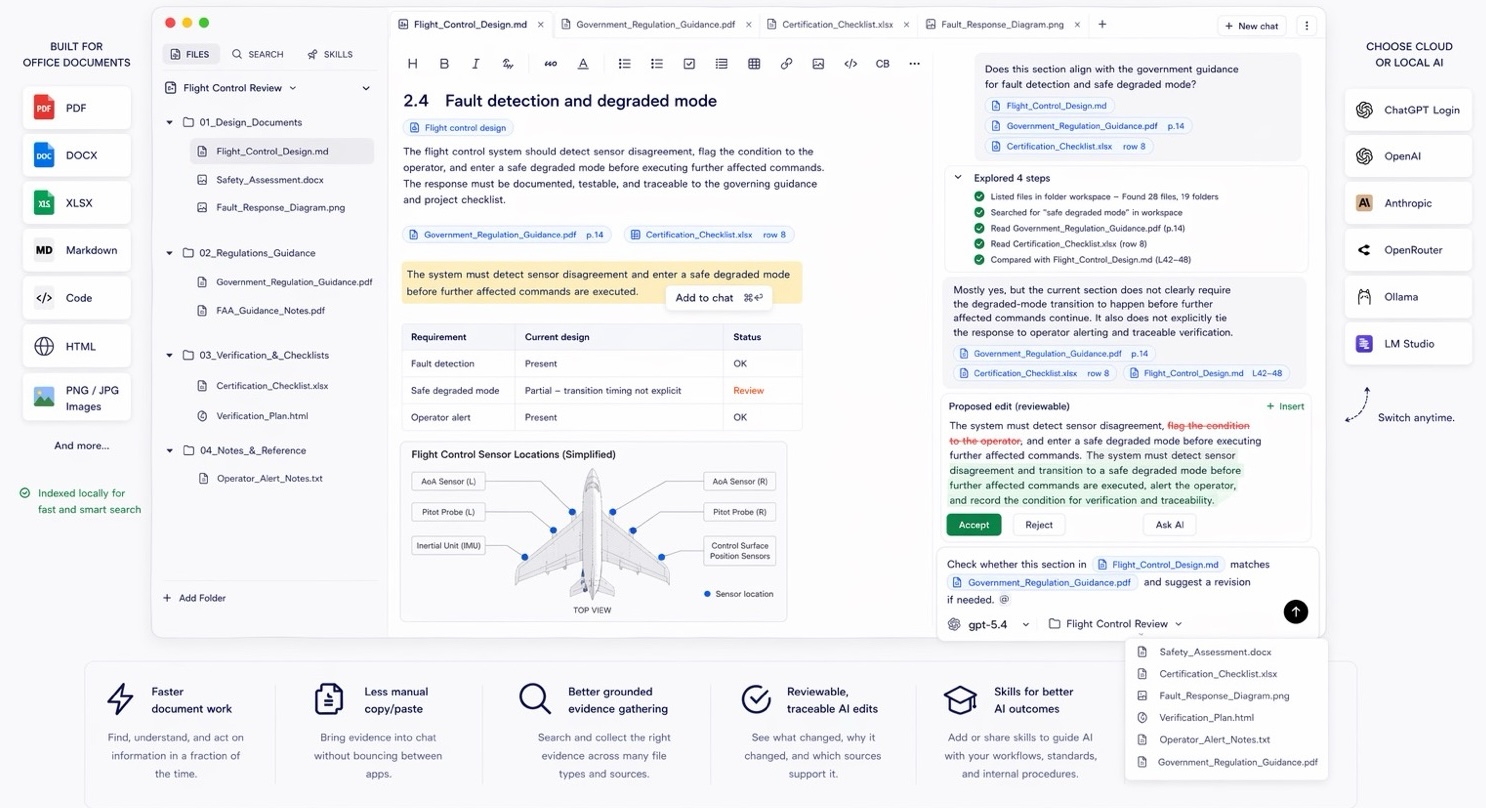
<p><img decoding="async" loading="lazy" alt="Aviation.Bot aviation document workflow infographic" src="https://aviation.bot/assets/images/infographic-v11-aviationbot-7223edb65702c6efa55d89ef4ddbb4bb.jpg" width="1486" height="808" class="img_tDZ2"></p>
<p>That is exactly where generic AI chat workflows start to break. Uploading a single PDF may produce a useful summary, but it does not answer the operational question: what else in the workspace is affected, and which source should a reviewer trust?</p>
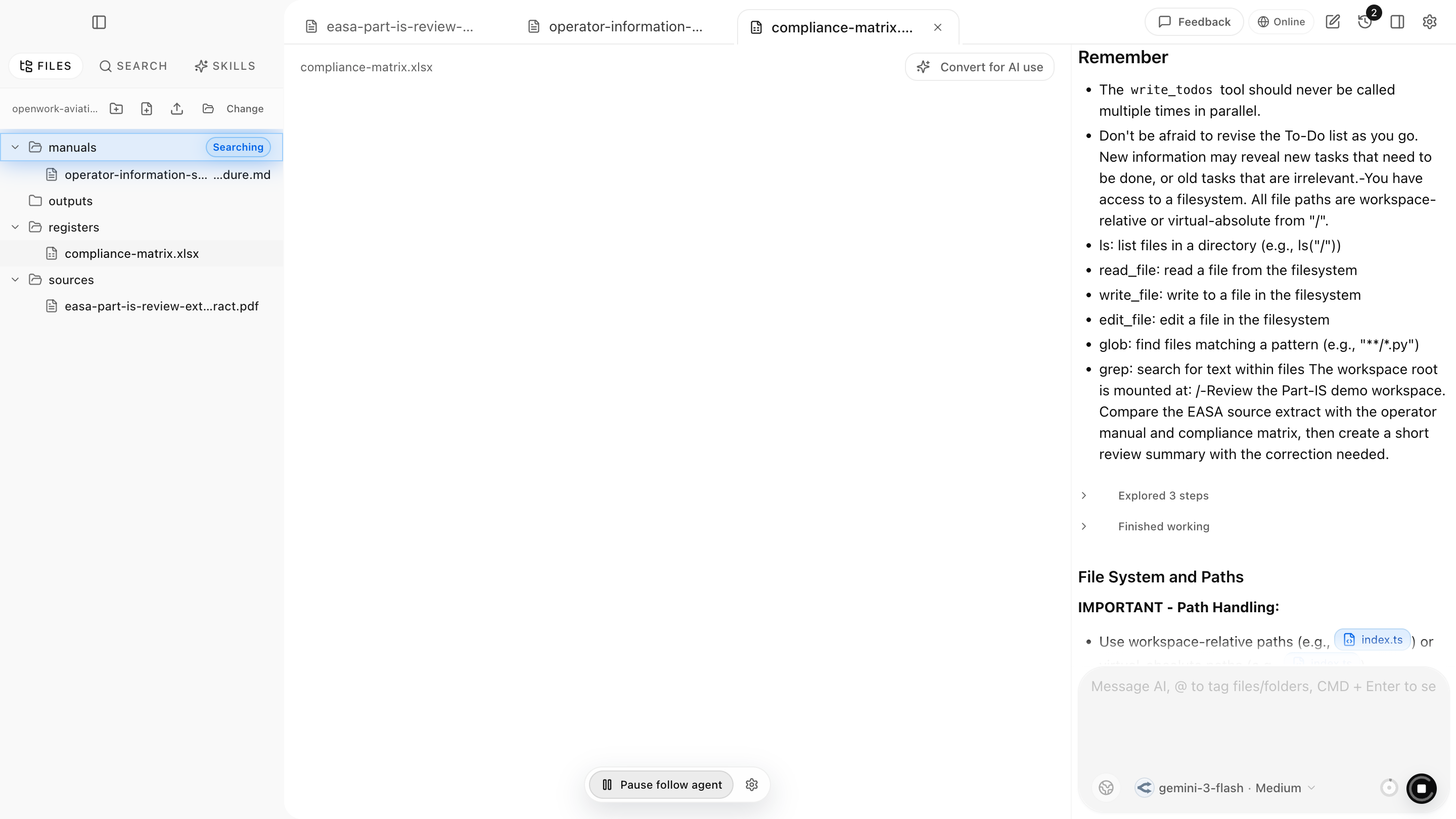
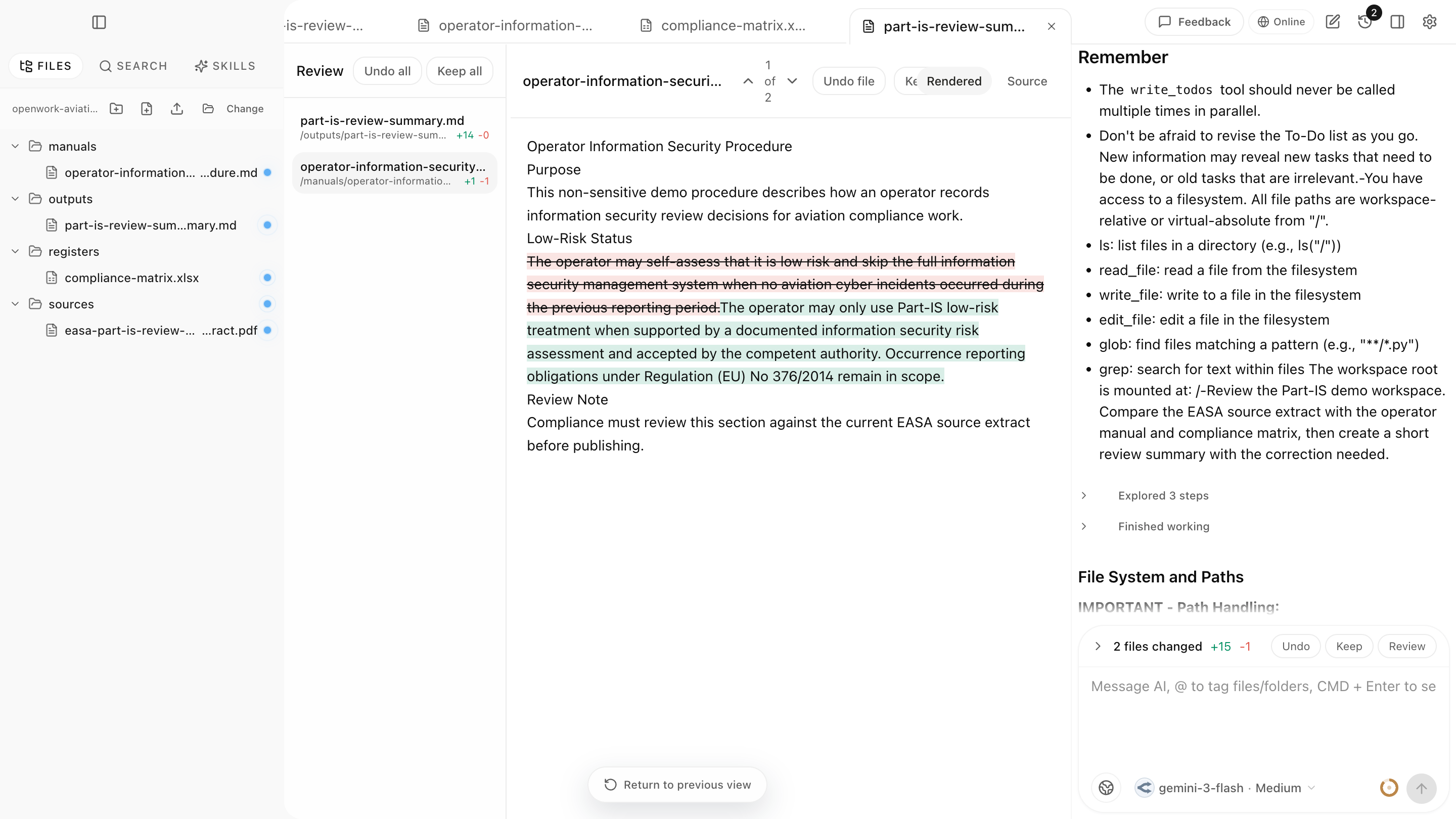
<p>The demo below uses a non-sensitive aviation compliance workspace generated by the Aviation.Bot visual test harness. It shows source inspection, matrix review, manual correction, and a generated review summary inside the actual app.</p>
<video controls="" width="100%" src="https://cdn.document.bot/marketing/easa-sora-application/easa-sora-application.webm" title="Aviation.Bot EASA SORA application workspace demo"></video>
<h2 class="anchor anchorTargetStickyNavbar_ugxl" id="the-aviation-documentation-problem">The Aviation Documentation Problem<a href="https://aviation.bot/blog/ai-document-workflows-for-aviation-compliance-teams/#the-aviation-documentation-problem" class="hash-link" aria-label="Direct link to The Aviation Documentation Problem" title="Direct link to The Aviation Documentation Problem" translate="no">​</a></h2>
<p>Aviation teams often need to answer questions like:</p>
<ul>
<li class="">Which documents mention this requirement?</li>
<li class="">Does this manual section match the latest guidance?</li>
<li class="">What evidence supports this statement?</li>
<li class="">Which downstream documents may need an update?</li>
<li class="">Are there conflicting terms across manuals, checklists, and review notes?</li>
</ul>
<p>The difficult part is not writing text. The difficult part is finding the complete evidence set and keeping the change reviewable.</p>
<h2 class="anchor anchorTargetStickyNavbar_ugxl" id="why-local-first-matters">Why Local-First Matters<a href="https://aviation.bot/blog/ai-document-workflows-for-aviation-compliance-teams/#why-local-first-matters" class="hash-link" aria-label="Direct link to Why Local-First Matters" title="Direct link to Why Local-First Matters" translate="no">​</a></h2>
<p>Many aviation and aerospace teams cannot freely upload operational, customer, or regulated documents into generic cloud AI tools. Even when cloud tools are allowed, teams still need to control which files are in scope and which model provider is being used.</p>
<p>A local-first workspace keeps the starting point clear: the user chooses the folder, the product indexes that workspace, and the AI workflow operates against that document set.</p>
<h2 class="anchor anchorTargetStickyNavbar_ugxl" id="a-better-workflow">A Better Workflow<a href="https://aviation.bot/blog/ai-document-workflows-for-aviation-compliance-teams/#a-better-workflow" class="hash-link" aria-label="Direct link to A Better Workflow" title="Direct link to A Better Workflow" translate="no">​</a></h2>
<p>For aviation compliance work, a practical AI workflow looks like this:</p>
<ol>
<li class="">Select the relevant workspace folder.</li>
<li class="">Search for every reference to a requirement, term, or change request.</li>
<li class="">Open the original source documents.</li>
<li class="">Draft a bounded change note or proposed update.</li>
<li class="">Review the diff and supporting sources.</li>
<li class="">Keep the expert in control of the final decision.</li>
</ol>
<p>Aviation.Bot is designed for this loop: find, reason, edit, review, and trace.</p>
<p><img decoding="async" loading="lazy" alt="Aviation.Bot compliance matrix review screenshot" src="https://aviation.bot/assets/images/02-compliance-matrix-2dbece048af9169558f4d1d82071acea.png" width="2880" height="1620" class="img_tDZ2"></p>
<p>The useful detail is not just that AI can draft a paragraph. The useful detail is that the reviewer can keep the source PDF, the affected manual section, and the proposed change in the same workspace.</p>
<p><img decoding="async" loading="lazy" alt="Aviation.Bot reviewable aviation manual change screenshot" src="https://aviation.bot/assets/images/03-reviewable-change-2f4d1b9950d059fc1cbfd47d4ac507da.png" width="2880" height="1620" class="img_tDZ2"></p>
<p>For a more concrete drone-operator example, see the SORA walkthrough: <a class="" href="https://aviation.bot/blog/find-gaps-in-easa-sora-application-before-submission/">How to find gaps in an EASA SORA application before submission</a>.</p>
<h2 class="anchor anchorTargetStickyNavbar_ugxl" id="what-to-avoid">What To Avoid<a href="https://aviation.bot/blog/ai-document-workflows-for-aviation-compliance-teams/#what-to-avoid" class="hash-link" aria-label="Direct link to What To Avoid" title="Direct link to What To Avoid" translate="no">​</a></h2>
<p>Do not treat AI as a certification shortcut. A document assistant can help teams search, compare, draft, and review, but it does not replace engineering judgment, compliance ownership, or formal approval processes.</p>
<p>The useful promise is narrower and more practical: reduce the search tax, make source inspection faster, and keep AI-assisted document changes reviewable.</p>
<h2 class="anchor anchorTargetStickyNavbar_ugxl" id="how-aviationbot-can-help">How Aviation.Bot Can Help<a href="https://aviation.bot/blog/ai-document-workflows-for-aviation-compliance-teams/#how-aviationbot-can-help" class="hash-link" aria-label="Direct link to How Aviation.Bot Can Help" title="Direct link to How Aviation.Bot Can Help" translate="no">​</a></h2>
<p>Aviation.Bot helps aviation teams work across the files that actually define a compliance problem: manuals, source PDFs, requirement tables, spreadsheets, review notes, and generated change summaries. Instead of asking AI to answer from one uploaded document, you can point it at the whole review folder and keep the source material visible while it searches, compares, drafts, and writes outputs.</p>
<p>The app is model-flexible: use a strong cloud model for speed and quality when permitted, or use a local/offline model for sensitive operational data, customer restrictions, company policy, or EU GDPR-sensitive workflows. The important product layer is the aviation document workflow around the model: indexed workspaces, original-source inspection, file-aware chat, generated reports, reviewable edits, and human sign-off.</p>
<p>Learn more at <a href="https://aviation.bot/" target="_blank" rel="noopener noreferrer" class="">aviation.bot</a>.</p>]]></content>
        <category label="aviation" term="aviation"/>
        <category label="compliance" term="compliance"/>
        <category label="document ai" term="document ai"/>
        <category label="local-first ai" term="local-first ai"/>
    </entry>
</feed>